Ridgefield Historical Marker Photos

More like Ridgefield Historical Marker
Recommended Reviews - Ridgefield Historical Marker
Start your review...



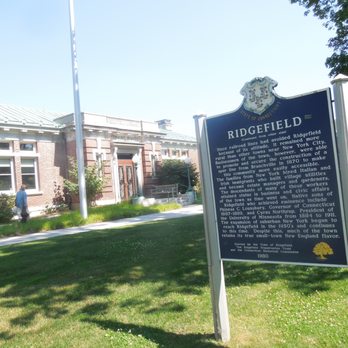
I've heard of the Ramapo Indians but never saw the tribe spelled as "Ramapoo" until yesterday when I saw that unusual combination of letters on the Ridgefield Historical Marker. The inscription details a fairly in depth story of the town, starting with the Ramapoo, then moving on to the town's historical significance during the Revolutionary War, and its evolution into a prosperous New York City getaway for the affluent. You'll find the marker in front of the Ridgefield Library where Main Street hits Prospect Street. It's a 2-sided marker from the CT Historical Commission in the familiar white lettering on a blue background. There is a different inscription on each side. The marker was dedicated in 1980 and is in excellent condition. The full inscription reads: This town was founded in 1708 by a group of families from Norwalk who purchased twenty thousand acres from the Ramapoo Indians for one hundred pounds sterling. They were aided by John Copp, a surveyor, who explored the land now lying between High Ridge and East Ridge and recommended it as a promising agricultural area, suitable for settlement. In 1777 at the Battle of Ridgefield, Colonial militia fought British and Hessian troops returning from a raid on American military stores in Danbury. They were headed back to Compo Beach on the shore of Long Island Sound. Ridgefield began as a farming community and remained a typical New England village until after the Civil War. Then it became a summer resort town for prosperous New York City families and many large homes were erected over the years on Main Street, West Lane, High Ridge, Peaceable Street, and East Ridge. Since railroad lines had avoided Ridgefield because of its altitude, it remained more rural than other towns near New York City. Businessmen of the town, however, were able to promote and secure the construction of a spur line from Branchville in 1870 to make this community more easily accessible. The families from New York hired Italian and Irish immigrants who built village utilities and became estate managers and gardeners. The descendants of many of these workers attained status in business and civic affairs of the town as time went on. Native sons of Ridgefield who achieved eminence include Phineas C. Lounsbury, Governor of Connecticut 1887-1889, and Cyrus Northrup, President of the University of Minnesota from 1884 to 1911. The expansion of suburban New York began to reach Ridgefield in the 1950's and continues to this time. Despite this, much of the town retains its true small-town New England flavor. Erected by Town of Ridgefield, The Ridgefield Preservation Trust and the Connecticut Historical Commission. 1980. Five stars for its excellent condition, two sides of an interesting inscription, and the Ramapoo! read more