Fairfield Historical Marker Photos


More like Fairfield Historical Marker
Recommended Reviews - Fairfield Historical Marker
Start your review...



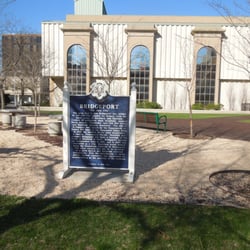
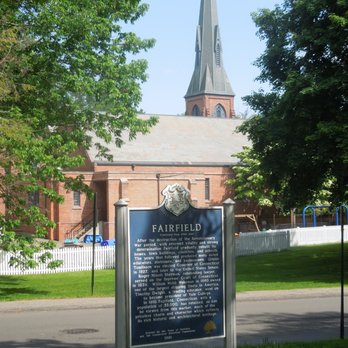
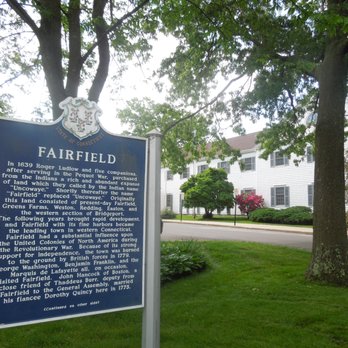
So you and five buddies survive fighting in a war, what do you do to celebrate? How about pooling your money, buying some waterfront land from the Indians and establishing bustling communities? Fairfield was one of them, a hotbed for American independence, and at one time or another, a host to visiting dignitaries such as George Washington, Benjamin Franklin, the Marquis de Lafayette all, and John Hancock. The radicalism in Fairfield so infuriated the British, that they burned the city to the ground in 1779. These are some of the fascinating facts I learned from this marker. It's a 2-sided marker from the CT Historical Commission in the familiar white lettering on a blue background. It's located on a grassy area in front of John J. Sullivan Independence Hall. . The marker was dedicated in 1981 and is in pretty good condition. The blue paint and white lettering are bright with no peeling. There is a small amount of discoloration on the top right corner of the front side. The full inscription reads: Marker front: In 1639 Roger Ludlow and five companions, after serving in the Pequot War, purchased from the Indians a rich and abundant expanse of land which they called by the Indian name "Uncowaye." Shortly thereafter the name "Fairfield" replaced "Uncowaye." Originally this land consisted of present-day Fairfield, Greens Farms, Weston, Redding, Easton, and the western section of Bridgeport. The following years brought rapid development, and Fairfield with its fine harbors became the leading town in western Connecticut. Fairfield had a substantial influence upon the United Colonies of North America during the Revolutionary War. Because of its strong support for independence, the town was burned to the ground by British forces in 1779. George Washington, Benjamin Franklin, and the Marquis de Lafayette all, on occasion, visited Fairfield. John Hancock of Boston, a close friend of Thaddeus Burr, deputy from Fairfield to the General Assembly, married his fiancee Dorothy Quincy here in 1775. Marker back: After the destruction of the Revolutionary War period, with renewed vitality and strong determination Fairfield gradually rebuilt its homes, town buildings, churches, and schools. The years that followed produced many noted educators, statesmen, and businessmen. Gideon Tomlinson was elected Governor of Connecticut in 1827, and later to the United States Senate. Roger Minott Sherman, outstanding lawyer served on the Supreme Court of Connecticut in 1839. William Webb Wakeman in 1860 owned one of the largest shipping fleets in America. Timothy Dwight, a leading educator, went on to become president of Yale College. In 1981 Fairfield, Connecticut, with a population of 55,000, has retained, as can be viewed from this marker, much of the priceless charm and character which reflects its rich historic and architectural heritage. Erected 1981 by the Town of Fairfield and the Connecticut Historical Commission read more