Observatory Science Centre Photos


Recommended Reviews - Observatory Science Centre
Start your review...



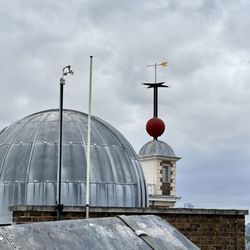
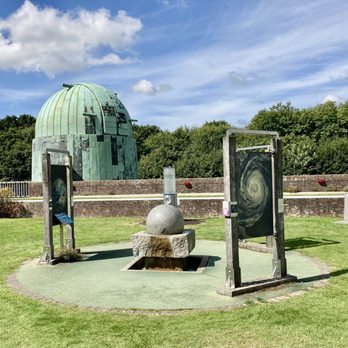
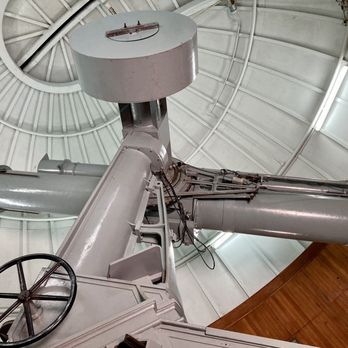
Formerly the site of the Royal Observatory (from 1958-1990), the site is now run by a charity as a venue for exhibitions, lectures and educational programmes. The renovated telescopes can be visited by the public, for school visits, and are used by colleges and astronomical societies. It makes a great fun-but-educational family day out. Most people associate the Royal Observatory with Greenwich, where it was founded by Charles II in 1675. It was increasingly recognised that London was not a good location due to light and atmospheric pollution, and the effects of vibrations from rising road and rail traffic. Plans were made to relocate the observatory in the 1930s; transfer began to the new site at Herstmonceux in 1947 and was completed in 1958. The complex of buildings was constructed to house three reflecting and three refracting telescopes in six domes, of brick and concrete with green copper domes and balustraded balconies, with adjoining support buildings, all set around a central ornamental pond. These are themselves classic examples of 1950s architecture. The telescopes were joined in 1967 by the giant 98-inch Isaac Newton Telescope (INT) once housed in the silver dome to the south of the main complex. The UK was never an ideal site for astronomical observations because of the preponderance of cloud, and over time, increasing light pollution from Eastbourne. The growth of cheap air travel in the 1960s enabled astronomers to travel to parts of the world with clearer skies and in 1984 the INT telescope was moved to the Canary Islands. Eventually, the decision was taken to close the site and move the remaining staff to the Institute of Astronomy at the University of Cambridge. The site reopened in its current guise in 1995 and the site, including the telescopes, was refurbished in 2004. Visitors now enter through the eastern grounds of Herstmonceux Castle (itself now a college of Queen's College, Ontario). Car parking is available in a small car park but in summer most park on the lawn in front. The ticket office at the entrance houses a small shop with merchandise aimed at children and young people, covering a range of scientific subjects. Numbers are limited, so advanced booking is strongly recommended. There are guided tours of the telescopes (which take about half an hour) and separate science demonstrations. The site has both indoor and outdoor hands-on activities for children (of all ages!) covering aspects of science and engineering - a bit like a small hands-on science museum. We found the volunteer staff to be friendly and knowledgeable, and the sessions were very interactive for the children. We happily spent a couple of hours there. There is a small cafe on site, serving drinks and a limited range of snacks. The site is on several levels and has a lot of steps and gravel pathways, but there are ramps for level access and a disabled toilet: more details are on the main website. Children must be accompanied and supervised by an adult at all times, and dogs are not admitted (except assistance dogs). As well as being open for general visits, there are periodic stargazing evenings: numbers are also limited for these and need to be booked in advance. read more

17 years ago
This is such an interesting place to take the kids for some star-gazing. They are so good at keeping everyone's attention on the go (things like this can get a bit boring). There's so many different night and daytime events on offer here and a lot of them depend on weather and, of course the stars but we had a great night there and got to see so many beautiful sights. There's a fantastic shop to pop into at the end of the day with some really interesting and informative books to buy. read more