Cancel

    Open app

    Search

    Steyning Museum Trust

    3.5 (2 reviews)
    Closed Closed

    Steyning Museum Trust Photos

    Recommended Reviews - Steyning Museum Trust

    Your trust is our priority, so businesses can't pay to alter or remove their reviews. Learn more about reviews.
    Yelp app icon
    Browse more easily on the app
    Review Feed Illustration
    Photo of James Y.
    2
    794
    763

    16 years ago

    Helpful 0
    Thanks 0
    Love this 0
    Oh no 0
    Photo of Josh H.
    2
    292
    332

    16 years ago

    Helpful 0
    Thanks 0
    Love this 0
    Oh no 0

    Verify this business for free

    Get access to customer & competitor insights.

    Verify this business

    The British Museum - At British Museum

    The British Museum

    4.6(1.3k reviews)
    44.4 miBloomsbury

    Huge crowds and it wasn't even a weekend. Reason: free…read more This is equivalent to Natural History ones in US. However, there are historical contexts with british roman empires and other inclusions that makes this place distinct in a variety of ways. There are also kid packet activities- ask front desk. Some areas have uneven heating and cooling so you may be prone to fainting / esp if the ennui alone is not enough to get you there- ha! Place is great for history buffs, though, as it is free- do not expect high end bathrooms and overall exceptional service. Otherwise, 5 stars for being free and for a very elaborate set up.

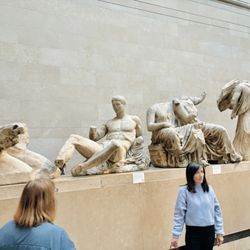
    British Museum, London, April 5…read more Our family of four with kids ages 9 and 10 spent part of the afternoon at the British Museum as an easy cultural stop during our London stay. Entry to the permanent collection is free and straightforward, with no reservation required, which made it simple to drop in. There are paid special exhibitions, but the main museum itself is open access. Arrival and First Impressions Entry to the building was very easy, and once inside the scale is immediate. The Great Court sets the tone right away, and everything feels larger and more layered than expected. Even just orienting yourself takes a moment because of how expansive the space is. Getting in was smooth and flexible, and the museum handles steady crowds well without ever feeling restrictive, which helped a lot with kids in tow. The Highlights The Egyptian galleries are one of the first moments where the scale really lands. The large stone sculptures and statues are far bigger in person than photos suggest, and they create a dramatic backdrop as you move through the space. The Rosetta Stone was another key highlight. Seeing it in person adds a different level of context, especially knowing its role in unlocking ancient Egyptian writing. It is not large or flashy compared to some of the other artifacts in the room, but it carries a quiet importance that draws attention naturally. The Samurai exhibition was a standout and required a paid entry ticket. It was absolutely worth it. The display of full armor sets, helmets, weapons, and artwork created a complete and visually rich picture of samurai life. The craftsmanship in the armor in particular held everyone's attention far longer than expected, and it felt more immersive than a typical museum exhibit. We also spent time in the hands-on style learning stations, which were a strong break in pace. These included real artifacts like a flint knife that was thousands of years old and a Roman cosmetic jar believed to have been used for eye makeup. Seeing objects like that up close made history feel very tangible for the kids in a way that glass cases alone do not. There is also a family area tucked away downstairs that worked well as a short reset point. It felt quieter and more relaxed, and it gave the kids a chance to decompress before continuing, which made the overall visit more sustainable. The museum works best as a series of short, flexible stops rather than a structured route, and we naturally moved based on interest and energy levels. The Challenges The main challenge is scale. It is very easy to underestimate how large the British Museum is, and even with breaks built in, pacing becomes the key factor in how enjoyable the visit feels. Trying to cover too much quickly would likely be overwhelming, especially for kids. Would We Return Yes, but with a more focused plan and specific sections chosen in advance rather than trying to see everything broadly again. Final Thoughts The British Museum is best experienced in segments rather than as a single continuous visit. The Egyptian galleries, the Rosetta Stone, the Samurai exhibition, and the hands-on artifact stations all offered very different but equally strong experiences. It is free, accessible, and incredibly rich, but the real value comes from slowing down and treating it like a collection of smaller discoveries, with breaks built in, rather than a single museum to "finish."

    Photos
    The British Museum - At British Museum

    At British Museum

    The British Museum - British Museum_Yelp_Sanju-1

    British Museum_Yelp_Sanju-1

    The British Museum - Easter Island head

    See all

    Easter Island head

    The Natural History Museum - Monkey carvings

    The Natural History Museum

    4.4(544 reviews)
    42.5 miKnightsbridge

    Housed in a grand and impressive building, the NHM is well curated, with impeccable displays, and…read moreit's free. However, a donation of £10 is HIGHLY suggested as you enter. As with all London museums, there is security checking all backpacks, but this museum was checking for alcohol! When you see all the school teens sitting on the stairways (perhaps waiting for parents to pick them up?), then the alcohol check is understandable. Out of all the displays, my favorite was the dimly lit Treasures room. Each piece exhibited tells an important story beyond what you actually see like an Iguanodon tooth from the Mesozoic strata and found by Gideon Mantell (or his wife) and the rivalry that ensued between Mantell and Owen, who later usurped Mantell's contribution in discovering the first known dinosaur species and shaping the early understanding of dinosaurs. While I find the digital text for each display as being the true treasures, only 1-2 people can read at a time so you feel a bit rushed if you're a person (like me) who reads everything, yet people are behind you waiting their turn. In addition to the wonderful displays, there is a photo booth whereby you can have 3 photos taken against a green screen depicting a dinosaur encounter. What they don't tell you upfront is that the photos are NOT free and can be downloaded (depending on the package you choose) from £12 to £22 pounds. When I asked the staff for information on particular exhibits, I found them to be more than helpful and friendly, too. Allow time for this expansive gem.

    Lots of bones! Plenty of old stuff! Great turn-of-the-century over-the-top ornate architecture!…read morePlan on an hour unless you're hardcore. Ride the escalator into the middle of the earth to find out what music is playing inside. See extraordinary taxidermy handiwork. Even see a fake dodo bird thought to be an adjacent species that didn't exist. And if you like dinosaurs this is your Mecca. Just don't dare sit anywhere like on some stairs in the corner or some overzealous guard will kick you right out. But otherwise you'll have a great time. Also enjoy the outside grounds for a stroll, and hit up the West entrance for zero lines while the hoards line up on the other side.

    Photos
    The Natural History Museum - Darwin

    Darwin

    The Natural History Museum - Fun dinosaur garden

    Fun dinosaur garden

    The Natural History Museum - One of my favorite scientists - Charles Darwin.

    See all

    One of my favorite scientists - Charles Darwin.

    Marlipins Museum

    Marlipins Museum

    3.3(3 reviews)
    4.5 mi

    This is a small, local museum in the centre of the historic fishing town of Shoreham-by-Sea…read more Although Shoreham can feel these days more like a suburb of Brighton, it was by far the more important town for most of recorded history, being an important port from Saxon times, and probably before. Marlipins Museum is housed in a charming old building, dating from the 12th ans 13th centuries. It's one of the oldest secular buildings in Sussex, with a facade decorated with an attractive chequerboard design of Caen stone and flints. Oddly, the Museum's strange name isn't explained anywhere. The museum traces Shoreham's history as a trading town and fishing port from the 11th century onwards, and much of the small collection focuses on ships and shipping, with a fine series of watercolour and oil paintings of the harbour and various ships, and various bits of shipping paraphernalia. But the museum records much else besides: Shoreham was the departure point from which the future Charles II escaped after the English Civil War, and it played a key role in the defences of the South Coast until recent times - the remains of a 19th fort are still visible on the shoreline, as are the more scant remains of the World War II anti-aircraft radar station situated here. Shoreham was also - incredibly - a major centre of the early British film industry, and over a dozen films were made in Shoreham studios in the silent film era. This attracted a suitably bohemian set of actors and hangers on, who established the 'bungalow town' on Shoreham beach. And, of course, Shoreham's famous and beautiful art deco airport was the UK's first licensed airport, still in regular use. But the strangest story belongs to the building itself: recent excavations found an unexplained pit under the oldest part of the building, in which was buried the skeleton of a cat. Further digging uncovered the remain of a another three cats. Theories for these strange burials range from the ancient practice of burying cats to bring good luck, to the more prosaic idea that in mediaeval times the building housed a furrier manufacturer. One of the skeletons makes for a grisly display. The museum is small enough to keep the attention of children as you go around, and is fully accessible for wheelchairs, thanks to the lift in a small modern extension.

    Marlipins Museum, on the Shoreham High Street (right next to the Marlipins Pub) is a brilliant…read morecombination of old and new, with one of the oldest lay buildings in Sussex linked to a modern two-storey building in a really tasteful manner. The displays are permanently running and mainly concentrate on Shoreham's maritime history and that of the River Adur. Also, which is a little known fact, Shoreham was once the hub for the UK's silent movie industry! They offer a popular Monday coffee morning so its the perfect place to head after a nice walk around Shoreham to find out some of the area's fascinating history.

    Photos
    Marlipins Museum

    See all

    Steyning Museum Trust - museums - Updated May 2026

    Loading...
    Loading...
    Loading...