Niagara Frontier Transit Metro System Photos


You might also consider

More like Niagara Frontier Transit Metro System
Recommended Reviews - Niagara Frontier Transit Metro System
Start your review...


Reviews With Photos


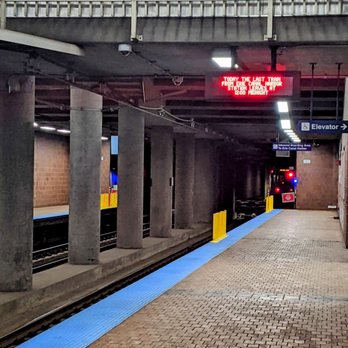
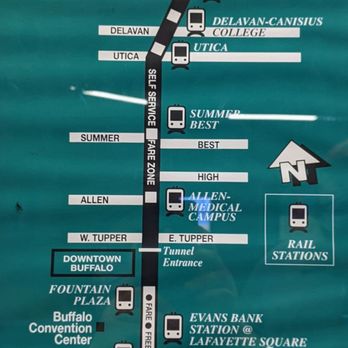
This was my first time taking Buffalo's city train. It couldn't have gone better and I'll be using it a lot more now, especially to get downtown! I was headed to my first Bisons game and wanted to minimize my walk there. I got the train at the Medical Campus station at Allen and Main St. Prior to boarding I had downloaded the Token Transit app and, very simply and quickly, bought a round trip ticket for $4. Walking into the Medical Campus station the transit employees ask you to hold up your phone showing the Token Transit app, to show that you've activated your ticket. Then they open the partition doors for you and you head downstairs to the train. The train and station was practically empty on a Friday in the late afternoon. Everything seemed clean enough. We easily boarded and got off a few stops later at the Seneca station right outside Sahlen's Field. I was happy. There aren't many stops, so it's very simple to navigate. It seems to run every 12 minutes or so. Super easy, I'll be back! P.S. Masks are still required.


You failed NFTA. Your machine took my $5 bill and your manager Chris, at the Metro Transportation center in downtown Buffalo didn't make matters any better. I understand that you guys have a process to validate claims. It was $5 and I had to visit you twice, and still my issue is unresolved. I honestly don't believe that I should have to be inconvenienced by Your poorly maintained machinery. It seems Ludacris that you would want bad public relations over a $5 bill, yet here we are. My suggestion to anyone who is thinking about riding this Transportation is get the app and pay on the app. It is more reliable than the poorly maintained kiosks which take your cash. The $5 was not as important as the principle of this. You might want to revisit your policies.


1 month ago

I am not a regular user of the NFTM services. I did use the train in the downtown area a lot when working there, but that's about it. Last Friday, we were planning on attending a play at a theater downtown and decided to take the train in from Amherst. I checked the schedule on line to figure which time would work best for us. The train left at exactly the listed time & got us to our stop right on time. Coming home was exactly the same. I'm not sure if during peak periods it's like this. The only complaint was the lack of cleanliness. Our train car had spilled beverages on seats and trash all over. The ride home was better. I wouldn't hesitate to do this again. So much easier to driving downtown and paying crazy parking fees. The train ride is $2 and only $1 for seniors. 2023-87 read more

5 months ago

This was my first time taking Buffalo's city train. It couldn't have gone better and I'll be using it a lot more now, especially to get downtown! I was headed to my first Bisons game and wanted to minimize my walk there. I got the train at the Medical Campus station at Allen and Main St. Prior to boarding I had downloaded the Token Transit app and, very simply and quickly, bought a round trip ticket for $4. Walking into the Medical Campus station the transit employees ask you to hold up your phone showing the Token Transit app, to show that you've activated your ticket. Then they open the partition doors for you and you head downstairs to the train. The train and station was practically empty on a Friday in the late afternoon. Everything seemed clean enough. We easily boarded and got off a few stops later at the Seneca station right outside Sahlen's Field. I was happy. There aren't many stops, so it's very simple to navigate. It seems to run every 12 minutes or so. Super easy, I'll be back! P.S. Masks are still required. read more


11 months ago

You failed NFTA. Your machine took my $5 bill and your manager Chris, at the Metro Transportation center in downtown Buffalo didn't make matters any better. I understand that you guys have a process to validate claims. It was $5 and I had to visit you twice, and still my issue is unresolved. I honestly don't believe that I should have to be inconvenienced by Your poorly maintained machinery. It seems Ludacris that you would want bad public relations over a $5 bill, yet here we are. My suggestion to anyone who is thinking about riding this Transportation is get the app and pay on the app. It is more reliable than the poorly maintained kiosks which take your cash. The $5 was not as important as the principle of this. You might want to revisit your policies. read more

1 year ago
2 years ago
2 years ago

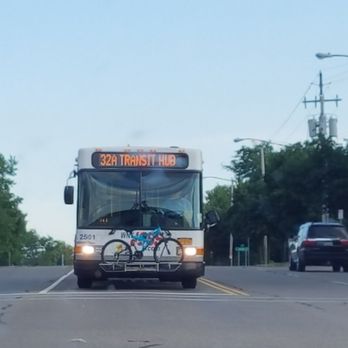
The Viagra Front-ear is an ear-like cavity that you attach to the forehead so that you can down a lot of Viagra directly into your brain. I'm not sure why people do it, nor why they named a bus network after it. It sounds kind of gross to me, but one day when I'm a 72-year-old man I'll probably need a Viagra Front-ear too, so I shouldn't hate on it. In the old days, I couldn't drive. I mean, I could, but not legally. So I'd ride buses all over town. I lived on the East Side, so there were plenty of buses available. I didn't like that late at night, most of the buses would stop running, since I'm a night owl. However I have to say that there's an excellent networks of buses, with good drivers, smart routes, and full coverage all over Buffalo and I appreciate that. It loses 1 point for not running late enough for me, and not providing enough coverage to suburbs... but then I suppose if there was a big suburban demand, then they would. And there probably isn't. read more



4 years ago
4 years ago
6 years ago
3 years ago
4 years ago

5 years ago

12 years ago

14 years ago
7 years ago
5 years ago


12 years ago
7 years ago

8 years ago

9 years ago

14 years ago

13 years ago
12 years ago

12 years ago


11 years ago

11 years ago
10 years ago


8 years ago
5 years ago
11 years ago