Cancel

    Open app

    Search

    Military Trail Photos

    Recommended Reviews - Military Trail

    Your trust is our priority, so businesses can't pay to alter or remove their reviews. Learn more about reviews.
    Yelp app icon
    Browse more easily on the app
    Review Feed Illustration
    Photo of Ariel W.
    4395
    5910
    103730

    6 years ago

    Helpful 87
    Thanks 0
    Love this 81
    Oh no 0

    Verify this business for free

    Get access to customer & competitor insights.

    Verify this business

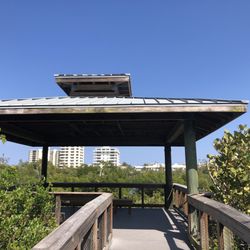
    Jupiter Ridge Natural Area - Path to the beach

    Jupiter Ridge Natural Area

    4.4(9 reviews)
    1.8 mi

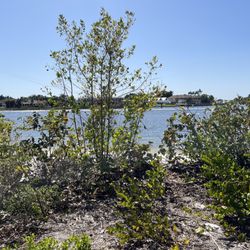
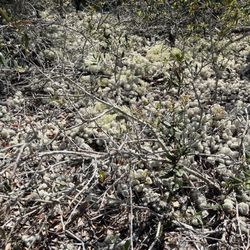
    I've been wanting to visit this ERM park ever since visiting its neighbor, Juno Dunes Natural Area…read more The last time I tried to visit, the very small parking lot was full. From the road, this park looks to be all scrub, but like the other park, it contains multiple habitats inside. The first paved walk leads to a very nice pavilion overlooking the River. The view was peaceful and beautiful. Trying to access the unpaved trails, however, proved problematic. We turned onto the red path, only to find that the marker stakes had most of the red faded away and were difficult to find. At one point there is a huge fork in the path with no direction on which way to go. The end of the trail is practically non existent, with no clear path, but it does return us to the park entrance. I insisted on trying to get to Ski Beach- whatever that was! It looked about a 1/3 the way of the yellow trail. The path was very sandy, and difficult to walk on for that reason, and it seemed to take forever! When we finally found Ski Beach, we found another Park kiosk, a garbage can, and a tiny path down to... a beach! and the Intracoastal. We watched fish swim by, and lots of boats go by. This could be a nice place to wade or further explore, if you lugged all of your things here. ERM, would have loved finding a bench here, so we had someplace to take our shoes on and off. We did not continue down the yellow trail due to being exhausted, but I would like to do this again. The landscape was nice- just difficult to walk in due to the white sand. We saw a cactus in bloom, a snake, and a TON of lichen. Lichen everywhere! It really looked like little fairy landscapes to me. I think I finally identified Florida rosemary too! Kudo to ERM for the map/brochures. My kids pore over every aspect of it while we walk, trying to find all the natural items pictured, excitedly matching the pictures to plants. Thank you!

    Jupiter Ridge is located south of the Jupiter inlet. It is part of the Great Florida Bird and…read moreWildlife Trail. This natural area is made up of 274 acres of scrub that contain five native Florida ecosystems: scrub, scrubby flatwoods, mesic flatwoods, depression marsh and mangrove swamp, It is one of the few places you can go in Jupiter to see how Florida looked before it was developed. Thirty one plant species live here as well as threatened and endangered species like the large-flowered rosemary, the Florida scrub-jay; and the gopher tortoise. Jupiter Ridge is owned by the state Conservation and Recreation Lands project which is managed by Palm beach County. This natural area has the longest shoreline along the Atlantic Intracoastal Waterway of any other natural area in Palm Beach County. There is also 7,600 feet of water frontage along the Intracoastal Waterway along the Loxahatchee River/Lake Worth Creek Aquatic Preserve. There are three hiking trails, the paved Little Blue Heron Trail, (0.2 miles), the sand Scrub Lizard Trail (1.7 miles). and the sand Pawpaw Trail (0.6 miles). The sand trails really give your legs a work out and there is no shade so the sun can be brutal. The natural area has canoe and kayak access from Ski Beach and you may be able to spot manatees. There is also an observation platform on the Little Blue heron Trail that overlooks Old Lake Worth Creek. Jupiter Ridge Natural Area is open to the public, sunrise to sunset, seven days a week.

    Photos
    Jupiter Ridge Natural Area - First part of trail

    First part of trail

    Jupiter Ridge Natural Area - Red trail

    Red trail

    Jupiter Ridge Natural Area - Lichen everywhere

    See all

    Lichen everywhere

    Jupiter Inlet Shipwrecks

    Jupiter Inlet Shipwrecks

    5.0(3 reviews)
    1.9 mi

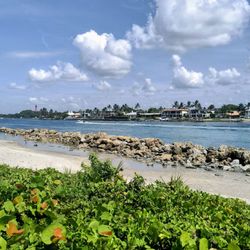
    Located at the intracoastal entrance and has a nice estuary backed up to the pier. There's a…read morebathroom and plenty of parking there. Plenty of fish and critters in the tide pools.

    This marker can be accessed at Jupiter Beach Park. It was installed at the Jupiter inlet on April…read more2, 2013 to honor all of the sailors who passed through the inlet. During the 17th century many Spanish galleons and merchant ships wrecked off the coast leaving behind a trove of gold, silver, cannons, anchors, flatware and navigational tools. The riches they left behind gave this section of Florida the name Treasure Coast. One of most well known ships was the San Miguel Arcangel which is thought to have sunk off the Jupiter coast in 1659 or 1660 while trying to enter the inlet during a storm. The ship was an aviso which carried letters to the Spanish court as well as treasure. The wreck was discovered by town lifeguard Peter Leo in 1987. He discovered the cannons in the sand while swimming, Silver and gold coins, flatware, musket and cannon balls, and a copper pot were eventually recovered. Six of the cannons still remain where they lay. Jupiter hopes that by setting up this marker along with others in Jupiter, people can learn more about the history of this area. Across from this marker is an anchor and cannons are in front of the nearby historic Dubois House. You can learn more about the area shipwrecks at the Jupiter Lighthouse Museum. A local restaurant on Dixie Hwy, the Shipwreck Bar and Grill is decorated to pay homage to the sunken Spanish Galleons and their spilled treasure off the coast.

    Photos
    Jupiter Inlet Shipwrecks
    Jupiter Inlet Shipwrecks
    Jupiter Inlet Shipwrecks

    See all

    United States Life Saving Station Jupiter Inlet 1885-1899 - Carlin's telescope.

    United States Life Saving Station Jupiter Inlet 1885-1899

    5.0(1 review)
    1.6 mi

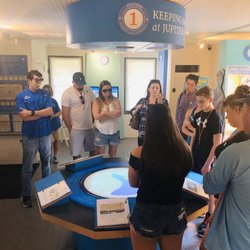
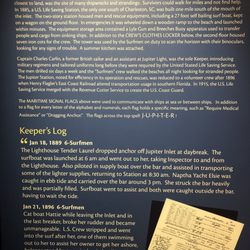
    In 1885 the only life saving station on the east coast was built near this spot. The actual…read morelocation is now underwater. The station operated until 1899. The construction of the station was overseen by Charles. R. Carlin who was the assistant keeper at the Jupiter Lighthouse. While the station no longer exists there is a historical marker in front of the Lazy Loggerhead Cafe in Carlin Park, The two story building had a four sided lookout tower on the roof with a powerful spyglass on a tripod that enabled the men to see out on to the ocean. The first floor had a utility room and a 27 foot rescue boat mounted on a ramp that slid down on to the beach. The second floor had the crew quarters and lockers for the six surf men who were skilled in shipwreck rescue. The men supervised by Carlin worked September through May and during the summer months only Carlin manned the post. After Henry Flagler brought the railroad to Florida ship traffic declined and paid workers were replaced with volunteers. After the station ceased operation Carlin remained to organize volunteers during emergencies until his death. While trying to prevent a brush fire from consuming the station he fell from the roof to his death. The During WWI Life Saving Service combined with the Revenue Cutter Service to form the United States Coast Guard. You can learn more about the life saving station at the nearby Jupiter Lighthouse museum. There is a room that has a display dedicated to the station that includes artifacts and photos. They have a locker from the station as well as Carlin's telescope.

    Photos
    United States Life Saving Station Jupiter Inlet 1885-1899 - Photo of the surf men who manned the station.

    Photo of the surf men who manned the station.

    United States Life Saving Station Jupiter Inlet 1885-1899 - Display explaining the history of the station.

    Display explaining the history of the station.

    United States Life Saving Station Jupiter Inlet 1885-1899 - A locker from the station.

    See all

    A locker from the station.

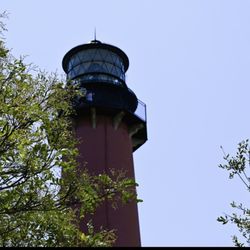
    Jupiter Inlet Lighthouse Outstanding Natural Area - Jupiter Lighthouse

    Jupiter Inlet Lighthouse Outstanding Natural Area

    5.0(2 reviews)
    1.8 mi

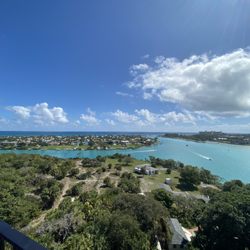
    Absolutely had nothing to do, so I decided that I should take an exercise walk in a park. By random…read morechance, I chose this location entirely by accident. The place I ended up exploring was the Jupiter Inlet Lighthouse Outstanding Natural Area, a beautiful 120-acre site in Tequesta, Florida. This area is dedicated to preserving its natural, historic, cultural, and scenic resources. One of the highlights of the area is the historic Jupiter Inlet Lighthouse, built in 1860. I discovered that it's a major attraction for visitors. Climbing to the top involves ascending 105 steps, but the effort is well worth it. From the lighthouse, I was treated to stunning panoramic views of the Atlantic Ocean and the Intracoastal Waterway. What a surprise for me! I truly enjoyed the experience discovering this scenic and historic spot turned out to be a delightful and unexpected adventure.

    The 120 acre Jupiter Lighthouse Outstanding Natural Area is located across the street from the…read moreJupiter Lighthouse. It has its own parking lot. When the Jupiter Lighthouse was built in 1860, this land served as a buffer around it and little of it was developed. This natural area was designated by congress in 2008 "for the preservation, protection and enhancement of seven key resources and values found on the site; these include the remarkable biodiversity and rich history of the site." The site is the only National Conservation Lands east of the Mississippi River, and the only one managed by the Bureau of land Management in the Eastern United States. This natural area contains four biologically sensitive areas where 26 species of special concern have been recorded. This natural area straddles an ancient coastal dune that is part of the Atlantic Coastal Ridge. It contains scrub habitats that are some of the most endangered in Florida because they are at the highest elevation which is where builders want to do their construction when they were building the Treasure Coast. Consequently many of the scrub preserves have been wiped out in Florida which has endangered animals like gopher tortoises and scrub jay's who call it home. They are certain plants and animals that only exist in a biologically significant scrub habitat so conservation of the land is extremely important. To prepare the preserve to open, invasive species of plants were removed and replace with native species. Today you can expect to see saw palmetto, Chapman oaks, and scrub oak. This natural area contains one of Florida's largest council trees. This area is where Loxahatchee River and Indian River Lagoon come together and there is evidence of human occupation dating back over 5,000 years.  The north trail is paved so it is wheelchair accessible. The south trail across the street next to the lighthouse is a natural surface trail that connects to Lighthouse Park. During WWII this area was a U.S. intelligence spy station with a secret radio base that tracked German U Boats. The trail is 1.5 miles on both sides of the road. On the north side, the trail leaves the parking lot and goes through native and restored Florida coastal habitats including Florida Scrub habitat, tropical hammock, and a mangrove swamp. It ends a quarter mile later at an observation tower overlooking three Florida habitats that serve as a manatee refuge surrounded by red mangroves. You can get a glimpse of the Indian River Lagoon. The return trip is uphill. There is no shade on the trail until you get to the observation tower so keep in mind that the trail can get very hot.

    Photos
    Jupiter Inlet Lighthouse Outstanding Natural Area
    Jupiter Inlet Lighthouse Outstanding Natural Area
    Jupiter Inlet Lighthouse Outstanding Natural Area

    See all

    The Jupiter And Lake Worth Railway Celestial Railway 1889-1895

    The Jupiter And Lake Worth Railway Celestial Railway 1889-1895

    5.0(1 review)
    1.4 mi

    In 1885 it was quite a journey to travel from Titusville south to Jupiter and on to Palm Beach and…read morepoints south. The trip required taking steamboats but when you reached the port of Jupiter and wanted to go on to the port of Juno Beach you had to rely on freight wagons pulled by oxen over 7.5 miles over rough road. To overcome this problem on June 8, 1887 it was announced that the worlds smallest railway lane, the Jupiter Lake Worth Railway would be built from Juno Beach to the Jupiter Lighthouse. The railway line was a 3 ft narrow gauge and began operating on July 4, 1889. The railroad did not have turning tracks so the train pointed towards Juno and when it traveled back to Jupiter it did so in reverse. To alert waiting passengers, the engineer played "Dixie" on the wood-burning steam engine whistle. The one way fare to ride at the time was 75 cents which was considered high. Stations were located at Jupiter, Mars, Venus, and Juno and a writer visiting the railway in 1893 called it the Celestial Railroad which became it's name. The death knell for the railway was sounded with the arrival of Henry Flagler to Florida. He wanted to build the Royal Poinciana Hotel in Palm Beach and at first paid the railroad to haul his building supplies. Tired of paying what he considered too high of a price he tried to outright buy the railway but they wanted too much money so he built his own over the Loxahatchee River bypassing Jupiter and Juno Beach. Flagler finished his railroad in 1894 and by June of 1896 the train of the Jupiter and Lake Worth Railway had been sold at auction and the railway was gone. Today all that remains of the railway is a few spikes in the dunes of Jupiter and this historical marker dedicated in 2017, where the railroad once crossed near Guanabanas Restaurant.

    Photos
    The Jupiter And Lake Worth Railway Celestial Railway 1889-1895

    See all

    Tennessee Volunteers and Militia Canp

    Tennessee Volunteers and Militia Canp

    3.0(1 review)
    2.0 mi

    The Battle of Loxahatchee took place on Jan. 24, 1838, There is a recreation of the battle every…read moreyear in January at Riverbend Park in Jupiter. The battle was fought between the United States Army and the Seminole Indians joined by former slaves. The government had already forced the Seminoles into Florida from Georgia and they were trying to move them again to Oklahoma along the Trail of Tears. The Seminoles were not willing to go and were very adept at avoiding the army by hiding in the Everglades. After the battle Major Lauderdale who Ft. Lauderdale is named for took his Tennessee Volunteers and pursued the Seminoles that had escaped after the battle. In a neighborhood in Jupiter is a small plaque and American flag that marks the site where the Tennessee Volunteers camped out while pursuing the Seminoles. They did not get along with the regular army so they established their own camp instead of staying at the army fort one mile to the west. Their animosity with the army was so great that they refused to follow Colonel Jessup into battle at Loxahatchee leading him to get shot in the face when he entered the battle thinking they were behind him. After that Jessup swore never to use volunteers again. The camp was discovered in 1989 by Richard Procyk, an hobby archaeologist who had recently moved to Jupiter. Unfortunately the area was being developed for housing. Only a little excavation took place before the site was built on although a granite marker was placed to mark the camp. At the time Palm Beach County did not have laws to protect historical sites but what happened here caused preservation ordinances to be passed.

    Photos
    Tennessee Volunteers and Militia Canp

    See all

    Military Trail - landmarks - Updated May 2026
    Loading...
    Loading...
    Loading...