Marks and Spencer Photos


Recommended Reviews - Marks and Spencer
Start your review...


Reviews With Photos


I love this station and use it everyday when I commute out of London. It does, however, have a couple of features which will annoy someone not used to the system and rushing for a train. Number 1 - the screen showing the departure times will remove a train when there is still a few minutes to jump on it leaving one with the invidious choice of trying to guess which platform. This is completely unnecessary. Number 2 - platforms 4, 5 and 6 are not brilliantly signposted. Everything else is decent and the sports bar is much better in quality than one would expect. Top tip - head downstairs at the sports bar, as there is loads of room.


An interchange between the busy Bakerloo line and the Chiltern Railways national rail services, Marylebone Station is quite modern and very clean. Transiting from the Underground to the train platform is extremely easy. My only complaint is that there are very few seats for waiting. There is an AMT Coffee (they're everywhere!) and a few other shops for grabbing a quick sandwich to take on the trains. read more


Connecting to the National Railway and Bakerloo line of the Subway, this station is famous for more than the ease of use and charming facade. Only opened in 1899, it is one of London's youngest mainline terminal stations. Beatles fans will recognize it as the opening location of their first film, A Hard Day's Night. Though much has changed since 1964, any true Beatles fan will enjoy imagining the Beatles running for a train with a mob of screaming birds in their wake. Walking the historic platforms, only recently expanded, I was overwhelmed with the everyday beauty and usefulness of a national transit system. read more


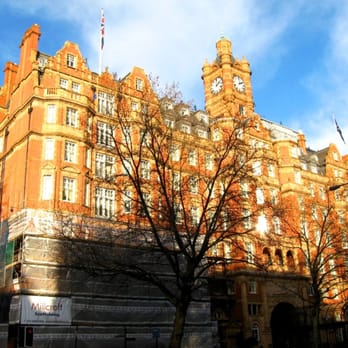
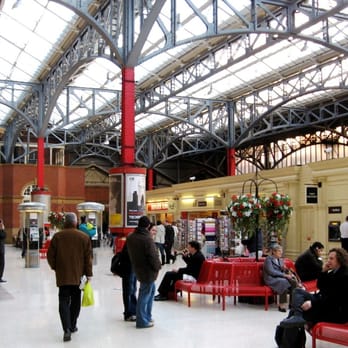
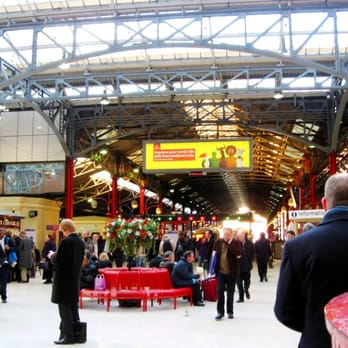
Marylebone is one of London's smallest, and certainly most charming station, as well as being the newest terminus. Now operated by Chiltern Railways, trains run to High Wycombe, Wembley, Aylesbury, Banbury, Stratford-upon-Avon and via Birmingham (Snow Hill) to Kidderminster. Opened in 1899, charming is not what the directors of the Great Central Railway would have wanted to hear. The Great Central, linking London to Leicester, Nottingham, Sheffield and Manchester, was a grand undertaking, the brainchild of Sir Edward Watkin, who envisaged a line linking England to the Continent, via a Channel Tunnel. The line was built to the European loading gauge (which governs the height, width and length of rolling stock), rather than the more restrictive British standard. But building the line at such a late stage into London was expensive: there was more development to build through, and although the route of the Metropolitan Railway was followed for much of the way, the last few miles required expensive tunnels and cuttings to avoid the steep gradients into Baker Street nearby. By the time they reached London, they had virtually run out of money, and there was not enough money even for an architect - the station was designed by the company's Civil Engineer. Instead of a grand terminus, there are charming domestic-style buildings in red brick, with terracotta capitals decorated with the simplest of egg and dart motifs. When built, it only had three platforms. The line never lived up to expectations, and was never expanded, despite having the most comfortable and modern trains. The rationalisation of the Beeching regime in the 1960s saw the closure of the Great Central main line, and Marylebone settled down to serving the Banbury and Aylesbury commuter services. For years, there was talk of closure. Its salvation came with the privatisation of British Rail, and the advent of Chiltern Railways. Their drive has seen passenger services develop to Birmingham via Banbury, the reopening of Birmingham's Snow Hill station, and more passengers using Marylebone than ever before: they even recently expanded the station, inserting new platforms to cater for the volume of trains. Although a slower option to Birmingham than Virgin, prices are rather lower and its half-hourly services are still the best way to reach places like Aylesbury, Stratford, Solihull, Warwick, Banbury, Leamington and Bicester. The station itself is now buzzing, with shops (including an M&S Simply Foods) and cafes. The concourse is bright and airy, with the ironwork beautifully restored. There is a direct connection to the Underground (Bakerloo), a covered taxi rank and cycle storage. Being so small, everything is a few seconds walk away, and the whole station provides step-free access. Chiltern's web-site also provides live real-time departures information. Finally, a word about the Great Central Hotel. This grand building, between the station and Marylebone Road, was built separately and dwarfs the station behind. Opened in 1899, and designed by the architect R W Edis, it was a byword for luxury, with its huge central Palm Court - the forerunner of to-days atriums. For many years the HQ of British Railways, in 1986 it was acquired and restored, and once again is resplendent at the 5-star Landmark Hotel. A covered entrance runs behind the hotel to the station, allowing visitors to arrive and depart in the dry. The rooms - at 592 square feet - are larger than my flat (See separate review on Qype for the Landmark Hotel) read more




8 years ago
I love this station and use it everyday when I commute out of London. It does, however, have a couple of features which will annoy someone not used to the system and rushing for a train. Number 1 - the screen showing the departure times will remove a train when there is still a few minutes to jump on it leaving one with the invidious choice of trying to guess which platform. This is completely unnecessary. Number 2 - platforms 4, 5 and 6 are not brilliantly signposted. Everything else is decent and the sports bar is much better in quality than one would expect. Top tip - head downstairs at the sports bar, as there is loads of room. read more


16 years ago

17 years ago

18 years ago

18 years ago

18 years ago

18 years ago

15 years ago

12 years ago

17 years ago

14 years ago

9 years ago

19 years ago

15 years ago

18 years ago

13 years ago
More info about Marks and Spencer
Review Highlights - Marks and Spencer

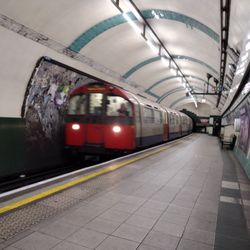
![London Underground - My wife ready to go =]](https://s3-media0.fl.yelpcdn.com/bphoto/WoRCJgbaxn8FpzAz3lTWRw/ls.jpg)












Why does Yelp recommend reviews?
1 review that is not currently recommended
The reviews below are not factored into the business's overall star rating.
15 years ago


