London Euston Photos



Recommended Reviews - London Euston
Start your review...


Reviews With Photos


Euston is one of a plethora of mainline rail stations in London, and like all the others is connected with all the other stations and the city as a whole through the amazing London Underground system aka "the Tube" famous for the phrase "Mind the Gap" and the fact that a truly amazing engineer Isambard Kingdom Brunel built the basics of it almost 200 years ago. It is humbling to see what he achieved in his 53 years on the planet!! https://www.britannica.com/biography/Isambard-Kingdom-Brunel Anyway - back to business - compared to the nearby St Pancras station (better than most airports in terms of facilities, restaurants and shopping) or even Kings Cross it is definitely economy (but more than adequate) and not even business class - but it works and forms a key part of the amazing public transport system in England! 3 well earned stars Review #2 2019


Outside of Paddington Station, the Euston station is probably the biggest transfer point from the Tube to get outside of London. The Virgin Trains are the main servicing lines here, with connections to other major cities in the UK. The trains are fast hitting speeds over 100mph and incredibly smooth. For those headed out to other major cities and with time, do yourself a favor and download the app to get train times and buy a ticket for far less (ahead of time) than you would at the station. You'll save a considerable amount of time and money this way. Also note, nothing here is really wheelchair accessible. In terms of navigating yourself in a maze, well, follow signs or ask station workers. You'll need to move fast around here or arrive early if you want to make your train. Be on the platform at least 5 minutes before it is set to depart, or you'll be likely to miss your train. Luckily, trains are frequent during the day and theres express lines (with fewer stops), including some to Birmingham.


Ah gosh!! I have a couple of check-ins for Euston Station, but can't believe didn't previously write a review! Well, with this review, have rectified my earlier omission! This is one of those railway station that's the heartbeat of London, as its located so close to so many museums/ places of interest like the British Library and the British Museum. There's also numerous train connections intersecting with other lines, so at all times, Euston Stations is just massively busy and crowded. The architecture of the station is very interesting - its low and hugs the ground and looks like a concrete log from the 1960s. Also (HT for Aussies) check out the cool statue of Matthew Flinders (bloke who circumnavigated the globe and provided the geography for Australia back in the day) as it is believed his grave lies under one of the stations platforms. (for more info: https://www.theguardian.com/science/the-h-word/2014/jul/18/matthew-flinders-bicentenary-statue-navigator-science-history). Yelp 4/ 2019


A busy station on the Underground, servicing Circle & Hammersmith, Northern and Victoria line trains, Euston is also a major terminus for overground lines including Virgin, London Midland, London Overground and First ScotRail who run the Caledonian Sleeper. I don't recommend switching from Victoria to Northern here and suggest you do so at Warren Street or King's Cross. Also, if you can avoid it, changing from the Overground to the Victoria line is a long and confusing walk, up and down and up and down. Ick. The Underground is consistent with other Underground Northern stations though it's important to note that it is not the same as Euston Square station, a short walk away.
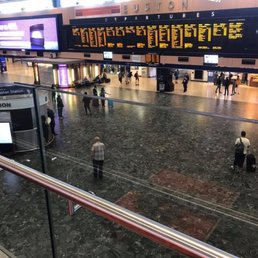

Not a lot of people ... well, not many Americans, at least ... can attest to a 34 relationship with a British train station, but I sure as heck can. It was 1983, and Euston Station was the utilitarian's dream. Tube accessible, city accessible, out-of-town accessible. My father, equal parts frugalist, explorer, scatalogical jokester, and intellectual, LOVED Euston station. We would come to town, staying frequently at the pencewise Cottage Hotel (defined by the most charitable as a B&B), which was walking distance from Euston Station. Euston was (and still is) less than a mile from the British Museum and Regent's Park, spitting distance to the British Library, and, oh yeah, the station you can take a train all over the UK from ... and the Tube all over foggy ole London. The food options are much more abundant back in the day, and the station itself is much cleaner. Still, necks are cricked down on the main floor as people await their trains to open up for boarding or arrive. And, in a case of "deja vu all over again", I waited, and waited, waited, and then scurried off to my train with the masses when the "BOARDING" sign finally lit up. Euston, we have a problem ... you're still crazy after all these years. But part of me still loves you and your craziness.


Not one of the best Railway stations ever, there is hardly anywhere to sit and its very crowded most of the time, they only let you know a few minutes before you have to board the train which causes absolute carnage and everyone has to rush for the train at once. There are a few fast chain eateries and a few supermarkets around the station for last minute light bites for the train journey. They are revamping Euston Station though so lets hope its for the better!!!


So I won't lie, I kind of hate Euston station - yes, hate is a harsh word but I don't think I have ever had a smooth experience there and I've definitely never smiled inside those walls (and that is very rare for me). My trains are always late, it is always absolutely packed with disgruntled people and even the staff are rude, with the majority having severe cases of resting bitch face - not exactly helpfully inviting. Harsh, but true! There are a selection of chain food spots, both outside and in, available however finding a seat in them is excruciating task in itself so please do prepare yourself to be stood up and waiting. You will have to pay to use the toilets. This is pretty standard these days in the large UK stations so please be sure to have some change on you otherwise you may have to attempt a Colin Jackson over the toilet barriers! One positive and encouraging thing I will say however is that there are improvement works going on currently which seem to be trying to rectify the above issues. They recently opened a Leon and a burger joint which provides more seating above the main station floor and although I don't know the exact plans for Euston's future layout they do seem to be starting to address their issues and move forward which can only be a positive thing! That smile may just be around the corner - I truly hope it is!


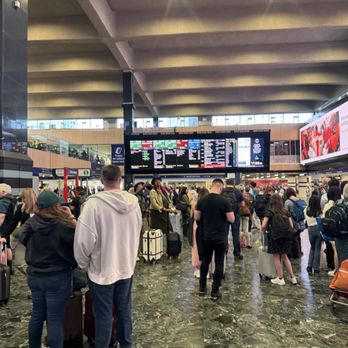
It's difficult to articulate quite how bleak the experience of using London Euston station is. It exists as a gateway to and from the north of England, and it's perhaps for this reason that it's never really been improved; compared to many of the places for which the station acts as a gateway, it's the veritable Taj Mahal of London - a palace fit for royalty. But in reality, this is surely where souls come to die. Picture, if you will, a gargantuan hall, surrounded by construction perpetually in progress. Large concrete blocks impose in on you from above you as gaze upon a gigantic board detailing the departure times, platforms and stopping points for the one saving grace of London Euston - an exit of any kind. With almost no seating available, you are crammed like cattle, willing the clock to tick faster, fighting the tangible sense of temptation that accompanies every announcement of impending departure. It soon becomes of secondary importance where the next train is going. Only that it is going. And you gaze in awe of those whose time has been called and whose legs cannot scuttle them quickly enough to the escape you so desire for yourself. But it is not your time. Not yet. You have fallen victim to a fate worse than death itself: the excruciating patience-testing experience of a London Euston train delay. You shake yourself from the cold, chilling feeling of dread that begins to take over and tell yourself it can't be as bad as you last remember it. Glancing around for any shred of comfort, you come up short. There is nothing here for you. Shops and facilities exist in the most crudely functional, unwelcoming manner. High street mainstays are here, each taking advantage of your predicament by inflating costs to the degree you begin to suspect they're in collusion with whatever evil madman designed this place, to gradually take your sanity. And then, the call. Could it be? Yes. You're not dreaming. Your lifeline from this hell-hole has arrived. Along with the other livestock, you move en masse through a completely impractical corridor, not nearly spacious enough to contain this now rabid exodus of the damned. 'Never again', you vow, 'will I put myself through that. I would rather combat-crawl through the sewers of this country.' Except you won't. Because you have no choice. You'll be back, again and again, and every time you do, those mysterious, masochistic suits will profit once again from this exercise in modern torture. Pros: Good disabled access.


I was travelling to Birmingham from london. We had an hour to kill. Great facilities in the station whsmith ect along with the generic burger king and other restaurants. The station offers free wifi service as well as connections to underground and bus services. Not a bad place to wait for a train


I really hate Euston Station, it's in a permanent state of "improvement" but the building works never appear to be getting anywhere. When you couple this with the amount of people using the station. At peak times it's a bloody nightmare so make sure you give yourself plenty of time when travelling!!!


Definitely one of the most conveniently located stations in central London! It is big with all the national rail service strains departing from here. The station definitely does its job to the tee. There are shops for your convenience (food, toiletries, books, clothes and restaurants). The information desk people are usually helpful (unlike a lot of stations) and sometimes even friendly. I always take my train back to Manchester from here, just wish sometimes it had better heating and more seats but besides that the station is definitely efficient and does its job well! There is an outside seating area where all the restaurants are which is quite a nice area for smokers like me to sit and have a smoke after a long train journey! The underground connecter is convenient so if you need to take a tube from the station its not much of a pain. The station also has an underground Taxi rank which is extremely helpful when you have a big bag with you or just lazy! Verdict: Useful, Convenient, Central Location and does its job well! (Better seating and a bit of warmth would be desirable)


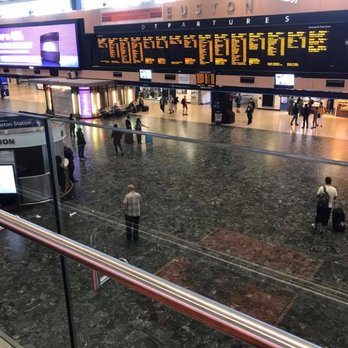
A bench, a bench, my kingdom for a bench! Otherwise it's usually an efficient standing adventure, gazing longingly at those screens to see how many minutes my train is delayed. But they do a good job announcing where we all should trot for a timely departure. The staff is predominantly helpful, especially for the newbies who have no idea why their train isn't listed within eyeshot on those screens. And it's a quick in/out to the underground, or even quicker for overground in the same building. Pro tip if you have a few extra minutes: go upstairs and grab a bench there, along with a drink/snack as you gaze down at the hoi polloi below. Just make sure you jump when the polite announcer calls your number. read more


I'm going to be knocking a point off of this place because of the ugly office building that they decided to erect in front of the station, though I suspect that it was a part of an entire revamp of the station, no doubt back in the 60s when the powers that be didn't particularly care about aesthetics. Oh, and they removed the old Doric Arch that used to stand at the front as well. However, beyond the ugliness of the facade, it is fairly typical of London Stations, especially since everybody will stand in the arrivals hall waiting to see from which platform their train departs. The thing is that there are always staff in the ticket office that will help you select the correct ticket from the machines, and they are pretty proactive as well, which I really do appreciate. read more


Euston is one of a plethora of mainline rail stations in London, and like all the others is connected with all the other stations and the city as a whole through the amazing London Underground system aka "the Tube" famous for the phrase "Mind the Gap" and the fact that a truly amazing engineer Isambard Kingdom Brunel built the basics of it almost 200 years ago. It is humbling to see what he achieved in his 53 years on the planet!! https://www.britannica.com/biography/Isambard-Kingdom-Brunel Anyway - back to business - compared to the nearby St Pancras station (better than most airports in terms of facilities, restaurants and shopping) or even Kings Cross it is definitely economy (but more than adequate) and not even business class - but it works and forms a key part of the amazing public transport system in England! 3 well earned stars Review #2 2019 read more


6 years ago

Outside of Paddington Station, the Euston station is probably the biggest transfer point from the Tube to get outside of London. The Virgin Trains are the main servicing lines here, with connections to other major cities in the UK. The trains are fast hitting speeds over 100mph and incredibly smooth. For those headed out to other major cities and with time, do yourself a favor and download the app to get train times and buy a ticket for far less (ahead of time) than you would at the station. You'll save a considerable amount of time and money this way. Also note, nothing here is really wheelchair accessible. In terms of navigating yourself in a maze, well, follow signs or ask station workers. You'll need to move fast around here or arrive early if you want to make your train. Be on the platform at least 5 minutes before it is set to depart, or you'll be likely to miss your train. Luckily, trains are frequent during the day and theres express lines (with fewer stops), including some to Birmingham. read more

1 year ago

8 years ago
Ah gosh!! I have a couple of check-ins for Euston Station, but can't believe didn't previously write a review! Well, with this review, have rectified my earlier omission! This is one of those railway station that's the heartbeat of London, as its located so close to so many museums/ places of interest like the British Library and the British Museum. There's also numerous train connections intersecting with other lines, so at all times, Euston Stations is just massively busy and crowded. The architecture of the station is very interesting - its low and hugs the ground and looks like a concrete log from the 1960s. Also (HT for Aussies) check out the cool statue of Matthew Flinders (bloke who circumnavigated the globe and provided the geography for Australia back in the day) as it is believed his grave lies under one of the stations platforms. (for more info: https://www.theguardian.com/science/the-h-word/2014/jul/18/matthew-flinders-bicentenary-statue-navigator-science-history). Yelp 4/ 2019 read more


A busy station on the Underground, servicing Circle & Hammersmith, Northern and Victoria line trains, Euston is also a major terminus for overground lines including Virgin, London Midland, London Overground and First ScotRail who run the Caledonian Sleeper. I don't recommend switching from Victoria to Northern here and suggest you do so at Warren Street or King's Cross. Also, if you can avoid it, changing from the Overground to the Victoria line is a long and confusing walk, up and down and up and down. Ick. The Underground is consistent with other Underground Northern stations though it's important to note that it is not the same as Euston Square station, a short walk away. read more


Not a lot of people ... well, not many Americans, at least ... can attest to a 34 relationship with a British train station, but I sure as heck can. It was 1983, and Euston Station was the utilitarian's dream. Tube accessible, city accessible, out-of-town accessible. My father, equal parts frugalist, explorer, scatalogical jokester, and intellectual, LOVED Euston station. We would come to town, staying frequently at the pencewise Cottage Hotel (defined by the most charitable as a B&B), which was walking distance from Euston Station. Euston was (and still is) less than a mile from the British Museum and Regent's Park, spitting distance to the British Library, and, oh yeah, the station you can take a train all over the UK from ... and the Tube all over foggy ole London. The food options are much more abundant back in the day, and the station itself is much cleaner. Still, necks are cricked down on the main floor as people await their trains to open up for boarding or arrive. And, in a case of "deja vu all over again", I waited, and waited, waited, and then scurried off to my train with the masses when the "BOARDING" sign finally lit up. Euston, we have a problem ... you're still crazy after all these years. But part of me still loves you and your craziness. read more


8 years ago

9 years ago

Not one of the best Railway stations ever, there is hardly anywhere to sit and its very crowded most of the time, they only let you know a few minutes before you have to board the train which causes absolute carnage and everyone has to rush for the train at once. There are a few fast chain eateries and a few supermarkets around the station for last minute light bites for the train journey. They are revamping Euston Station though so lets hope its for the better!!! read more


11 years ago
So I won't lie, I kind of hate Euston station - yes, hate is a harsh word but I don't think I have ever had a smooth experience there and I've definitely never smiled inside those walls (and that is very rare for me). My trains are always late, it is always absolutely packed with disgruntled people and even the staff are rude, with the majority having severe cases of resting bitch face - not exactly helpfully inviting. Harsh, but true! There are a selection of chain food spots, both outside and in, available however finding a seat in them is excruciating task in itself so please do prepare yourself to be stood up and waiting. You will have to pay to use the toilets. This is pretty standard these days in the large UK stations so please be sure to have some change on you otherwise you may have to attempt a Colin Jackson over the toilet barriers! One positive and encouraging thing I will say however is that there are improvement works going on currently which seem to be trying to rectify the above issues. They recently opened a Leon and a burger joint which provides more seating above the main station floor and although I don't know the exact plans for Euston's future layout they do seem to be starting to address their issues and move forward which can only be a positive thing! That smile may just be around the corner - I truly hope it is! read more


It's difficult to articulate quite how bleak the experience of using London Euston station is. It exists as a gateway to and from the north of England, and it's perhaps for this reason that it's never really been improved; compared to many of the places for which the station acts as a gateway, it's the veritable Taj Mahal of London - a palace fit for royalty. But in reality, this is surely where souls come to die. Picture, if you will, a gargantuan hall, surrounded by construction perpetually in progress. Large concrete blocks impose in on you from above you as gaze upon a gigantic board detailing the departure times, platforms and stopping points for the one saving grace of London Euston - an exit of any kind. With almost no seating available, you are crammed like cattle, willing the clock to tick faster, fighting the tangible sense of temptation that accompanies every announcement of impending departure. It soon becomes of secondary importance where the next train is going. Only that it is going. And you gaze in awe of those whose time has been called and whose legs cannot scuttle them quickly enough to the escape you so desire for yourself. But it is not your time. Not yet. You have fallen victim to a fate worse than death itself: the excruciating patience-testing experience of a London Euston train delay. You shake yourself from the cold, chilling feeling of dread that begins to take over and tell yourself it can't be as bad as you last remember it. Glancing around for any shred of comfort, you come up short. There is nothing here for you. Shops and facilities exist in the most crudely functional, unwelcoming manner. High street mainstays are here, each taking advantage of your predicament by inflating costs to the degree you begin to suspect they're in collusion with whatever evil madman designed this place, to gradually take your sanity. And then, the call. Could it be? Yes. You're not dreaming. Your lifeline from this hell-hole has arrived. Along with the other livestock, you move en masse through a completely impractical corridor, not nearly spacious enough to contain this now rabid exodus of the damned. 'Never again', you vow, 'will I put myself through that. I would rather combat-crawl through the sewers of this country.' Except you won't. Because you have no choice. You'll be back, again and again, and every time you do, those mysterious, masochistic suits will profit once again from this exercise in modern torture. Pros: Good disabled access. read more


I was travelling to Birmingham from london. We had an hour to kill. Great facilities in the station whsmith ect along with the generic burger king and other restaurants. The station offers free wifi service as well as connections to underground and bus services. Not a bad place to wait for a train read more


I really hate Euston Station, it's in a permanent state of "improvement" but the building works never appear to be getting anywhere. When you couple this with the amount of people using the station. At peak times it's a bloody nightmare so make sure you give yourself plenty of time when travelling!!! read more


14 years ago
Definitely one of the most conveniently located stations in central London! It is big with all the national rail service strains departing from here. The station definitely does its job to the tee. There are shops for your convenience (food, toiletries, books, clothes and restaurants). The information desk people are usually helpful (unlike a lot of stations) and sometimes even friendly. I always take my train back to Manchester from here, just wish sometimes it had better heating and more seats but besides that the station is definitely efficient and does its job well! There is an outside seating area where all the restaurants are which is quite a nice area for smokers like me to sit and have a smoke after a long train journey! The underground connecter is convenient so if you need to take a tube from the station its not much of a pain. The station also has an underground Taxi rank which is extremely helpful when you have a big bag with you or just lazy! Verdict: Useful, Convenient, Central Location and does its job well! (Better seating and a bit of warmth would be desirable) read more


Euston is one of London's oldest stations, and can fairly argue to be the terminus of the first trunk railway in the world, the London and Birmingham, opened in 1837. Alas, alas. You'd never know it now. This great gateway to the West Midlands, Lancashire, North Wales and Glasgow (otherwise known as the West Coast Main Line) is the only long-distance station to have been completely rebuilt (in 1968). The result has never been loved. To understand why, we need to go back to 1837. When built, the original Euston was furnished with a grand entrance arch, a gateway to the world of possibilities offered by this new and novel means of transport. The arch was designed by Philip Hardwick (1792-1870) and consisted of a truly huge Doric portico with fluted columns over eight feet in diameter, flanked by paired stone lodges, also in the Doric style, and with elaborate wrought iron gates. When built, the columns were the tallest in London. A further pair of stone lodges was added in 1870. The station behind was always inadequate, and in 1846 Hardwick was commissioned to design a new waiting room and other buildings. The Great Hall, as it came to be known, was another masterpiece, and regarded by Sir John Betjeman as one of London's finest public rooms: in the Ionic style, it had a dramatic coffered ceiling and a grand, curving double staircase. It also contained the Shareholders' Meeting Room, decorated in a sumptuous Baroque. Over the years, the station was extended east and west in piecemeal fashion, and a new ticket office opened in 1916. However, by the 1960s the station was in need of serious refurbishment, and the electrification of the West Coast Main Line provided an opportunity to modernise the station. This was the era before the conservation movement had gained momentum, however, and the new design - resembling the airports of the time - required the complete demolition of the old. The most controversial move was the demolition of the Euston Arch, and the battle over this was one of the key moments in the history of conservation. Alas, this early battle was lost to the Philistines: the protests from preservation societies, the London County Council and the Royal Fine Art Commission fell on deaf ears. Even the demolition contractor famously offered to re-erect the Arch at his own expense on a site chosen by the then British Railways. He was refused (although apparently, some of the stones are still intact, lying on the Thames riverbed at Bow Creek and in the gardens and ponds of the men contracted to demolish the arch 46 years ago). The arch came down in 1962, although two of the lodges survive. Instead, the large concrete shed with its long approach roads and glass curtain wall was erected in its place and opened by the Queen in 1968. It's buffets have always attracted criticism as being plastic and unpleasant, the long walks through the terminal have always been unpopular, and there has always been too little seating (amazingly, public seating was almost entirely absent in the original design). The taxi rank is also underground, and suffers from traffic fumes. But perhaps the major failing has been the platform area: the train shed roof is low and dark, and the platforms are approached by long sloping ramps equipped with huge metal screens. It's a dismal gateway to London, and the habit - again taken from airport practice - of holding passengers in the waiting hall until the train is ready has never been popular with passengers. It still serves passengers going to the original destinations, as well as a substantial commuter service to Watford, Milton Keynes and Northampton. The station is used by 27 million passengers a year, is open 24 hours a day and has all the facilities you'd expect of one of Europe's busiest stations. Efforts have been made in the last decade to cheer up the concourse with more shops, more seating and brighter lighting, with some success; less successfully, the platforms have been resurfaced in white marble and given hanging baskets of flowers, but they are still claustrophobic and dank. The original lawns in front of the station have become a sort of piazza, and various office blocks have been built in front, which at least gives the station some life. Another plus is that buses pull into the area in front of the station and run to a wide range of destinations in central London and points north. However, there is light at the end of this particular tunnel: Network Rail is committed to rebuilding the station, and a campaign has started to rebuild the Euston Arch. Its website is at: http://www.eustonarch.org . Please support it! read more


12 years ago


12 years ago


17 years ago

13 years ago

15 years ago


It does the job but I'm sure Euston station used to be better, it's certainly got colder and for one of London's busiest main stations, there is just not enough seating to rest up when waiting for that delayed train. It's fine in the summer or on dry days as there is plenty of seating outside, to go with all the chain cafes in what I call the spill-over; there is no more room inside so they have build in the courtyard. It makes sense of course. It also makes sense that a Sainsbury's has been added to the plethora of mini-stores, outside at the opposite end of the essential (as far as I'm concerned) Marks & Spencer. Also essential is the mini chain seen at stations, AMT just for their chai steamer. I'm not sure if I've ever had their coffee. At the current count, there is also Boots, WH Smith, Paperchase and Body Shop amongst the plentiful foodie places plus a pub if you look upwards, on the right as you go in via the front entrance. It's overdue an overhaul but if fits the purpose, despite not having any trash cans still (after they were taken out of all the stations years ago for security reasons) but if you chase the trash collector outside, you should be able to dispose of your junk food packaging. read more


Page 1 of 3
More info about London Euston
London Euston Reviews in Other Languages
Review Highlights - London Euston

















Why does Yelp recommend reviews?
6 reviews that are not currently recommended
The reviews below are not factored into the business's overall star rating.
15 years ago
18 years ago

10 years ago

18 years ago

11 years ago

12 years ago


