Kasper Hauser Denkmal Photos

Recommended Reviews - Kasper Hauser Denkmal
Start your review...



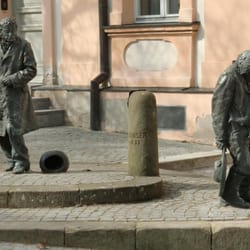
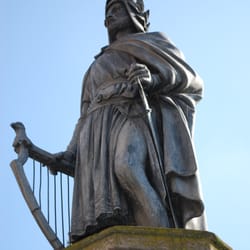
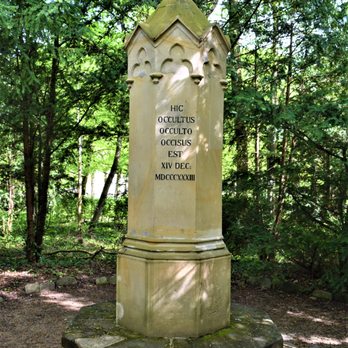
This memorial marker is located in Hofgarten Ansbach with an inscription in Latin: Hic occultus occulto occisus est; translated in English--"Here unknown (referring to Kaspar Hauser) was murdered by unknown. December 14, 1833." There's also a statue of Kaspar in Ansbach's Old Town section. The story of Kaspar Hauser (30 April 1812 - 17 December 1833) is mysterious at best, and it's somewhat bizarre. He was a German youth who claimed to have grown up in the total isolation of a darkened cell. Hauser's claims and his subsequent death by stabbing, sparked much debate and controversy. His tale aroused great curiosity and made Hauser an object of international attention. Rumor's arose that he was of princely parentage, possibly of Baden origin, but there were also allegations that he was an impostor. After Kaspar Hauser appeared in Nuremberg in 1828 and quickly became the most famous boulder in modern history, he moved to Ansbach in 1831. There he died on December 17, 1833 as a result of an assassination attempt that must be regarded as one of the most mystical of the 19th century. These two years of life in Ansbach were enough for the "Child of Europe" to inscribe itself in the history of the Middle Franconian government city and become its best-known citizen far beyond time and space. For more than 190 years, Kaspar Hauser has evoked a wide range of interests and research -- all questions leading to the mystery of his origin -- embedded in a time of great historical upheaval. But it is also becoming increasingly important in philosophy, psychology and education. Who was Kaspar Hauser? Why did he have to die? What's his secret? How do you explain his extraordinary nature? These and many other questions are taken up every two years at the Kaspar Hauser Festival in Ansbach since 1998 (in even-numbered years). Based on an extensive selection of existing and new works, she sets herself the task of making the uniqueness of the phenomenon understandable. Many of the events take place at historical locations that Kaspar Hauser was already familiar with and dealt with in a diverse, both artistic and scientific program. read more