Cancel

Open app

Search

James Joyce Statue Photos

Recommended Reviews - James Joyce Statue

Your trust is our priority, so businesses can't pay to alter or remove their reviews. Learn more about reviews.
Yelp app icon
Browse more easily on the app
Review Feed Illustration

Reviews With Photos

Aoife R.

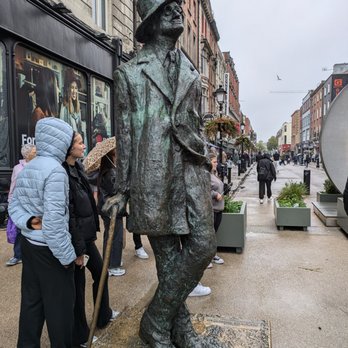
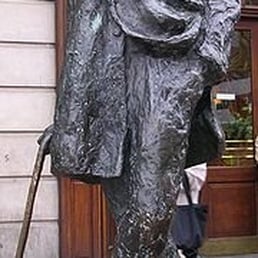
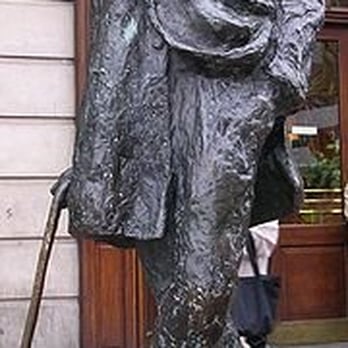
A lovely bronze statue of one our most beloved and yet incomprehensible authors, set appropriately enough in the "heart of the rowl" on North Earl Street, where Dubliners are literally at his feet, sometimes eating a meatball sandwich from the Subway across the way. This statue is so popular that it has even spawned an imitator on Grafton Street - a man who dresses up not only like James Joyce, but like a statue of James Joyce. He sometimes bangs his stick to get you to give money to him, but you can walk unmolested by the Jim on this street.

James feeling cold

See all

2 months ago

Helpful 2
Thanks 0
Love this 3
Oh no 0

2 years ago

Helpful 5
Thanks 0
Love this 4
Oh no 0
Photo of Alexandra M.
27
409
480

17 years ago

Helpful 2
Thanks 0
Love this 2
Oh no 0
Photo of Aoife R.
42
408
427

17 years ago

Helpful 1
Thanks 0
Love this 2
Oh no 0

12 years ago

Helpful 7
Thanks 0
Love this 7
Oh no 0

11 years ago

Helpful 5
Thanks 0
Love this 6
Oh no 0

14 years ago

Helpful 1
Thanks 0
Love this 2
Oh no 0
Photo of Gerry O.
5
112
73

15 years ago

Helpful 0
Thanks 0
Love this 0
Oh no 0

14 years ago

Right on Earl Street stands the glorious James Joyce. A must-see and must-take-a-picture-with statue.

Helpful 1
Thanks 0
Love this 1
Oh no 0

James Joyce Statue Reviews in Other Languages

Verify this business for free

People searched for Landmarks & Historical Buildings 247 times last month within 5 miles of this business.

Verify this business

St Mary's Pro-Cathedral - Photo from website

St Mary's Pro-Cathedral

(3 reviews)

North Inner City

Although located on the grim skid-row of Marlborough Street, St Mary's Pro-Cathedral is an…read moreabsoulute gem of a building. Along with St Andrew's Church on Westland Row, the Pro-Cathedral is one of the finest modern church buildings in the city centre. The Pro-Cathedral is a fine example of a church built in the Classical Greek style, with large Doric cloumns on the inside as well as outside. The Pro-Cathedral was built early in the 19th century, and is modeled on the church of St Philippe-le-Roule in Paris. St Mary's Pro-Cathedral would not be the most frequented tourist attraction in Dublin, located off the beaten track as it is, but it only a minutes walk from O'Connell St, and it should definitely be part of your itinerary if you are visiting Dublin and old churches are your thing. I prefer the Classical style of St Mary's to the medieval Gothic of Christchurch or St Patrick's Cathedrals personally, and best of all, the Pro-Cathedral has no admission charge, whereas the other two have.

Back in the early 19th century, when Protestants didn't care too much for Catholics, the idea was…read moremooted to put the Pro-Cathedral on O'Connell Street. However, such a flagrant symbol of Taigism was judged unwise, what with the Penal Laws and all their attendant imaginative punishments, so it was built on Marlborough Street instead. From the outside, its most distinguishing feature is its sea-green dome, whereas inside it is a mix of Greek and Roman architectural styles, (more white marble statues than you can shake a crosier at), beautiful stained glass and an amazing panelled ceiling - the inside of the dome. Strangely, the name doesn't mean that it has professional cathedral status - in fact, it isn't officially recognised as a cathedral at all.

Dublin Castle - Dublin Castle_Sanju-12

Dublin Castle

(156 reviews)

South Inner City

Its a easy experience to go through, beautiful castle with free lockers to store backpacks.read more

Dublin Castle was originally built in the early 1200s as a medieval fortress under the instruction…read moreof King John of England. For centuries, it was the headquarters of English (and eventually British) rule in Ireland. In 1684, a large fire destroyed a large portion of the castle. Instead of matching the original Gothic style, most of it was rebuilt using a Georgian style, similar to what you'd find in the French Palace of Versailles! It's quite the contrast. When you visit Dublin Castle, you can choose to explore it in two ways: with a self-guided tour to the state apartments or with a scheduled guided tour that visits the Viking Excavation, the Chapel Royal, and the State Apartments. When you first enter the courtyard, you'll immediately see the newer Georgian architecture in the neat red brick buildings surrounding the square. From the 13th century to the early 20th century, the castle was under British control. It served from being a royal palace and parliament to a prison. Dublin Castle was eventually handed over to General Michael Collins on the 16th of January in 1922. Collins was a soldier and a politician who lead the Irish people through their fight for Independence Dublin Castle plays a huge role in Ireland's history and a walk around the grounds is time well spent. Today the castle is a government complex and tourist attraction. Stroll through the famous Chester Beatty Library if time permits

Garden of Remembrance

Garden of Remembrance

(25 reviews)

Parnell Square

One of the must see free gardens and parks in Dublin. We met our tour guide here as he deemed it…read morethe "staple of the city center" and talked about the significance of the Garden of Remembrance. If you've taken any time to study Irish history - you'll know the Irish fought for their land and freedoms for centuries and often times, they were not the victors. In the few years spent traveling to Ireland you'll hear a lot of the Irish people's plight for freedom and it was never an easy battle. Essentially this garden of remembrance signifies the Irish people and their contributions towards fighting for their freedoms. What I found interesting is that Our tour guide called himself a "blue blood" which in simpler terms he referred to him being a true Dublin local and that these garden means a lot to his people and those working in the city. He taught us a lot about the grounds, the fountains and statues. We toured the grounds with him and they were very nice and well kept. While looking over the fountain statues we were introduced to one of the groundskeepers as well. As lovely as it is it's also a somber place. We were told the story of what the children and swan statue represents, an Irish folklore. All interesting stuff and while the garden is free, I'd highly recommend hiring a local guide as there is so much we wouldn't have learned had we not had someone to tell us the history and stories of what we were looking at on the grounds.

Just like so many other memorials and tributes, this one is dedicated to victims of battle-people…read morefighting for their rights and freedom. No matter the culture, this seems to be a prevailing characteristic of humanity-we like to fight each other. It's a lovely little garden with a water feature in the center. There's a large sculpture at the end which depicts four children who were transformed into swans and will turn back into humans after 900 years, according to the legend of the Children of Lir.

Ha'penny Bridge - Ha'Penny Bridge_Sanju-5

Ha'penny Bridge

(28 reviews)

Temple Bar

if you are coming by Air, you can see the poster of this famous bridge on airport. The Halfpenny /…read moreHa'penny Bridge, was built in 1816, Ireland's first iron bridge. Although there are over 20 bridges crossing the River Liffey, none are as popular as the Ha'Penny Bridge. The Ha'Penny Bridge is a pedestrian-only bridge over the River Liffey in Dublin, Ireland, providing a great shortcut from the Temple Bar to the North Quays. Though the official name is the Liffey Bridge, it is commonly referred to as the Ha'Penny Bridge because anyone crossing was charged a toll of a half penny. The toll was dropped in 1919, and visitors are free to cross. Before the Ha'Penny Bridge was built, the only way to cross the River Liffey was by ferry. These ferries were operated by a William Walsh and were in bad condition. Walsh was informed that he had to either fix them or build a bridge. Walsh opted to build a bridge. The bridge was built in 1816 of cast iron.

While wandering around Dublin, we had to make a trip, several actually, across the famed and…read morehistoric Ha'penny Bridge! If the history of the bridge and the fact that it has been in operation for over 200 years doesn't impress you, then maybe the intricate wrought iron railings and lighting, or maybe the views of the river and Dublin cityscape will do it for you!? Honestly, all the above for us. Ha'penny Bridge is worth the visit, whether it is out of the way or on your route, make it point to stop by, get some photos and just take it all in!

James Joyce Statue - landmarks - Updated May 2026

Loading...
Loading...
Loading...