Cancel

    Open app

    Search

    Herstmonceux Castle Photos

    Recommended Reviews - Herstmonceux Castle

    Your trust is our priority, so businesses can't pay to alter or remove their reviews. Learn more about reviews.
    Yelp app icon
    Browse more easily on the app
    Review Feed Illustration
    Photo of David J.
    96
    2344
    11912

    3 years ago

    Helpful 4
    Thanks 0
    Love this 2
    Oh no 0

    8 years ago

    Helpful 1
    Thanks 0
    Love this 1
    Oh no 0

    Verify this business for free

    Get access to customer & competitor insights.

    Verify this business

    The Long Man of Wilmington

    The Long Man of Wilmington

    4.8(4 reviews)
    5.8 km

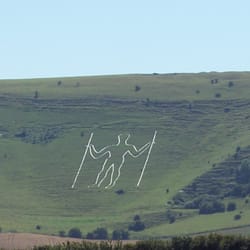
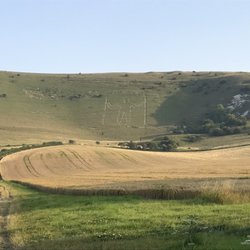
    The Long Man is one of several chalk figures cut in the landscape of southern England, and along…read morewith the Cerne Abbas giant, one of only two human figures. At over 70m tall, the Long Man is Europe's largest representation of the human form and the second largest in the world. The figure is formed from trenches dug into the ground to reveal the chalk substrate below. History So who is he? His age has long been a mystery and is the topic of fierce dispute. The first recorded image is a drawing made in 1710, which showed him with facial features, a helmet-like head and his feet pointing outwards. It showed the outline as more of an indentation in the grass than a solid white line. Subsequent 18th century drawings depicted the 'staffs' as being a scythe and a rake, although evidence on the ground does not support this - nor the theory that, like the Cerne Abbas giant, he once had genitalia. An archaeological analysis in 2003 of the chalk on the hillside gave a mid-16th century date, although some excavations have produced Roman pottery from the trenches, implying a pre-Roman date. Similar Northern European depictions of helmeted figures with staffs or spears appear from the Iron Ages to the Viking periods and on Roman coins. If he is pre-mediaeval, it is however strange that there is no reference to the figure in the records of the nearby Wilmington Priory. We will probably never know for sure, but there's no doubt that he cuts an imposing figure on the landscape. Whatever his origins, the current image was formed in 1874 when outlined in yellow brick by Rev. W. de St. Croix of the Sussex Archaeological Society, although even then it was realised that the new outline distorted the original image. In 1891 the bricks were replaced with white versions, painted regularly to keep him fresh, but was rather ignominiously painted out using green paint during World War II to prevent him being used as a landmark by enemy planes! In 1969 the outline was remade using concrete blocks into the form we see today. Practicalities There's a car-park just south of the ruined Priory in Wilmington village, from where a public footpath take you right up to the figure. There are excellent views from a wide area of the surrounding countryside.

    I grew up in this village, with its majestic chalk man looking down over us each and every day…read more When we were youngsters we used to be able to take our sleds up on a snowy day and whizz down over the Long Man but over recent years they have taken much better care of him and now have fencing erected to preserve him. The walk is quite steep and if you are not too sure-footed, it would be best to just admire the view from the lower levels as both access points (either to the left or to the right of the Priory carpark exit) are very rough. muddy and pitted by horses hooves. Pagans celebrate around the Long Man on specific pagan/wicca "holidays", such as Imbolc, Beltane, Lammas and Samhain (Hallowe'en) including the equinox celebrations although obviously they are also not allowed on to the figure itself. No-one really knows where he came from 'tho many theories exist. Locals believe he is an older figure, along the lines of the White Horse in the West Country but whatever, he is a powerful image and draws many many tourists to the area each year. He rests in a dip in the Sussex Downs, in many respects sheltered from the worst of the weather from inland and the coastal region (which is only a few miles away). There are plenty of pathways and walks across the Sussex Downs, for example starting off in Polegate and walking across to the River Cuckmere at Exceat, a beautiful walk, which will bypass our Long Man.

    Photos
    The Long Man of Wilmington
    The Long Man of Wilmington
    The Long Man of Wilmington

    See all

    Combe Hill Neolithic Camp

    Combe Hill Neolithic Camp

    5.0(1 review)
    10.0 km

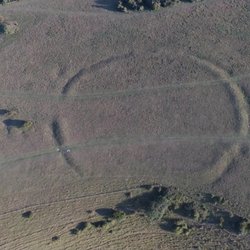
    This is a 5,400 year-old Neolithic causewayed camp or enclosure, situated on Combe Hill between the…read moreEastbourne suburb of Willingdon and the village of Jevington. Although there isn't a great deal to see unless you're an aficionado, it's a lovely place for a walk, with great views, and it is older than Stonehenge! History and what to see The camp consists of two (possibly three) sets of concentric ditches and ring is the most complete of the three, measuring 90 by 70 metres and enclosing an area of 0.53 hectares, and rising to 1.2m. That may not sound much, but archaeological finds of flints, animal bones, an unusual small carved chalk block and Ebbsfleet Ware pottery have dated the site to around 3,400BC - earlier than the first phase of Stonehenge. It's not surprising that erosion over the millennia have reduced its physical impact. Evidence also suggests that, when built, it would have been constructed in newly cleared forest. Finds from the ditches indicate the site was used up to the fourth century AD, possibly for votive offerings, but its use is unlikely to have continuous. The material includes Bronze Age Beaker Ware pottery, bronze rings and Roman coins. It's not exactly known what such enclosures were used for, but it is unlikely to have been continuously inhabited. It has been speculated that they were religious or social meeting places, cattle enclosures or trade centres, and were rare clearings in otherwise dense forest. There are three bronze Age barrows adjacent, one to the west and two to the east, and date from around 2,000BC. The western 'Bowl' barrow rises to nearly 2m, and is 20m in diameter. In 1908 four Bronze Age axe heads were found within the mound. The other two mounds to the east are slightly smaller, but all three may have been damaged by early and unrecorded amateur antiquarian investigations which have reduced their height. Practicalities The site lies a mile from Willingdon and 1.5 miles from Jevington on the 1066 Country Path, Ordnance Survey reference TQ 5702. It's 600ft up, so allow a good half hour to reach it from either starting point, and take a map and good shoes - the paths can be very steep, and the grass can be slippery in wet weather.

    Photos
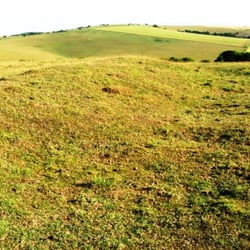
    Combe Hill Neolithic Camp - Approaching the hill summit from Jevington on the 1066 Country Walk path, with the western Bronze Age barrow on the left.

    Approaching the hill summit from Jevington on the 1066 Country Walk path, with the western Bronze Age barrow on the left.

    Combe Hill Neolithic Camp - A section of one of the ditches (centre) and banks (to the left) of the causewayed enclosure. Built c. 3,400BC.

    A section of one of the ditches (centre) and banks (to the left) of the causewayed enclosure. Built c. 3,400BC.

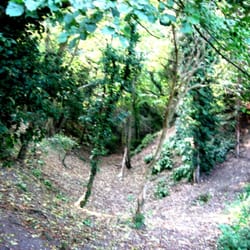
    Combe Hill Neolithic Camp - Standing in one of the concentric ditches, with the bank to the right; the causeway across it is straight ahead. The bank on the

    See all

    Standing in one of the concentric ditches, with the bank to the right; the causeway across it is straight ahead. The bank on the

    Battle Abbey & Battlefield

    Battle Abbey & Battlefield

    4.5(10 reviews)
    11.5 km

    Came here without much expectations. And were suprised by the size of the grounds, all the…read morebuildings and all the things to discover. We've spent many hours here in the end. A real highlight on this years Road Trip through the UK. Parked right next to on the official carpark. Fixed price of 4£ was a fair deal (free for members). We bought tickets online before and there was next to no wait to enter. The Battle of Hastings, fought on 14 October 1066, is one of the best-known events in England's history, when William of Normandy defeated the army of King Harold of England. William the Conqueror founded Battle Abbey. The abbey thrived as a Benedictine monastery for over 400 years, and after its suppression in 1538 the abbot's lodging was transformed into a grand country house. Exploring the Abbey is a great and fun thing to do. There's so much history to read and to take in here. You can go to the top as well, enjoying the views. Or go explore every corner there is - you might find the old toilet here as well (it's named "garderobe"). After enjoying history at the Abbey we walked on the grounds. Checking out the Ice and Dairy House, the King Harold and High Altar Memorial and the Crypt. And a quick look at the walled garden. Then went onto the Battelfield. If you don't have an audio guide, you still can read all the info plates along the way. Really well done and informative. And the walk around the battlefield is a pretty one. With some wildlife as well. We did have our Bulldog with (and a pet stroller) without problems. Just the first section has some steps, after that it's pretty stroller-friendly. Then in the end we've visited the old Abbey ruins. Again: very impressive architecture. We had a great day here. There's so much to see and to do. Of course there's also a shop, a restaurant, a food truck and toilets. Some games for kids as well. A fantastic visit. And surely not to be missed. A must-do.

    I remember coming back here in 2011 and, well, it wasn't so much closed off, it was just that it…read morewas closed. You see, this has been turned into a private boarding school, so you can't really come trapesing through here at any hour of the day. Actually, it's a site of historical significance, so yeah, they usually fence them off as well. Anyway, it's not bad. There are actually wooden cutouts of soldiers around the fields, which is pretty cool. At first I thought this was the school, and apparently you simply can't walk into the school, but not, it is actually the ruins next to the school. The reason these are ruined is because of King Henry (which the English don't seem to be too impressed with). Anyway, it's pretty cool, and you can actually find a number of underground chambers here that you can explore, though they don't happen to be hugely extensive (or if they are, parts of them are being used by the school). Oh, the ticket includes both the abbey and the battlefield.

    Photos
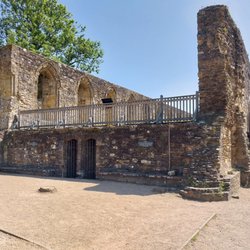
    Battle Abbey & Battlefield - Abbey Ruins

    Abbey Ruins

    Battle Abbey & Battlefield - Abbey Ruins

    Abbey Ruins

    Battle Abbey & Battlefield - Spiral stairs to interior of Abbey Gatehouse

    See all

    Spiral stairs to interior of Abbey Gatehouse

    Bramber Castle - Bramber castle - dry moat

    Bramber Castle

    3.8(6 reviews)
    45.9 km

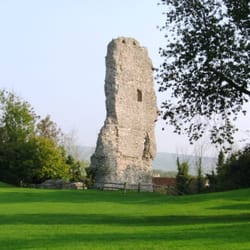
    Built to defend an important port on the River Adur, Bramber Castle was constructed as a motte and…read morebailey castle around 1073 by William De Braose, who fought alongside William the Conqueror at the battle of Hastings in 1066. Apart from a period of confiscation during the reign of King John, it remained in the ownership of the De Braose family until themale line died out in 1324. Thereafter, it passed via the Mowbray and Howard families into the estate of the Dukes of Norfolk, who held it until it until 1926. It was given to the National Trust in 1946. Very little survives of the original castle, thanks to a gradual decline over the years, damage during the Civil War in 1642 and looting of the stones as a quarry for building by the locals. The most prominent feature is the tall and unsteady-looking fragment of the Gatehouse tower, still standing to almost its full original height. In the centre of the grounds is the impressive original motte, its earthen mound rising some 30ft (10m). A short distance away is a section of the curtain wall which survives up to 10ft (3m) in places. Around the perimeter are also the remains of the castle's impressive moat. (NB be careful with small children, as there are some sheer drops in places). Although the ruins are rather fragmentary, the grounds are beautifully kept by the National Trust, and make a wonderful place for a picnic, as well as affording excellent views of the surrounding countryside.

    This place is a bit of a let down. There seems to be no effort to make it obvious where/what parts…read moreof the ruins were. They have a lame sign at the entrance but little else. It just seems like an enclosed play field.

    Photos
    Bramber Castle
    Bramber Castle - Bramber Castle - remains of main gatehouse

    Bramber Castle - remains of main gatehouse

    Bramber Castle

    See all

    Church of St Michael and All Angels, Southwick

    Church of St Michael and All Angels, Southwick

    5.0(1 review)
    40.8 km

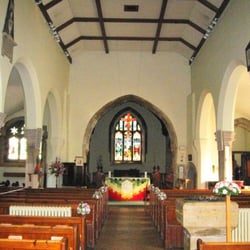
    Southwick is now firmly part of the suburban sprawl running from Brighton and Shoreham, and is…read moreknown to most people for the power station that dominates the far side of Shoreham Harbour. But there was a community here in Saxon times, and its church is surprisingly ancient. In fact, the walk from the station crosses the Green, an attractive and villagey stretch of tree-lined common which splits Southwick into two halves. There are some handsome cottages surrounded by well appointed semi-detached suburban homes, and a rather less appealing row of post-war shops. St Michael and All Angels was, until the 18th century, dedicated to St Margaret, and sits among a very pretty churchyard, thickly studded with trees. Although there was probably a church here in Saxon times, it first recorded in 1086, and in 1206 the right to appoint the rector was granted to the Templars, and then to the Hospitallers, although much of the early mediaeval period was taken up with disputes over these rights with the monks of Sele Priory. The ownership passed from Sele Priory to Magdelene College at the Dissolution, and patronage thereafter passed to the Crown until the 20th century. Fire in the 19th Century damaged the nave and an unexploded bomb (and the subsequent excavation to remove it) damaged the tower in 1941. The church itself is built of flint, and is essentially in three parts: the tower, nave and chancel. The tower is by far the most impressive part: its foundations and lower walls are said to be Saxon, although it mostly dates from the late 12th and 13th centuries. It is an attractive composition, with paired round-headed arches with narrow openings surmounted by paired gothic lancets and, above that, a shingle broach spire. The west door is also attractive, but a modern addition: the tower was carefully taken down and faithfully rebuilt in 1950 after the bomb damage, with vestries built either side. The chancel is mostly 13th century, with two original lancets, framed by a 14th century chancel arch. There are two round headed arches to the south, although the central column probably dates from the Victorian rebuilding. A 14th wooden screen with narrow lancets also survives in the south aisle. The nave burned down in the 1830s and was rebuilt with narrow lean-to aisles in 1834, with round-headed arcades and lancet windows. Pevsner's Buildings of England described the nave as a 'loveless cover for pew-space', which I think is a bit harsh, although there's no doubt it doesn't match the quality of the tower. The furnishings other than the south aisle screen - are limited in interest to what appears to be a mediaeval aumbry, some 18th and 19th century tombs and memorials, and a sturdy, square font, probably from the 13th century. The church is today the centre of large and busy parish, and has a vibrant church life, with services daily through the week.

    Photos
    Church of St Michael and All Angels, Southwick
    Church of St Michael and All Angels, Southwick
    Church of St Michael and All Angels, Southwick

    See all

    Reculver Towers & Roman Fort - Reculver Towers & Roman Fort

    Reculver Towers & Roman Fort

    4.5(4 reviews)
    81.5 km

    Reculver Towers is the remains of a 12th century church, which is located on the remains of Roman…read moreand Saxon buildings. The Towers themselves are perched on the top of a large cliff, which has been heavily eroded in the past and is the reason why there are only partial remains of the church left standing. Due to its location on the north coast, the towers lend themselves to some lovely photographs with the sunset to their rear and the sea to one side. There is a large stony beach at the base of the cliffs, which is ideal for dog walking rather than bathing, as the Thames Estuary leaves it somewhat muddy. Also be aware that the tide can come rather far in at certain times of the year, partially cutting off some areas at the base of the cliffs!! There are reputed to be a decent number of fossils to be found along the beach, especially following storms, though me and the dog have never found anything exciting. There is ample parking in the vicinity of the towers, good paths suitable for wheelchairs and buggies along the cliff top. There is also a pub very close by and a small shop/amusements arcade associated with the nearby caravan park. All in all, a nice place for a picnic or for a stroll.

    A beautiful area to have a picnic on a sunny day. About 3k walk from Herne Bay. Not easily…read moreaccessible by public transport. Very good toilet facilities though, which is important on a picnic! Worth a visit if you're in the area, as it really is a beautiful spot.

    Photos
    Reculver Towers & Roman Fort - Reculver Towers & Roman Fort

    Reculver Towers & Roman Fort

    Reculver Towers & Roman Fort

    See all

    Bodiam Castle

    Bodiam Castle

    4.6(20 reviews)
    20.6 km

    We did lots of castles, cathedrals and abbeys on this years Road Trip through England and Scotland…read more And this here was one of the finest we've encountered. We came by car, there's a huge parking lot with even some options at the shade. If you're a member then parking and entrance is free (scan your card for free parking). At the entrance there's a ticket office, a fine little restaurant and some shops. It's a short walk to the wonderful castle. Pretty flat and goes around the whole site. Dogs are allowed - our Bulldog had a great time. And not just our Bulldog; we did as well. It's a fantastic, well-preserved and well taken care of castle. With the mout surrounding it, it looks just like a "typical" castle you'd imagine. It was built from 1380-1385. By by Sir Edward Dallingridge. He was even promoted by King Richard II himself. So this castle here belonged to a person of great importance. Be sure to check out the interiour as well. It's a stunner from outside, but it's really worth your time going in and on top of it for some great views. There are lots of facilities on the site and also picnic spots with views of the castle. A great place to spend a few hours. One of the highlight of our Road Trip surely. Staff was very friendly and helpful. And be sure to grab a bite at the restaurant by the entrance (jacket potatoes were great).

    This is what a castle should look like. Tall towers, complete ramparts, portcullis, drawbridge and…read morea huge moat. It's every child's dream! Built in 1385, it functioned as both castle and a comfortable late mediaeval home. Now owned by the National Trust, it is set in lovely well-maintained grounds which are perfect for a family picnic. In the summer, there are lots of activities going on (check website for details), with people dressing up as mediaeval knights, jousting and cool stuff like that. For the adults there are also occasional concerts. The site is very family friendly, with the information office supplying all kinds of material to help children (of all ages!) enjoy their visit, and to stimulate their imaginations. The website has excellent information about access for wheel-chair users. The site has ample car-parking, and is close to some other excellent attractions - the Kent & East Sussex preserved steam railway, and the village of Battle where William the Conqueror beat the Anglo-Saxons in 1066.

    Photos
    Bodiam Castle
    Bodiam Castle
    Bodiam Castle

    See all

    Herstmonceux Castle - landmarks - Updated May 2026

    Loading...
    Loading...
    Loading...