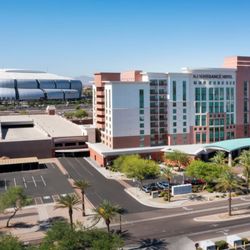
A Disquisition on Hospitality at Tru by Hilton Phoenix Glendale Westgate: Or, How One Man's Virtue…read moreRedeems the Mundane
By Capt. 619, Peripatetic Scholar of Transient Domiciles and Human Excellence
Let us first dispense with the axiomatic: the modern hotel, in its essence, is an exercise in utilitarian homogeneity. A room, as Kant might posit, is a synthetic a priori--a space defined not by its inherent qualities, but by its function. Tru by Hilton Phoenix Glendale Westgate adheres to this universal truth. Its chambers are serviceable, its amenities competent, its aesthetic an echo of the Platonic "Form of the Mid-Tier Lodging." On the scale of Aristotelian potentiality, it achieves a hexad (6/10)--a respectable, if unremarkable, actualization of shelter.
Yet! Here lies the rub: hospitality, as Seneca observed, is not a static condition but a dynamic virtue. And in this locus, virtue found its avatar in Richard, a steward of such magnanimity that he transmuted leaden routine into golden experience.
I. The Telos of Service: Richard as the Unmoved Mover
Each dawn, as Helios' chariot crested the Arizona horizon, Richard greeted guests with a Socratic inquiry: "What may I do to render your day excellent?" Not a hollow pleasantry, but a dialectic--an invitation to co-create eudaimonia. His attentions were neither obsequious nor perfunctory, but precise as Aquinas' Five Ways. Forgotten toothpaste materialized; coffee preferences were memorized with the rigor of a Benedictine scribe; local dining recommendations bore the insight of a seasoned flâneur. In him, the hotel's potential 6 became an actualized 10.
II. The Paradox of Hospitality: Substance vs. Accident
Let us parse the Categories. The hotel's substance (rooms, linens, waffle irons) belongs to the genus "Adequate." But its accidents--the staff, the ethos--are where essence resides. Richard, like Descartes' genius malignus in reverse, dissolved skepticism with each act of grace. A traveler who, like myself, dwells 200 nights yearly in interchangeable abodes learns this: marble foyers fade; human warmth endures.
III. The Ethical Imperative
To proprietors of such establishments, heed Aristotle: "We are what we repeatedly do. Excellence, then, is not an act, but a habit." Richard's excellence is habitual, his ethos contagious. He is the phronimos of hospitality, embodying practical wisdom where others merely follow script.
Conclusion: A Summa of Transient Flourishing
Tru by Hilton is, in itself, a cipher. But within its walls operates a man who elevates the prosaic to the profound. To stay here is to witness a Thomistic proof: Existence precedes essence. The hotel exists; Richard gives it essence.
Verdict: 6/10 (sine Richard); 10/10 (cum Richard). Fellow wayfarers--seek him. For in a desert of mediocrity, he is the oasis.
"Non nobis solum nati sumus."
--Capt. 619, Emeritus Fellow of the Collegium Hospitium et Peregrinationis