The temple is just across the Tiber River from the Vatican…read more
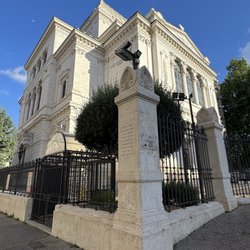
The Great Synagogue of Rome is large and impressive, dominating the square where it sits, and is of a very eclectic style with the only squared dome in the city.
It is rich with symbolism of the past persecution of Jews, who for nearly 300 years until the mid-19th century were forced to make compulsory payments to the popes.
In 1993, under the late Pope John Paul, the first pontiff to visit a synagogue, the Vatican established diplomatic relations with Israel.
Pope Francis visited Rome's Great Synagogue on January 27, 2016 - he made his first visit to a synagogue as Pontiff. During his visit, the pope condemned violence in the name of religion.
--------------------------------------------
I was there that day, and watched this memorable event.
I saw Pope go inside the temple, and coming out. I didn't take any pictures because it was too dark (and too cold), and there was insane amount of security, police, carabiners etc. I took photos of U.S. News crew interviewing people coming out of the Synagogue after the Pope's historic speech.
--------------------------------------------
He denounced all violence committed in the name of God, and joined in the diaspora as a sign of interfaith friendship.
Pope Francis repeated several times the words first spoken by Pope John Paul, saying that Jews were the "elder brothers" of Christians.
Pope Francis spoke of the Holocaust, saying, "I would like to express my closeness to every witness of the holocaust who is still living, in particular all those who are present today." As survivors applauded, he said, "Their suffering, their anguish, their tears should never be forgotten."
HISTORY -
The Great Synagogue of Rome, or Tempio Maggiore di Roma, is the largest synagogue in Rome. The Jewish community of Rome goes back to the 2nd century B.C.
In the city that is the center of the Catholic Church, it's surprising to learn that, after Jerusalem, Rome is the site of the longest continuous Jewish community in the world.
The present Synagogue was constructed shortly after the unification of Italy in 1870, when the Kingdom of Italy captured Rome and the Papal States ceased to exist. The Roman Ghetto was demolished and the Jews were granted citizenship.
On April 13, 1986, Pope John Paul II made an unexpected visit to the Great Synagogue. This event marked the first known visit by a pope to a synagogue since the early history of the Roman Catholic Church. He prayed with Rabbi Elio Toaff, the former Chief Rabbi of Rome. This was seen by many as an attempt to improve relations between Catholicism and Judaism and a part of Pope John Paul II's program to improve relations with Jews.
When the Roman Empire had an alliance with Judea, under the leadership of Judah Maccabaeus, back in 2nd century B.C., many Jews came to Rome from Judea.
During the centuries that followed, their numbers increased, due to the settlement that came with Mediterranean trade. Then large numbers of Jews were brought to Rome as slaves following the Jewish-Roman wars in Judea from 63 to 135 CE.
The history of Italian Jews pre-dates the destruction of the second Temple at Temple Mount in Jerusalem. Thus, they are not Sephardi (from the eastern or Arab countries) or Askenazi (from Eastern Europe), and they have their own rite called Nusach Italki. Even in Hebrew, they are distinct, and called "Romanim."
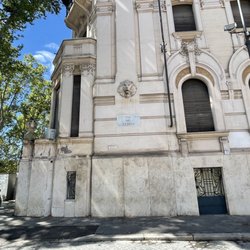
On the more recent note, there is a commemorative plaque in honor of the local Jewish victims of Nazi Germany.
On October 9, 1982, the synagogue was attacked by armed Palestinian militants at the close of the morning Sabbath service. A toddler was killed during that attack. There is a commemorative plaque recognizing the forces behind that attack, a Palestine Liberation Organization.