Cancel

    Open app

    Search

    Cripta dei Cappuccini

    4.8 (22 reviews)
    Open 9:00 am - 7:00 pm

    Cripta dei Cappuccini Photos

    Recommended Reviews - Cripta dei Cappuccini

    Your trust is our priority, so businesses can't pay to alter or remove their reviews. Learn more about reviews.
    Yelp app icon
    Browse more easily on the app
    Review Feed Illustration

    Reviews With Photos

    Brandy G.

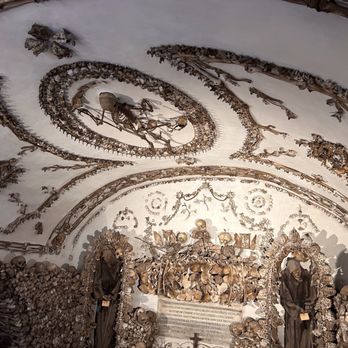
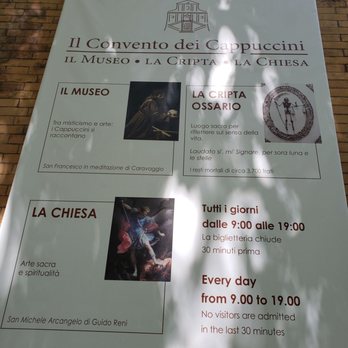
    If you're into the macabre then the Capuchin Crypts are a must-visit when in Rome. Your visit will be separated into two portions. The first an in-depth review of the Capuchin Order and the man who founded the brotherhood centuries ago - St. Francis of Assise . The second half of your visit will of course then be the famous Capuchin Crypts. I highly suggest spending the 8 Euros to purchase the accompanying audio tour that will help you navigate the first portion of your visit in the museum dedicated to helping visitors better understand the Capuchin Order, both historically and in-modern day. It's really quite interesting. The crypts of course are the true showstopper in your visit and will be the final part of your tour before you exit into a gift shop. You'll find yourself in a dimly lit, long hallway lined with 10 or so rooms displaying various artwork scenes created using the bones and mummified bodies of more than 3,000 former monks of the order. It really is something to see and beautiful in its own macabre way. Photography will not be allowed (and is closely monitored), but you can always purchase post cards and books in the gift shop. Skip the lines at the Colosseum and the crowds at Trevi Fountain for the quiet of the Capuchin Crypts.

    Ray L.

    Quite a strange attraction seeing so many human remains used to decorate a series of rooms in this place. They have stacks of skulls and other skeletal parts stacked, used in the design of designs to even light fixtures. You enter the church with a museum with artifacts and written history of the place. The final section is several rooms with the display of the remains.

    A postcard I picked up
    Jessie L.

    Visiting the Capuchin Crypt has been on my bucket list for some time and I am so pleased I finally got to see it in person. Standing in each room, face to face with nearly 4,000 human remains is extremely surreal. I don't think I've ever felt so mortal. Don't get the impression that this is simply a morbid or macabre display, the message is Christian and quite clear and well worth your time. It's definitely an experience that will stay with me for a long time. ___ Entry costs €8.50 per person. You begin by going through a small museum with a collection of Capuchin monk belongings, ect. A Carravacchio painting very much worth seeing and information about some well known monks. The museum leads directly into the crypt which is broken up into four rooms, three of which are adorned in intricate bone-work, skeletons and remains of dressed monks. You aren't allowed photos but there are some postcards in the little gift shop at the end that you can purchase. Remember to dress accordingly, bare shoulders and knees are not permitted as it is a church and crypt. *I feel the need to mention that this is not an underground catacomb. It is a crypt. I'm not sure why some people go expecting the Paris catacombs (???)

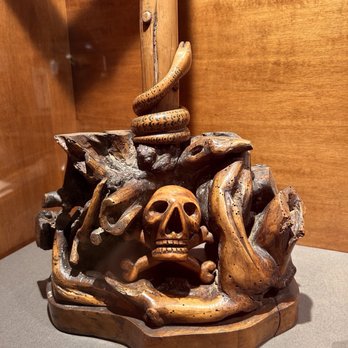
    Bone art.

    See all

    Photo of Sara G.
    222
    1728
    3288

    1 year ago

    Helpful 5
    Thanks 2
    Love this 7
    Oh no 0

    2 years ago

    Helpful 4
    Thanks 3
    Love this 2
    Oh no 0

    1 year ago

    Helpful 1
    Thanks 0
    Love this 0
    Oh no 0

    3 years ago

    Helpful 2
    Thanks 0
    Love this 0
    Oh no 0

    4 years ago

    Helpful 1
    Thanks 0
    Love this 0
    Oh no 0

    6 years ago

    Helpful 0
    Thanks 0
    Love this 0
    Oh no 0

    3 years ago

    Helpful 2
    Thanks 0
    Love this 1
    Oh no 0
    Photo of Greg T.
    359
    1835
    207

    7 years ago

    Helpful 7
    Thanks 0
    Love this 10
    Oh no 0

    4 years ago

    Helpful 0
    Thanks 0
    Love this 0
    Oh no 0

    7 years ago

    Helpful 3
    Thanks 0
    Love this 3
    Oh no 0
    Photo of Ray L.
    33
    727
    34490

    7 years ago

    Helpful 6
    Thanks 0
    Love this 5
    Oh no 0

    10 years ago

    Helpful 4
    Thanks 0
    Love this 4
    Oh no 0

    8 years ago

    Helpful 2
    Thanks 0
    Love this 1
    Oh no 0

    8 years ago

    Helpful 2
    Thanks 0
    Love this 1
    Oh no 0

    5 years ago

    Helpful 0
    Thanks 0
    Love this 0
    Oh no 0

    10 years ago

    Helpful 2
    Thanks 0
    Love this 1
    Oh no 0

    10 years ago

    Helpful 1
    Thanks 0
    Love this 1
    Oh no 0
    Photo of Shell L.
    5
    134
    215

    10 years ago

    Helpful 1
    Thanks 0
    Love this 0
    Oh no 0
    Photo of Paul G.
    6
    781
    1751

    14 years ago

    Helpful 3
    Thanks 0
    Love this 1
    Oh no 0

    Cripta dei Cappuccini Reviews in Other Languages

    Review Highlights - Cripta dei Cappuccini

    Prior to entering the crypt you walk though a museum that explained the history of the order, ect.

    Mentioned in 11 reviews

    Read more highlights

    Verify this business for free

    Get access to customer & competitor insights.

    Verify this business

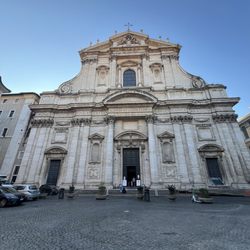
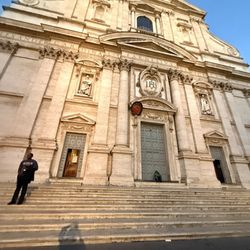
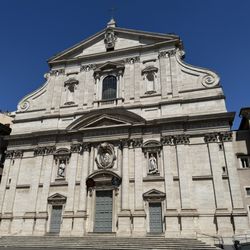
    Chiesa di Sant' Ignazio di Loyola - Outside of Chiesa di Sant' Ignazio di Loyola in Rome, Italy  (pic taken on Tues. 09/30/2025)

    Chiesa di Sant' Ignazio di Loyola

    4.9(30 reviews)
    1.0 kmCentro Storico

    Honestly, save your time and your one euro coin. The church…read moreitself is beautiful, but the entire experience has been completely ruined by social media hype. We waited in line for a literal hour just to reach the famous "selfie mirror" to get a photo with the ceiling fresco. When you finally get to the front, you have to pay 1 euro, and you're rushed through it so fast you can barely even check if the photo turned out.

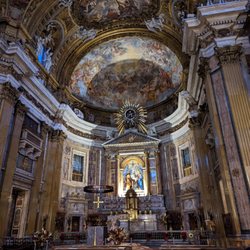
    To think, I almost avoided visiting this STUNNING 17th-century church - Chiesa di Sant' Ignazio di…read moreLoyola, when visiting Rome, Italy (09/25/2025 - 10/01/2025) because it is Tik-Tok and IG "famous" for being the "mirrored church" to take an iconic selfie... yes, you read that correctly..iconic selfie. I was for sure it was going to be crowded w/ social media influencers and I was correct..it was crowded but don't let that deter you from seeing this historical beauty! Chiesa di Sant' Ignazio di Loyola is known as the "mirrored church" because it has a mirror strategically placed to see the beautiful painted ceiling fresco. (see pics & videos included in this review from my visit on Tuesday 09/30/2025 - at 10:56am) It also has a painted illusion of having a real soaring dome on a flat ceiling - very cool for sure and does make you look twice just to confirm it's indeed an illusion! Here are a few helpful fyi(s) that I wanted to pass along: --- - long line for the mirror right as you enter the church - if there is a line of people waiting for the mirror, you don't have to wait in that line if you don't want to take a selfie w/ the mirror and are only wanting to see the church...as someone else mentioned in a previous review, you can get creative w/ taking a selfie w/ the beautiful ceiling. My hubby & I took our selfie pic while we were sitting in the pew and used a timer on our phone (see pic included). ---- visit early to avoid the crowds & to fully enjoy your experience at this church Avoid the crowds so you can really take in how detailed and beautiful the architecture and paintings are. Trust me, you'll enjoy your experience so much more w/ less people. ---- it's free to visit but do bring some money w/ you to give as an offering --- just a reminder to be respectful when visiting because it is a holy place Chiesa di Sant' Ignazio di Loyola truly is something special and of the MANY Rome basilica's I've explored during my 2 visits to Rome, it is now my FAVORITE basilica thus far. Hope this info helps. :)) Rebecca visiting Rome, Italy from Austin, Texas (USA) 09/25/2025 - 10/01/2025

    Photos
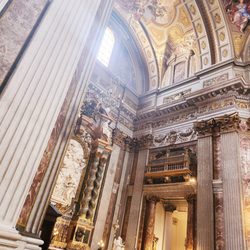
    Chiesa di Sant' Ignazio di Loyola - Inside lighting

    Inside lighting

    Chiesa di Sant' Ignazio di Loyola
    Chiesa di Sant' Ignazio di Loyola

    See all

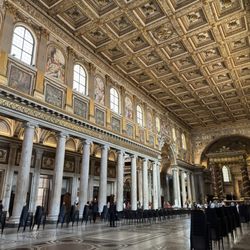
    Basilica di Santa Maria Maggiore - Shrine

    Basilica di Santa Maria Maggiore

    4.6(37 reviews)
    1.2 kmTermini

    We arrived in Rome by train in the early evening, but we wanted to make the most of the remainder…read moreof our day. We took a bus over and ate a quick dinner nearby before getting in line for the Basilica di Santa Maria Maggiore 30 minutes before closing. Entrance is free. There is a security check before entering and the line moved pretty quickly. The Basilica di Santa Maria Maggiore is one of the four basilicas in Rome and it is dedicated to honoring the Virgin Mary. Tradition holds that the Virgin Mary appeared in a dream to a wealthy Roman couple and Pope Liberius, instructing them to build a church where snow would miraculously fall in August. The next morning, August 5th snow reportedly blanketed the Esquiline Hill, marking the site of the basilica. Every August 5th, white rose petals are dropped from the ceiling to celebrate the "Miracle of the Snow." The interior was absolutely stunning. From the ceiling to the walls, and all of the paintings and sculptures were magnificent. This basilica houses some of the oldest representations of the Virgin Mary in art. It also holds the holy crib relic that contains pieces of the manger where Jesus was laid. This was the first basilica we visited in Rome and we also saw how there were multiple confession boxes with a Priest assigned and their language and hours. Very modern. I guess that helps with people of all ethnic backgrounds coming to Rome for their religious pilgrimages. I was so impressed by this basilica when we visited, but to be honest I am so glad we came here before seeing St Peter's Basilica because I would have been underwhelmed by compare if I went there first. I recommend coming here before going to St. Peter's Basilica so you can feel impressed here, and then even more impressed at St Peter's Basilica.

    Such a special moment getting to pay our respects & visit the resting place of Pope Frances during…read moreThe 2025 Jubilee (on Thursday, September 25, 2025 at 4:30pm) at the Basilica di Santa Maria Maggiore (St. Mary Major) when my husband & I were visiting Rome, Italy for the 2nd time (09/25/2025 - 10/01/2025). Even though, this was our 2nd time in Rome, we had not previously visited the Basilica di Santa Maria Maggiore so for sure it was on the itinerary as a must-do for a few special reasons - - ---- Final resting place of Pope Frances after his death in April 2025. The Pope requested his tomb to very simple w/ only the inscription of "Franciscus" & it is exactly that, which only makes it even more special. During our visit (Thursday, 09/25/25) there was a line to get in however, we only had to wait about 20 mins before getting inside the basilica. I did want to mention that when we walked by a few days later on a Saturday, the line to get in was so much longer than it was just a few days before during the weekday so definitely plan your visit for a weekday, if possible. --- Holy Door : There is a Holy Door located at this basilica, which is only opened every 25 years during the Jubilee years and 2025 is a Jubilee year so we were able to walk through the open Holy Door when we visited on 09/25/2025. You don't have to be Catholic and/or religious to walk through the holy door and trust me, it is a very special moment for all who walk through the holy door at this grand basilica. Fyi(s): -- - Security line: during our visit, we did have to go through security screening before entering the basilica however, I don't know if this was because it was a Jubilee year and/or if this is how it will be even after it is no longer a Jubilee year now that Pope Frances is buried at this basilica. (I guess I'll have to make a 3rd trip to Rome do I can give an update on this review! :)) -- - Be respectful w/ no photos/videos inside the basilica. This one always rubs me the wrong way, when there are signs clearly posted both outside and inside a basilica stating that no pics/videos are allowed and this basilica even had an attendant near Pope Frances's stone, trying to enforce this however, people kept taking photos and videos. Please note that the pics/videos, included w/ this review were taken of the outside. -- - Free to visit : No appointment is needed to visit & it is free however, I do recommend that you take some money w/ you so you can give an offering during your visit. Hope this info helps! Rebecca visiting from Austin, Texas (USA) 09/25/2025 - 10/01/2025

    Photos
    Basilica di Santa Maria Maggiore
    Basilica di Santa Maria Maggiore - The Basilica's baldachin

    The Basilica's baldachin

    Basilica di Santa Maria Maggiore

    See all

    Santa Maria della Concezione

    Santa Maria della Concezione

    4.9(14 reviews)
    0.1 kmCentro Storico

    Right next to the Church of Santa Maria della Concezione dei Cappuccini (that rolls off the tongue…read morelike a Latin exam you didn't study for), this museum is part chapel, part crypt, and part humble brag for the Capuchin friars, the Franciscan branch known for vows of poverty, haircuts, and a surprising flair for interior bone design. Did we come to this museum to learn about the friars, Mmmmmm. Ok maybe. You'll walk through exhibits showing how these robed legends brewed up herbal potions, lived in literal caves, and humbly redefined the phrase less is more. We really came for the Caravaggio. Turn the corner, and there it is, the Caravaggio's "St. Francis in Meditation", just casually hanging there like it's no big deal. Spoiler: It is a big deal. This moody masterpiece punches you in the soul. Saint Francis looks like he's just remembered his iCloud password and is deeply not okay with it. Shadows engulf him, light hits him like a holy spotlight, and suddenly you're questioning all your life choices in front of a painting that's older than the United States. Caravaggio, ever the art world's tortured bad boy, painted like he lived, fast and bold, and usually on the run from the law. His contribution here adds gravitas to an already gravity-heavy museum, where death is literally the décor.

    Also know as " The Crypt of the Capuchin Monks"…read more Absolutely creepy as hell, but worth every minute spent here. This place is fantastic. My wife, son and nephew and I thoroughly loved it. It can be a little hard to find, but all that's expected is a small donation and a promise not to take pictures. The ones that I've included are from their website and the Internet. Here's some additional information: "The crypt is located just under Santa Maria della Concezione, a church commissioned by Pope Urban VIII in 1626. The pope's brother, Cardinal Antonio Barberini, who was a member of the Capuchin order, in 1631 ordered the remains of thousands of Capuchin friars exhumed and transferred from the friary Via dei Lucchesi to the crypt. The bones were arranged along the walls, and the friars began to bury their own dead here, as well as the bodies of poor Romans, whose tomb was under the floor of the present Mass chapel. Here the Capuchins would come to pray and reflect each evening before retiring for the night. The crypt, or ossuary, now contains the remains of 4,000 friars buried between 1500 and 1870, during which time the Roman Catholic Church permitted burial in and under churches. The underground crypt is divided into five chapels, lit only by dim natural light seeping in through cracks, and small fluorescent lamps. The crypt walls are decorated with the remains in elaborate fashion, making this crypt a macabre work of art. Some of the skeletons are intact and draped with Franciscan habits, but for the most part, individual bones are used to create elaborate ornamental designs. The crypt originated at a period of a rich and creative cult for their dead; great spiritual masters meditated and preached with a skull in hand. A plaque in one of the chapels reads, in three languages, "What you are now, we once were; what we are now, you shall be." This is a memento mori." Thank you Wikipedia. Well worth the visit, and there are some excellent restaurants close as well.

    Photos
    Santa Maria della Concezione
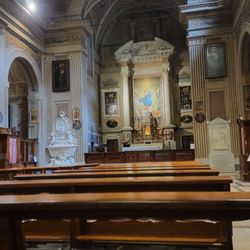
    Santa Maria della Concezione - The church Pews

    The church Pews

    Santa Maria della Concezione

    See all

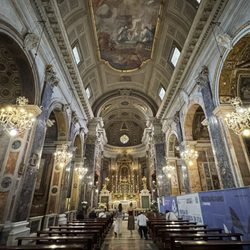
    Santa Maria in Via - Inside with a view of the main altar and the ceiling fresco

    Santa Maria in Via

    4.3(4 reviews)
    0.6 kmCentro Storico

    The Santa Maria in Via church was founded in Rome during the dark ages, but it wasn't formally…read moreestablished as a parish church until 1205. Note that it is not the nearby church of Santa Maria in Via Lata. Santa Maria in Via is regularly translated into "Our Lady in the Street" in English; however, some historical documents gave the parish other names. The church gained fame on September 26, 1256 when the well in the yard of 13th-century Cardinal Pietro Capocci flooded and overflowed with a painted terracotta tablet of the "Blessed Virgin" miraculously floating in the water. From that event, the dedication of the church is to the Blessed Virgin Mary with a special title of Our Lady of the Well (Madonna del Pozzo). The first chapel on the right is the Cappella della Madonna del Pozzo (aka the Well Chapel) which was built in 1491-1513 on the orders of Pope Innocent VIII around the actual holy well from 1256. Upon completion in 1513, Pope Leo X granted the church to the Servite Order which still serves the church and parish. The chapel was constructed with funds from Monsignor Giovanni Battista Canobi whose memorial is on the left side of the chapel. The altarpiece in the Cappella della Madonna del Pozzo contains the original iconic 13th century tile after being framed in polychrome marble and alabaster in 1646 following a Papal decree. The building (including other chapels) we see today was completed between 1592-1609 under the supervision of Italian architects Francesco da Volterra and Carlo Lombardi. The travertine limestone façade was designed by the famous Italian Renaissance architect (and Michelangelo collaborator) Giacomo della Porta who worked on many beautiful fountains and churches throughout Roma including St. Peter's Basilica. The front wasn't actually completed under the direction of Baroque Italian architect Carlo Rainaldi in 1681. The Latin inscription on the front reads "Deo in hon Mariae virginis matris Dei, dd a MCCLVI" meaning "Dedicated to God in honor of the virgin mother, 1256 AD." The interior has single nave with four chapels on each side. Besides the chapel of the well, the right side has ornate chapels dedicated to St. Philip Benizi, the Annunciation, and the Holy Trinity. On the left are chapels to St. Andrew, the Sacred Heart or Jesus, the Seven Holy Founders of the Servite Order, and St. Pellegrino Laziosi (patron of cancer sufferers). Obviously, the Santa Maria in Via church is more impressive than most churches in your hometown even though it is just one of 900 Catholic churches in Rome. The history and inspiration it offers shouldn't be discounted just because isn't ranked among the most influential in the city. In addition, it now serves as a national church in Rome for the devout Ecuadorian community. Except during mass, the church is open to visitors on weekdays from 7:15 a.m. - 8:00 p.m. and on Sundays from 8:00 a.m. - 10:00 p.m. September is a busy time in the church including the feast of the Madonna of the Holy Well on September 8 and a night vigil on September 26, the anniversary of the miracle of the well.

    A little gem of a church, there are so many in Rome! Peered in for a peek when walking past…read more There's always something about the formal, austere exteriors that makes me wonder what's inside, and I'm usually awed by the ornate details within!* One could say a the majority of these churches have some resemblance to each other, similar cross shapes with a longer nave, then shorter arms at left and right towards the front altar, a number of smaller chapels along the sides. This one is no different. Colored marble in tones of grey and shallow crimson, Baroque architectural details, and a beautifully restored fresco on the nave ceiling. The story of this church pertains to a well located in the stables that once stood here, belonging to Cardinal Pietro Capocci, which one day in the 13th century overflowed carrying a stone slab with an image of the Virgin Mary. Following which Pope Alexander IV decreed a chapel be built in this location, dedicated to the Madonna. To this day there is a small tap in one of the chapels on the right after entry that allows parishioners to take a sip of this water from the ancient well below. Interesting storyline--it's like learning about the esoteric parts of history not in textbooks. Spent about 5 minutes looking around, a quick stop for sure! Free to enter and they are open pretty early and late too: 7:15am-7:45pm Tues-Sat 8:30am-9:30pm Sunday 7:15am-1pm and 4-7:45pm Monday For more info: https://www.turismoroma.it/en/places/church-santa-maria-madonna-del-pozzo *Maybe it's because we have so much less of these type of medieval/gothic/classical/baroque/romanesque styles of architecture represented in the States, when I have the opportunity to walk past a church every so often in Europe, it behooves me to scratch that itch and see what's behind each doorway.

    Photos
    Santa Maria in Via - Inside

    Inside

    Santa Maria in Via - The nave of Santa Maria in Via (built 1491-1513)

    The nave of Santa Maria in Via (built 1491-1513)

    Santa Maria in Via - Entering Santa Maria in Via Basilica from the front entrance

    See all

    Entering Santa Maria in Via Basilica from the front entrance

    Basilica di Santa Maria Sopra Minerva

    Basilica di Santa Maria Sopra Minerva

    4.7(6 reviews)
    1.2 kmCentro Storico

    lWe spent three nights at a hotel in the Piazza della Minerva and walked into this church because…read moreit was right there. After a week in Rome, we weren't surprised to find that this random neighborhood church was, in fact, an impressive basilica. Naturally, it has its own Wikipedia page. Basilica di Santa Maria sopra Minerva, or the Basilica of Saint Mary above Minerva, is a minor basilica church, consecrated in 1370. It's a beautiful gothic church with a ton of art, including its own Michelangelo statue, the Cristo della Minerva. There was a helpful map showing where to find the art--though it was strangely bootleg, made with clipped print-outs and construction paper like a diligent child's school project. Unfortunately, the church was undergoing some kind of renovation when we went in, and a lot of the interior was inaccessible, including the area with the Michelangelo. The church was gorgeous, though, even with construction scaffolding all over the place. Lots of marble, which almost goes without saying, and a striking vaulted ceiling, painted bright blue with colorful religious figures and a sparkly smattering of gilded stars. We only went in for five to ten minutes, and I'm sure we missed plenty in this cursory visit. I'm glad we peeked in, though. It was a quick, rewarding thing to do on our last day of wandering around Rome. If you find yourself around Piazza della Minerva, the basilica is quiet and free and well worth checking out.

    Absolutely must see if you're a fan of art and architecture…read more This spot is often overlooked because it's near the Pantheon. Not only does it have the famous elephant obelisk outside but inside it's amazing. It's the only church in Rome that's done in the gothic architecture style. Once inside, people often walk right past a genuine Michelangelo sculpture. Note- he did not cover Jesus up, that golden fabric looking part was later added due to the church wanting modesty.

    Photos
    Basilica di Santa Maria Sopra Minerva
    Basilica di Santa Maria Sopra Minerva
    Basilica di Santa Maria Sopra Minerva

    See all

    Basilica di Santa Maria degli Angeli e dei Martiri

    Basilica di Santa Maria degli Angeli e dei Martiri

    4.5(13 reviews)
    0.7 kmCentro Storico

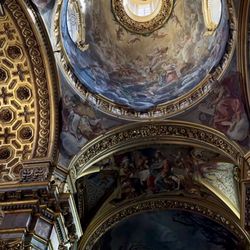
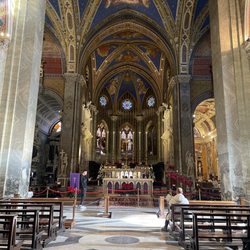
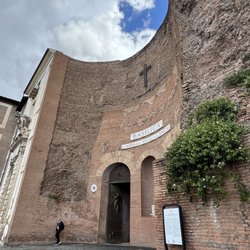
    Ancient peoples used to be more tolerant of reusing existing buildings for new purposes, instead of…read morethe tearing down and reconstructing using inferior techniques we see today, and this church is a prime example. At the behest of Pope Pius IV based on a request by Sicilian priest Antonio del Duca, this church was designed in 1562 with input from Michelangelo within the former frigidarium* of the Terme di Diocleziano ancient baths. Work continued after Michelangelo's passing through Giacomo Del Duca, Antonio's nephew and protege of Michelangelo. The works lasted until the middle of the 18th century with Luigi Vanvitelli undoing some of the modifications of his predecessors post Del Duca, and transferring some of the altarpieces from Saint Peter's Basilica here. The ornate interior of this basilica contrasts with its simple, comparatively anachronistic facade. It's really a sight to behold and very different inside with a soaring nave and transept of colored marble columns, vibrant frescoes, beautifully hewn patterned marble floors. A special feature of the dome is a stained glass lantern that seals the oculus, of which the original function during Roman days was a hole letting in rain water into the bathing pools below. Replacing the ones by Michelangelo and Del Duca due to inclement weather considerations, Italian artist Narcissus Quagliata's version is the one visible today. With a diameter of about two meters, it's partitioned into eight wedges with twenty-four multi-colored glass plates, inside which are three astronomical lenses placed at different heights, angled to concentrate the sun's rays downwards. Together they project a beam of light onto the floor of the basilica that reaches the exact center of the floor at noon daily. What a feat of mathematical engineering! Today this space is a functional Catholic parish, setting for special events like weddings or state funerals for public figures. Visitation is free of charge. Highly recommend a visit! *central classroom. Not refrigerator. Baths used to be centers of society and discourse in ancient Rome.

    The Basilica of Saint Mary of the Angels and Martyrs can be easily missed. It doesn't look like…read moremuch from the outside but the interior is beautiful. It was built in the 16th century based on a design by Michelangelo. The basilica is a fantastic construction with beautiful frescoes, paintings and sculptures. It is well worth visiting, you won't be disappointed.

    Photos
    Basilica di Santa Maria degli Angeli e dei Martiri
    Basilica di Santa Maria degli Angeli e dei Martiri
    Basilica di Santa Maria degli Angeli e dei Martiri

    See all

    Cripta dei Cappuccini - churches - Updated August 2026

    Loading...
    Loading...
    Loading...