Goodman Crescent Photos


Recommended Reviews - Goodman Crescent
Start your review...



15 years ago
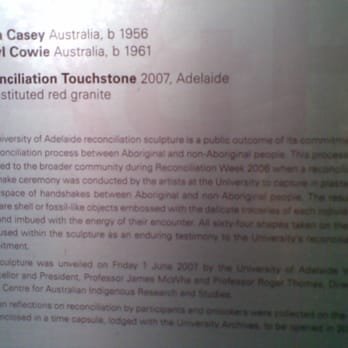
Goodman Crescent is a small grassed area on North Terrace just within the gates of the University of Adelaide, boardered by Bonython Hall and the Mitchell Building. It is a lovely peaceful little place, and is a popular hangout for students on days where the weather is fine. Goodman Crescent contains three sculptures of markedly different styles and significance. The first two are bronzes in the classical realist tradition, depicting Sirs Thomas Elder and Walter Hughes, both gentelmen of white colonial backgrounds, who made significant contributions to the University of Adelaide. Sir Elder, incidentally, was responsible for the introduction of Camels to Australia. I believe that the sculptor in both instances was Alfered Drury, who was also responsible for a number of other sculptures along North Terrace. In each case the sculptures show terrific workmanship and draw out the characters of the men depicted. Sir Elder, a highly successful businessman, is depicted standing, high upon a pedestal, hand upon hip and jacket boldly outthrust. His arrogance almost reeks from his stance. Sir Walter Hugehs, considered to be the father of the university is depicted seated and stern. More of a man of letters than his counterpart, although highly successful in his own right, his rigid form gives an air of magesty, albeit a cold majesty at that. In direct contrast to the above is the contemporary work Reconciliation touchstone by Karen Casey and Darryl Cowie. Unveiled in 2007, the Reconciliation touchstone presents rythmical geometric solids formed by the division of a square prism with a sinusoidal cut. On the inside of the cut the smooth surface of the rhythmical solids is warped by shell or fossil like bumps. These bumps were formed by the casting by the artists of the negative spaces produced by the shaking of hands of indigenous and non-indigenous Australians during Reconciliation week 2006. The culpture is representative of the continued efforts towards reconciliation between the indigenous and non-indigenous in Australia and a tesimony to the university's reconiliation efforts. . read more




More info about Goodman Crescent
North Tce
Adelaide South Australia 5000
Australia
Adelaide
Directions
Hours
Outdoor Amenities