Cancel

    Open app

    Search

    Fort Denaud Cemetery Photos

    Recommended Reviews - Fort Denaud Cemetery

    Your trust is our priority, so businesses can't pay to alter or remove their reviews. Learn more about reviews.
    Yelp app icon
    Browse more easily on the app
    Review Feed Illustration

    3 years ago

    Helpful 13
    Thanks 2
    Love this 10
    Oh no 0
    Photo of Ariel W.
    4395
    5923
    104133

    6 years ago

    Helpful 58
    Thanks 1
    Love this 49
    Oh no 0

    Verify this business for free

    Get access to customer & competitor insights.

    Verify this business

    Downtown LaBelle Historic District - Downtown LaBelle Historic District

    Downtown LaBelle Historic District

    (2 reviews)

    LaBelle had its beginning as a settlement in the 1880's. Captain Francis A. Hendry, a Condederate…read moreofficer during the Civil War purchased land after the war for his home and a large cattle ranch. He founded the town of LaBelle naming it after his daughters Laura June and Carrie Belle. Tcounty of Hendry Florida was Captain Hendry. In the early 20th century E. E. Goodno began purchasing land in the LaBelle area from Francis A. Hendry eventually owning the majority of the Hendry holdings. Goodno's additions to LaBelle soon grew the town to twenty times the size of the original subdivision. The Downtown LaBelle Historic District is a U.S. Historic District in LaBelle Florida that was designated on March 25, 1999. The three acre district is on the 300 Block of North Bridge Street. It contains nine historic buildings that reflect the development of this rural community between the years of 1911 to 1945. The buildings in the district were used for business, social gatherings, and housing. The primary architectural style is Frame Vernacular. There is also a Mediterranean Revival and Moderne style of the type that was popular in Florida during the 1920s to the 1940s. The Curtis Honey House is located in a mercantile from the 1920's. It has been a landmark here since 1954 selling locally produced honey and honey product. Rudy and Maggie's Me & My Girls Antiques and Home Decor in the historic Susan Doub Store and has become a destination for both collectors and browsers. The LaBelle Heritage Museum in located in the Historic 1912 William Hardy Poole Store & Residence. These are just a few of the historic buildings in this district. The historic district of downtown LaBelle is small and very charming. The district is anchored by the beautiful Barron Park on the the Caloosahatchee River. A stroll down the street is like a walk back to a simpler time. The city is currently at work trying to attract more businesses into this area.

    This marker is located in front of Barron Park where Park Avenue meets Bridge Street as you enter…read moreLaBelle from the north. It is in excellent condition and has the same text on both sides. It reads, "Downtown LaBelle Historic District. In 1895, prominent landowner and cattleman Captain Francis A. Hendry (1833-1917) platted a townsite at LaBelle, which was first settled as a center for cattle and citrus industries. A post office, general store, school, and a church were eventually built, and LaBelle became the first town and commercial center in what became Hendry County. Although Hendry is credited with settling LaBelle, E.E. Goodno (1858-1936), who purchased Hendry's former land holdings in 1903 and financed many of the town's first improvements, is recognized as the "Father of LaBelle." LaBelle's historic business district extends along and near Bridge Street from the Caloosahatchee River south to Hickpockee Avenue. At one time, both sides of the street were lined with commercial establishments, some of which featured living accommodations on the second floor. Sadly, many early downtown buildings were destroyed in a 1928 fire, but some have survived, including the Poole Store (1911), First Bank of LaBelle (1925), the Royal Poinciana/Newcomb Bakery (1911-1912 --one of the buildings constructed for both commercial and residential use). The Downtown LaBelle Historic District is listed on the National Register of Historic Places. I did not spend much time in LaBelle and will be looking forward to returning. [Review 14818 overall, 320 of 2021, number 1307 in Florida.]

    Fort Thompson

    Fort Thompson

    (1 review)

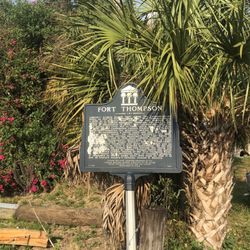
    In the 1800's white settlers flooded into Florida and the government became determined to relocate…read moreall Native Americans west of the Mississippi. This forced removal policy sparked the Second Seminole War 1835-1842. As the Seminoles fled south into Florida to evade capture and being sent out west, they moved into the Everglades in order to hide. In response the army set up forts south of Tampa to the east coast along rivers as they chased after the Seminoles who were much more skilled at surviving in the terrain than the soldiers. Fort Thompson was one of these forts and it was established in 1838 as a military post to store supplies for the Seminole Wars. The fort was named Lt. Colonel Alexander Thompson, who died in the battle of Okeechobee in 1837. I was able to watch a recreation of the Battle of Okeechobee earlier this year and I learned a lot more about the battle. All that remains of the fort is the marker that signifies where it was built. The marker was placed by the LaBelle Heritage Museum. The last remnants of the fort were washed away with the dredging of the Caloosahatchee River. The Confederate army used this land during the Civil War to raise cattle. After the Civil War a community named Thompson built up around the old fort because it was the best place to cross the Caloosahatchee River for miles around. Confederate Captain Francis Asbury Hendry purchased the property in 1879 which he used it for his home and a cattle ranch. Hendry founded the town of LaBelle in the late 1880's along the western edge of the property, named for his daughters Laura Jane and Carrie Belle. Hendry County is named in honor of Captain Hendry. In 1885 steamboat service began between Fort Myers and LaBelle. Fort Thompson was purchased in 1905 by Edgar Everett Goodno who built an ice and electric plant. Goodno built the Fort Thompson Park Hotel on the site which brought many people to the area including Thomas Edison and Henry Ford. Ford purchased part of Goodno´s property in 1924 and it renmained in his name until 1942 when he sold it to one of Captain Hendry´s cousins, Joseph B. Hendry. The old Fort Thompson Park Hotel was torn down in the early 1940's. The historical marker erected on this site is a bit difficult to see and is faded. It is next to the gate of a private home located on SR80 just east of the City of LaBelle, FL. Five stars for the history of this place.

    Captain Francis A. Hendry House

    Captain Francis A. Hendry House

    (1 review)

    As a fan of historic architecture I was excited to find this structure on a recent trip to Labelle…read more The house is located at 512 Fraser Ave. next to the LaBelle Nature Park. This historic vernacular one and one and a half story home was built in 1914 for Captain Hendry who fought in the Confederate Army in the Civil War. After the war Hendry became a cattle rancher. Hendry hired self taught builder Benjamin F. Magill to supervise the construction of his home in the town of LaBelle which he founded on the western end of his vast ranch holdings in Monroe County. Hendry moved into the home at the age of 81 with his wife. Due to his poor health, Hendry was only able to live in the house for a few months before moving to Fort Myers for better access to medical care. He passed away in 1923 and his final resting place is a private family cemetery in Fort Myers. When Hendry County was formed in 1923 it was named after Captain Hendry. This is is the only surviving structure left associated with him. After Hendry's death, the house had numerous owners through the years. On February 5, 1998, it was added to the U.S. National Register of Historic Places. The house is not open for visitors. It looks like construction is being done on the stairs and porch. It was still fun to peek in the windows and around the outside. I love the huge wraparound porch. It looks like there are a few period furnishings inside and historic photos on the wall. I saw online that LaBelle uses the grounds for outdoor events and weddings.

    Fort Denaud

    Fort Denaud

    (1 review)

    As white settlers flooded into Florida the government became determined to relocate all Native…read moreAmericans west of the Mississippi. This forced removal policy sparked the Second Seminole War in 1835. The Seminoles fled south into Florida to evade capture and being sent out west and they moved into the Everglades in order to hide. In response the army set up forts south of Tampa to the east coast along rivers as they chased after the Seminoles who were much more skilled at surviving in the terrain than the soldiers. Fort Denaud was established by Captain B. L. E. Bonneville and troops of the 7th Infantry in 1838 on the the south side of the Caloosahatchee River. The fort was named in honor of Pierre Denaud, A French-Canadian trapper who had traded with the Seminoles and who owned land in the area in the 1830's. The fort consisted of a blockhouse with tents around it and it served as a supply depot for troops in Lake Okeechobee. The stockade at the fort guarded a bridge over the river on a military highway between Fort Myers and Fort Meade. The Fort Denaud historical marker marks the site of the blockhouse at Fort Denaud. Fort Denaud was closed after the end of the Second Seminole War and reopened at the beginning of the Third Seminole War in 1855 under Brevent Major William Hays. Soldiers added a hospital, guardhouse, jail, Sutler's store, and stables. A fire ravaged the fort in 1856 and it was rebuilt two miles downstream on the north side of the river. The fort was abandoned in May of 1858. After the war settlers moved into the town of Fort Denaud that sprang up and began farming sugar cane and citrus but most of them left after the fort was abandoned. Although there is no trace of the fort a few historic structures still remain. Today the area is mainly citrus groves and a new housing development.

    Fort Denaud Bridge - Fort Denaud Bridge, LaBelle

    Fort Denaud Bridge

    (2 reviews)

    Swing bridges are pretty awesome and I'm a little bummed that there wasn't any traffic on the…read moreCaloosahatchee River this morning to see it open. It's right there in the name: swing bridge. When opening, the bridge swings horizontally on the central pivot. They're generally cheaper to build and operate as they don't require the heavy counterweights for a bascule or draw bridge. The Fort Denaud Bridge was built in 1963 and, as Ariel W. points out in her review, is 434.7 feet from end to end. When closed, it has a clearance of 8.9 feet to the water below. It is one of the few remaining swing bridges in Florida, including the Boca Grande Swing Bridge in Charlotte County (about an hour west). I've also seen the Southport Maine Swing Bridge https://www.yelp.com/biz/southport-swing-bridge-southport?hrid=XRV4yJRMiSNPuQaTZB9bYA and caught the New Bedford - Fairhaven Bridge opening https://www.yelp.com/biz/new-bedford-fairhaven-bridge-new-bedford?hrid=nnr8b8LqYCW_JOtDZv2iFg. The bridge was not initially constructed here. The bridge had been on the Intracoastal Waterway in Pompano Beach (about 120 miles away, southeast). Did they float it here or bring it over the road? I don't know. There is no toll to cross the bridge. [Review 19284 overall - 1632 in Florida - 254 of 2023.]

    The Fort Denaud Bridge is a 435 foot historical swing bridge built in 1963. The bridge was…read morepreviously used in Pompano Beach and brought here to replace another bridge that was condemned and removed in the early 1960's. The bridge is 434.7 feet long from end to end and has a vertical clearance of 8.9 feet over the river. The bridge allows cars to cross over the Caloosahatchee River. The bridge was rehabilitated in 1987. The Fort Denaud Bridge is named for Pierre Denaud a French Canadian trapper who traded with the Seminoles and owned land here in the 1830's. The bridge is located at Fort Denaud, the site of a military encampment in the early 19th century. When a boat wants to pass under the bridge, the captain calls the bridge tender who walks out to the middle of the bridge and cranks the machinery to turn allowing it to swing open to allow the boat traffic to pass down the river. It is one of only three swing bridges in SW Florida. I was surprised to learn that this bridge was from Pompano Beach, the town next to where I live. It must have been quite an ordeal to bring it over here. I have previously visited the Snow-Reed Swing Bridge, another historic swing bridge in Ft. Lauderdale. I love these bridges and their history and it is always fun to watch when they swing open. Unfortunately there weren't any boats coming down the river today. It is still a pretty bridge and enjoyed my walk over it.

    Fort Denaud Historical Marker - Fort Denaud Historical Marker, Labelle

    Fort Denaud Historical Marker

    (1 review)

    Located adjacent to the Fort Denaud Swing Bridge that crosses the Caloosahatchee River, this marker…read morepoints out the fort that used to be here but was abandoned in 1858. The marker is on the side of the road which is not quite wide enough to stop to view and read. The sign is in excellent condition and reads, "The combined pressure of growing white settlement in Florida and federal policy of relocating Indian tribes west of the Mississippi sparked the outbreak of the 2nd Seminole War in 1835. Controlling the coasts and campaigning in the heart of Seminole lands were the objectives of Major General Thomas Jesup in 1837. Captain B.L.E. Bonneville established Fort Denaud in 1838 as one of a series of posts linking American operations south of Tampa to the east coast. It was constructed on the south bank of the Caloosahatchee River 27 miles from Fort Myers on land owned by Pierre Danaud, a French Indian trader. The fort consisted of tents with a blockhouse in their midst. It served as a supply depot for troops in the Lake Okeechobee area and was utilized intermittently until the war ended in 1842. Fort Denaud was reopened in 1855, soon after the outbreak of the 3rd Seminole War. Additions included company quarters, hospital, guardhouse, sutler's store and stables. A few months after a fire ravaged the post in June 1856, another site on the north bank of the river one mile west was chosen. The fort, which was abandoned in May 1858, gave its name to the nearby community of Fort Denaud." [Review 19282 overall - 1631 in Florida - 252* of 2023.] *As my 252nd review of 2023 on the 63rd day of 2023, I am now caught up to an average of 4 reviews per day for the year.

    ECHO Global Farm - Jane our guide

    ECHO Global Farm

    (14 reviews)

    What a great stop ! I had heard about this place from a…read morelocal nursery so I decided to stop in. Wonderful tour and tour guide ( Jane). Easy, flat walking tour (or you can ride in their golf cart). Jane was great as a tour guide, with a wealth of knowledge and an easygoing style of sharing information. What an incredible amount of plants here ! While their focus is more on edible plants and plantings, there was more than enough for people interested in colorful or blooming plants and trees. Beautiful setting, like walking through a tropical arboretum, lush and tropical. We were given samples of probably a dozen leaves to eat or smell through our tour. It really opened my eyes to trying to plant a few things that I hadn't considered before. There's also a small gift shop with some unique items as well as a nursery/garden center with some of the many plants that we had seen on our tour. Nice variety and decent prices !

    Such a neat place to visit and learn from, especially if ur into gardening or creating a food…read moreforest in SWFL. Christian organization who explains their mission, accepts volunteers and does homeschool tours as well. Great to c various items growing in r climate - quinoa, buckwheat, broccoli, etc. Really wanted to c the local spinach, but they didn't have it during r visit. Assumed SWFL was too hot for sheep, but they had some living comfortably on property so now we're motivated to look into getting some. Also liked how they had them elevated w/slatted floors so the waste dropped down and fertilized the ground below or could be collected to fertilize crops. Various examples of how to create water filtration with what u have on hand. R tour guide was a really lovely older gal - very personable, upbeat, excited to share what's happening at ECHO. Definitely an asset to the organization, especially as it seems many of these people r volunteers so there is a lot of volunteer opportunity for those interested. A couple things I didn't care for....some pushing of the climate change narrative, there was an example/demo of pond water put into a plastic disposable water bottle and how u could just put that bottle into the sun to kill off the bacteria (of course the plastic carcinogenic chemicals can leech into the water when u leave those bottles in the sun so maybe not a great thing to push) & they had an outhouse for people to use that includes a composting toilet where they use the diluted waste on crops. Ummmm.....human waste of lots of unknown visitors is going to have remnants of medications/drugs and then putting that onto crops would b antithetical to natural/chemical free gardening. Anyway, at the end of the tour they have a gift shop w/some cool items. Love the earthy, natural options. They have lots of seeds, some snacks, and even got some bamboo dental floss that was pretty nice. It's about $12 for the tour. It's a walking tour, but terrain is very flat and easy. Go check it out!

    Fort Denaud Cemetery - landmarks - Updated May 2026

    Loading...
    Loading...
    Loading...