Cancel

Open app

Search

Foredown Tower

3.5 (2 reviews)
Closed • Closed

Foredown Tower Photos

Recommended Reviews - Foredown Tower

Your trust is our priority, so businesses can't pay to alter or remove their reviews. Learn more about reviews.
Yelp app icon
Browse more easily on the app
Review Feed Illustration
Photo of Marc R.
8
248
264

16 years ago

Helpful 0
Thanks 0
Love this 0
Oh no 0
Helpful 0
Thanks 0
Love this 0
Oh no 0

Verify this business for free

Get access to customer & competitor insights.

Verify this business

Church of St Michael and All Angels, Southwick

Church of St Michael and All Angels, Southwick

(1 review)

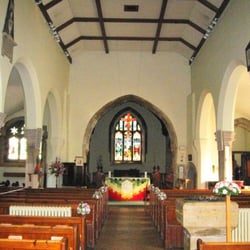
Southwick is now firmly part of the suburban sprawl running from Brighton and Shoreham, and is…read moreknown to most people for the power station that dominates the far side of Shoreham Harbour. But there was a community here in Saxon times, and its church is surprisingly ancient. In fact, the walk from the station crosses the Green, an attractive and villagey stretch of tree-lined common which splits Southwick into two halves. There are some handsome cottages surrounded by well appointed semi-detached suburban homes, and a rather less appealing row of post-war shops. St Michael and All Angels was, until the 18th century, dedicated to St Margaret, and sits among a very pretty churchyard, thickly studded with trees. Although there was probably a church here in Saxon times, it first recorded in 1086, and in 1206 the right to appoint the rector was granted to the Templars, and then to the Hospitallers, although much of the early mediaeval period was taken up with disputes over these rights with the monks of Sele Priory. The ownership passed from Sele Priory to Magdelene College at the Dissolution, and patronage thereafter passed to the Crown until the 20th century. Fire in the 19th Century damaged the nave and an unexploded bomb (and the subsequent excavation to remove it) damaged the tower in 1941. The church itself is built of flint, and is essentially in three parts: the tower, nave and chancel. The tower is by far the most impressive part: its foundations and lower walls are said to be Saxon, although it mostly dates from the late 12th and 13th centuries. It is an attractive composition, with paired round-headed arches with narrow openings surmounted by paired gothic lancets and, above that, a shingle broach spire. The west door is also attractive, but a modern addition: the tower was carefully taken down and faithfully rebuilt in 1950 after the bomb damage, with vestries built either side. The chancel is mostly 13th century, with two original lancets, framed by a 14th century chancel arch. There are two round headed arches to the south, although the central column probably dates from the Victorian rebuilding. A 14th wooden screen with narrow lancets also survives in the south aisle. The nave burned down in the 1830s and was rebuilt with narrow lean-to aisles in 1834, with round-headed arcades and lancet windows. Pevsner's Buildings of England described the nave as a 'loveless cover for pew-space', which I think is a bit harsh, although there's no doubt it doesn't match the quality of the tower. The furnishings other than the south aisle screen - are limited in interest to what appears to be a mediaeval aumbry, some 18th and 19th century tombs and memorials, and a sturdy, square font, probably from the 13th century. The church is today the centre of large and busy parish, and has a vibrant church life, with services daily through the week.


Bramber Castle - Bramber castle - dry moat

Bramber Castle

(6 reviews)

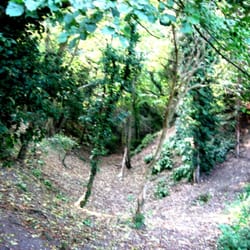
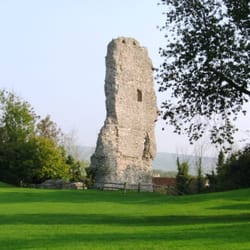
Built to defend an important port on the River Adur, Bramber Castle was constructed as a motte and…read morebailey castle around 1073 by William De Braose, who fought alongside William the Conqueror at the battle of Hastings in 1066. Apart from a period of confiscation during the reign of King John, it remained in the ownership of the De Braose family until themale line died out in 1324. Thereafter, it passed via the Mowbray and Howard families into the estate of the Dukes of Norfolk, who held it until it until 1926. It was given to the National Trust in 1946. Very little survives of the original castle, thanks to a gradual decline over the years, damage during the Civil War in 1642 and looting of the stones as a quarry for building by the locals. The most prominent feature is the tall and unsteady-looking fragment of the Gatehouse tower, still standing to almost its full original height. In the centre of the grounds is the impressive original motte, its earthen mound rising some 30ft (10m). A short distance away is a section of the curtain wall which survives up to 10ft (3m) in places. Around the perimeter are also the remains of the castle's impressive moat. (NB be careful with small children, as there are some sheer drops in places). Although the ruins are rather fragmentary, the grounds are beautifully kept by the National Trust, and make a wonderful place for a picnic, as well as affording excellent views of the surrounding countryside.

This place is a bit of a let down. There seems to be no effort to make it obvious where/what parts…read moreof the ruins were. They have a lame sign at the entrance but little else. It just seems like an enclosed play field.

West Blatchington Windmill

West Blatchington Windmill

(5 reviews)

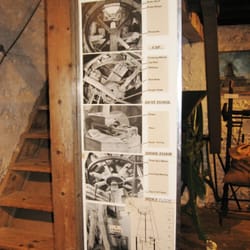
Visitors driving along Holmes Avenue through modern suburban West Blatchington could be forgiven…read morefor doing a double-take as they approach the crest of the hill: somewhat ignominiously stranded between its two carriageways is a fine early 19th Century windmill, a reminder of the proud tradition of Sussex windmills that once dotted the landscape around the South Downs. West Blatchington mill was built around 1820 to provide flour and animal feed to the tiny village that has existed here since mediaeval times. The mill is unusual in that it was attached to a barn, and the 'A' frame which supports the sail mechanism inside was built from rescued ships' timbers. Milling stopped in 1897 and, although no longer operational, much of the interior mechanism survives in good condition. The building is listed at Grade II+. The mill is a 'smock mill', so named because the octagonal, wooden structure with its sloping weather boarded sides resembles a linen smock. The cap at the top of the mill could rotate to face the wind, driven around by a small fantail rotor (rather like a modern helicopter's rear rotor) on the opposite side of the cap from the main sails. Inside, the ground and first floors comprise an exhibition of the local area and country life in general, with several examples of early agricultural machinery, many of which are still in working order, together with some fine models of windmills. Higher galleries allow access to the milling floor and the bagging floor, and offer fine views over the surrounding countryside. The adjacent barn is now used as a seminar and meeting room, and light teas are available when the mill is open. There is also a small souvenir shop by the entrance. Entry (2008) Adults £1.00 Children 50p Wheelchair Access There is level access to the ground floor (although it is slightly uneven in places). There is also a disabled access toilet. The upper floors are reached by a series of very steep, open-tread steps.

Built around 1820, West Blatchington Windmill is a sight to behold. You can see it when you…read moreapproach Hove from Devils Dyke by car and I always think that its amazing its still there surrounded by modern houses. This 'Smock' windmill was famously painted in water colours by John Constable in 1825 and is an ideal venue for all age groups to come and visit. Its only open to the public on Sundays and bank holiday Mondays but for schools and large groups they can make an exception. This mill has been quoted as being one of the finest windmills in the country so definitely worth a trip!

Foredown Tower - landmarks - Updated May 2026

Loading...
Loading...
Loading...