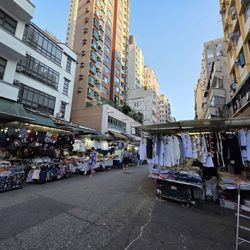
Someone once asked me what it's like growing up in Hong Kong. Well, Hong Kong is a pretty crowded…read moreplace (5.5 million around 1985 or so, close to 7.4 now), it's hot (same Latitude as Aguascalientes, Mexico and Calcutta, India), it's humid (oooog, no worse swamp-ass like Southern Chinese swamp-ass), and it's tiny - if you factor out all the hilly areas or all the small islands that are found in the territory, the total flat land area available for housing and commerce (reclaimed coastlines and alongside valleys) are about the same as Brooklyn (a borough in New York City that only holds about 2 million people, and well known for its flatness). The population density within its older, poorer inner core is mind-boggling, and even in its more prosperous new towns, it's still something to behold. It's not uncommon to see 18 story multipurpose buildings downtown, and 40 story residential condo towers in the new towns, reaching 300+ feet above the ground in clusters above major thoroughfares, shopping centers and transit centers, adjoining valleys and hillsides. The new towns and various neighborhoods in the inner cores often house and employ up to tens, if not hundreds of thousands within a relatively small space.
Now imagine trying to get these residents to and from their workplaces, businesses, centers of education, commerce and whatnot, and all channeled through major chokepoints (for a rough idea of what it is like, look at King's Road on Hong Kong island - it's literally 3 blocks north to the waterfront, and 3 blocks south to the hills), roadways reaching up some fairly steep and curvy places to get around the hilly local terrain (Route TWISK in the New Territories is notorious). Well, that's where the double decker buses make their indelible mark in Hong Kong's collective memory, alongside Queen Elizabeth dollars, tri-color canvas bags, street food carts, and the old Khaki Green RHKP uniforms. First bought in the 1950s from UK firms like Albion, Guy and Daimler, it eventually became so highly demanded that the firms consider it their most profitable export market, offering better suspensions, stronger engines, better ventilation and more doors to get the passengers in and out quickly.
British buses like the Leyland Victory 2, the Fleetlines, the Guy Arab Vs and the CVGs ended up being the daily ride of an entire generation of Honkers, conveying them to/from school, work, their ancestor's memorial sites, their weekend getaways in local beaches and country parks. Hong Kong is a small place, and the buses can take you everywhere. Americans might think of freeways as a symbol of freedom and idolize their Corvettes and Mustangs, Honkers think of various buses and bus routes as conduits to memories of past events and experiences. Ask an old Honker what he thinks of the yellow Daimler E on the old Route 6A, and he'll no doubt scream out Lai Yuen 荔園, the long lost and lamented amusement park that used to be across the street from the Lai Chi Kok 荔枝角 terminal. Mention the Mercedes O305 on the 68 route and the bus geeks will regale you with exciting tales of Gran Turismo, bus edition on route TWISK. Mention the Fleetlines on the 15 and it's taking a girlfriend up to Victoria Peak for a shot at first base.
80M is basically a manifestation of this yearning for past experiences, captured in (expensive) ABS form. Parents might want to say that it's a store for kids...it's not. It's really for the grownups. Those who has a soft spot in his/her heart for a certain bus in a certain color scheme that has a certain roll-sign for a certain route. The fully assembled, highly detailed models have very limited production runs of several hundred only, and once they are sold out, they are sold out forever. Due to its nature as a collectible, they are not cheap, either. A good quality model can run about 100 USD each, and 80M is often your only source (as they commissioned the work from niche toy manufacturers). This might call back to Hong Kong's past as a major toy maker, but it's also the manifestation of home town pride, captured in plastic form. You might not "get" it, but just like the TinyHK stop upstairs, it's a living museum of Hong Kong culture.