Cancel

Open app

Search

Coombes Church

5.0 (1 review)

Coombes Church Photos

Recommended Reviews - Coombes Church

Your trust is our priority, so businesses can't pay to alter or remove their reviews. Learn more about reviews.
Yelp app icon
Browse more easily on the app
Review Feed Illustration
Photo of David J.
96
2344
11912

18 years ago

Helpful 0
Thanks 0
Love this 0
Oh no 0

Verify this business for free

Get access to customer & competitor insights.

Verify this business

Steyning Parish Church of St Andrew and St Cuthman

Steyning Parish Church of St Andrew and St Cuthman

4.0(1 review)
3.4 km

Steyning is a lovely village to visit, if you are in this part of West Sussex, with an interesting…read morehistoric core of buildings, which also extends to nearby Bramber. The origins of Steyning's church are somewhat vague: it was founded around the 8th or 9th centuries, supposedly by St Cuthman. But it is clear that during the 9th century there was a flourishing Minster church here, dedicated to its presumed founder, and Ethelwulf, King of Wessex and the father of Alfred the Great, was buried here in 858. (His body was later moved to Winchester Cathedral.) An ancient gravestone in the porch purports to be from his tomb. Unfortunately, nothing else recognisably survives from the Saxon period: after the Norman conquest, the church came into the care of the monks of Fecamp Abbey in France, who rebuilt the church in romanesque style between the late 11th and mid 12th centuries. The porch was added in the 15th century and the tower in the 16th, but after the dissolution, the Norman chancel decayed and the present chancel is a Victorian addition. But the nave remains a Norman building of very high quality, which makes a strong, even dramatic impression as you enter. The arcades and clerestory are richly carved, with the typical Norman decorations across the arches and columns of ziz-zag and dogtooth carving, with additional human and animal motifs. The whole scheme is a delight, and is preserved in excellent condition. Also in Steyning are some lovely half-timbered houses and a small museum. After a visit to Steyning, cross the busy A283 to the ruined Bramber Castle. Situated at the entrance to the equally delightful village of Bramber, it makes a perfect spot for a summer picnic.

Photos
Steyning Parish Church of St Andrew and St Cuthman

See all

St Mary's Church

St Mary's Church

5.0(1 review)
5.6 km

St Mary's is a classic Manor church; it sits next to the impressive bulk of Wiston House, reached…read moreby driving across a huge park and some distance away from any modern settlement, although it remains parish church. The church is mentioned in the Domesday book, but underwent significant restoration by G M Hills in 1862, who swept away much of the earlier fabric. (Pevsner refers to it as being 'terribly treated' in the Sussex Volume of his Buildings of England). But it is still an interesting church to visit, its faded wooden pews lending it an air of antiquity. The church itself has a short nave, with a large two-bay south aisle, which leads in turn to a spacious Lady Chapel. The style is a mixture of Early English and Decorated Gothic, although much dates from 1862: the east and West windows are original, with 14th century reticulated tracery, and both contain fragments of colourful, original glass, the shields in the east window also dating from the 14th century. The Norman font sits on a pedestal of rather later date. But most interesting are the monuments in the Lady Chapel, where pride of place goes to a magnificent brass of Sir John de Brewys (Braose in French), who died in 1426. Adjacent is a recumbent effigy of a child beneath a Perpendicular canopy, which may be that of his infant son, whose early death resulted in the manor passing to the Sherley family. Sir Richard Sherley (d. 1540) is shown on a wall memorial with his two wives, although a harsh restoration makes it look almost modern. On the window are the kneeling figures from the monument of Sir Thomas Shirley (d. 1612). At the other end of the chapel, a late 18th century monument to Sarah Goring (d. 1798) could not be more different: a peculiar mixture of a classical mourning figure under a Gothic canopy. On my visit this had been charmingly taken over for a series of prayer requests and candles.

Photos
St Mary's Church
St Mary's Church
St Mary's Church

See all

Church of St Nicholas, Bramber Castle

Church of St Nicholas, Bramber Castle

4.0(2 reviews)
2.4 km

Bramber is a picture-postcard village of the sort that wins 'Britain in Bloom' prizes. Sandwiched…read morebetween the equally pretty vllages of Steyning and Upper Beeding, it sits between the River Adur and the steep castle mound of Bramber Castle. The castle (see separate entry) is now a ruin, but its church - the oldest Norman church in Sussex - is intact, and still in regular use. Situated on a hill above the village, the church was built at the same time as the castle in 1073, by William de Braose. Originally a chapel for the castle, it became the parish church in 1250, but it declined with the village as its harbour on the River Adur silted up. The church was used as a gun emplacement for attacking the castle during the Civil War in 1642, and was ruinous by the mid-18th Century. It was restored in the 19th century. It's exterior is typically Norman - a strong, squat tower, which could also serve as a refuge, a short nave and thick walls. On the South Wall are the remains of an original Norman doorway, with a simply decorated arch. The original transepts and chancel have long since been demolished, and the church now consists only of a small west porch/vestry, nave and the tower, which functions as the chancel. Inside, the church is dark and atmospheric. The eye is drawn to the chancel arch, a perfect example of rustic Norman romanesque, and is one of only three examples to feature the original Norman figure carvings on the capitals. On the left, these feature two simple human heads, but on the right the human heads are accompanied by animal carvings in relief, showing birds and what appear to be dogs or foxes - some of them with more birds in their mouths (possibly an early 'fox and goose'). There are more Norman carvings on the capitals of the infilled north cancel arch. After a visit to the church, it's a only short climb to the lovely grounds of Bramber Castle - a perfect spot for a summer picnic.

This church seems vastly over looked but the graves are not that old. Some are within recent years…read more The inside is classic Norman but needs a make over. The walls are peeling.
Photos
Church of St Nicholas, Bramber Castle - Chancel arch - 11th century carvings

Chancel arch - 11th century carvings

Church of St Nicholas, Bramber Castle
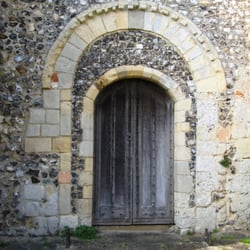
Church of St Nicholas, Bramber Castle - Bramber church. South wall - Norman Door.

See all

Bramber church. South wall - Norman Door.

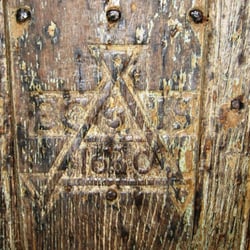
St Botolph's Church, Botolphs - Date on the church door - 1630 - and the initials of (possibly) the Churchwardens

St Botolph's Church, Botolphs

5.0(1 review)
1.1 km

Sussex is well endowed with Saxon churches, and St Botolphs is one of the finest…read more Situated in the hamlet to which it gave its name, the church also serves the adjacent hamlet of Annington. Together, their population is today less than 50, but this large church gives away the fact that in earlier times this was a thriving port on the nearby River Adur. The church dates from 950 AD, and the nave is typical of the Saxon style: narrow, tall and long. Around 1250, a north aisle was erected, and three generous and elegant Early English Gothic arcades were inserted in the north wall. At the same time, the chancel was rebuilt, possibly replacing a Saxon apse, and the west tower added. However, as the river silted up and changed its course, the little town declined, and around 1450 the north aisle was demolished and the north wall closed up, although the three arcade arches are still clearly visible, both inside and out. Thereafter, little has altered: the south wall is the Saxon original, and includes a small Saxon window alongside newer (mostly mediaeval) insertions. The chancel arch includes a Saxon roll on its interior, unusual in that it does not follow the arch to the floor, but rests on two corbels, which have early Saxon decoration, made using a trowel. The chancel has some fine very early Gothic lancet windows, including two 'squints', to allow people outside the church (such as those excommunicated or with a disease) to watch the service within. The one on the north side is probably a 'Leper's Squint'; we know there was a leper's hospital in nearby Bramber in mediaeval times. The one on the south wall has a scratch sun-dial outside, possibly to denote the times of confession. There are also faint wall paintings above the chancel arch, the oldest of which may date from the Saxon period. Three bells dating from 1536 still ring out from the tower, hanging in their original wooden frame. There is a fine Jacobean pulpit, and a royal coat of arms from the time of Charles II. The heavy wooden door bears the date 1630 and the initials of the churchwardens. The church is well worth a visit - why not combine it with a walk along the adjacent Downs Link long distance footpath?

Photos
St Botolph's Church, Botolphs - Remains of the elegant north arcade of the nave, with Early English gothic arches resting on plain moulded capitals. Built

Remains of the elegant north arcade of the nave, with Early English gothic arches resting on plain moulded capitals. Built

St Botolph's Church, Botolphs - Interior of church door.

Interior of church door.

St Botolph's Church, Botolphs - Overal view of the church from the north west.

See all

Overal view of the church from the north west.

All Saints Church

All Saints Church

5.0(1 review)
7.3 km

All Saints can lay a strong claim to being England's most hidden church. Although only yards from…read morethe busy A283, it lies across a small, thickly wooded valley from a narrow lane, only a diminutive wooden sign hinting that there might be a church here. To reach it, you follow a path falling steeply to the bottom of a small valley, across a wooden footbridge and rising back up again. As if to make it even harder to find, the lane is signposted 'Wiston', a mile further east than the turning for Wiston Park and House. On my visit, the path was lined with bluebells and ramsons. The church itself a small, simple two-celled structure, with a Norman nave and small Norman windows high up in the walls. Blocked arches abound, although the church guide assures us that the church was never larger. They must remain a mystery. The Chancel is brighter, with a 14th century East Window and two Early English lancets lending a little more light. The walls have small fragments of homespun 14th century wall paintings, and the Chancel arch crude Romanesque decoration. Until 2004 this included an interesting horizontal figure carved on the impost on the North side, possibly some sort of fertility symbol, sometimes called a Sheela-na-gig. Sadly, this was destroyed by an act of vandalism - after 800 years. I hope it can be restored. More happily, to the right of the altar, a perfect Decorated Piscina dates from the 14th century. Of perhaps more interest, however, are the various arches on the outside of the chancel, especially those on the north side (see above). Of late 12th Century date and of extraordinary quality, these too are something of a mystery: they clearly weren't meant for their present position. They may have come from the nearby Benedictine Priory at Sele and inserted in the 14th century when the chancel was being rebuilt. Whatever their origin, they are a delight.

Photos
All Saints Church
All Saints Church
All Saints Church

See all

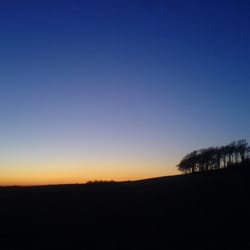
Chanctonbury Ring - Chanctonbury at dusk.

Chanctonbury Ring

4.5(2 reviews)
6.6 km

Many Brightonians tend to find themselves in need of a retreat from the busy streets and beaches of…read moreBrighton and Hove of a summer's weekend. Displaced from the city they by incomers from London and the summer tourists they splash like droplets of water from a dewpond whose surface has been shattered by the stone throwing misadventures of small boys. But where do they go? Well one place I find myself visiting on a July eve is Chanctonbury ring. A pleasant spot on the South Downs, Chanctonbury Ring was a hill fort in the Iron Age, hence its superb panoramic views. Chanctonbury is an important archaeological site, with caches of Roman coins and pottery having been discovered there from its time as a temple. Human remains have also been found. Reports were made in the 1970s of paranormal activity and evidence of occult ceremonies having taken place, but when questioned, local occult groups claimed that the site had a bad atmosphere and they wouldn't risk going there. This may stem from the legend that Chanctonbury Ring is one of the clods of earth the devil threw from Devil's Dyke, when he was carving out a channel inland to drown humankind before being foiled by a cockerel and an old lady's sieve. However, the sheep nibble away in blissful ignorance, and the grassy knolls seem unlikely to conceal Satan in any of his myriad forms. The ring of trees from which the place takes its name came comparatively late, planted by Charles Goring, the then owner of Wiston Estate. The locals at first objected to the idea, but later when the trees were destroyed by the 1987 hurricane, they planted replacements in his memory. The hill is also an ordnance survey trig point, and beacons are lit there on New Year's Eve in sequence with the rest of the Downs. All in despite its slightly sinister past this spot offers an earthy and un-crowded spot to have that Sunday afternoon BBQ with a little shade and plenty of space to ruminate on the weekend behind you or the week ahead.

This has to be one of my favorite places in Sussex! Although its a bit of a trek to get to, so I…read moresuggest you have some snacks with you, it's really worth the effort! The views from the top are amazing and on a clear day, you can see for miles! If you want to go somewhere that you can feel completely away from the world, this is the place to go! You can't hear any traffic from the top, all that can be heard are the sheep during the warmer weather! It can get pretty windy as there is no shelter up the top but its worth braving it. Once you emerge from the forest walk, take the path along the South Downs Way, heading west (turn right) and you'll come to a cattle grid and then you can't miss the trees! :-)

Coombes Church - religiousorgs - Updated May 2026

Loading...
Loading...
Loading...