Cancel

Open app

Search

Cherokee Heritage Center

4.9 (8 reviews)

Cherokee Heritage Center Photos

Recommended Reviews - Cherokee Heritage Center

Your trust is our priority, so businesses can't pay to alter or remove their reviews. Learn more about reviews.
Yelp app icon
Browse more easily on the app
Review Feed Illustration

4 years ago

Helpful 1
Thanks 0
Love this 0
Oh no 0

15 years ago

Helpful 8
Thanks 0
Love this 1
Oh no 0

8 years ago

Helpful 0
Thanks 0
Love this 0
Oh no 0
Photo of Henry T.
177
37
239

12 years ago

Helpful 3
Thanks 0
Love this 1
Oh no 0

15 years ago

Helpful 2
Thanks 0
Love this 0
Oh no 0
Photo of Billy H.
23
226
66

14 years ago

Helpful 1
Thanks 0
Love this 0
Oh no 0

9 years ago

Helpful 0
Thanks 0
Love this 0
Oh no 0

18 years ago

Helpful 2
Thanks 0
Love this 0
Oh no 0

Ask the Community - Cherokee Heritage Center

Verify this business for free

Get access to customer & competitor insights.

Verify this business

Cherokee National Prison Museum - That bucket was their "toilet"

Cherokee National Prison Museum

4.0(2 reviews)
3.0 mi

As a corrections officer this peaked my interest, so I decided to go with the whole family. Loved…read moreeverything about this old prison now museum, it was interesting, informative, kept the kids entertained and best of all it was all free. I definitely recommend checking it out.

I wish I could give this like a 3.5... It's not quite a 4 but not so much a 3 either…read more The entry fee is $5 and you walk in to a small little "gift shop" of shelves filled with books and local, handmade, and Cherokee gifts including marbles, pins that say "Osiyo" and books from Cherokee writers. The main exhibit is really about 2 rooms that are all open to each other. There are life size scale mannequins with "outlaw" and "prisoner" regalia, as it is a prison museum. There are a few interesting stories as well as a few interactive activities such as pulling the weight of a dumbell that would have been attached to a prisoner's leg. Outside there is a replica of the "gallows" and the space that the prisoners might have lived and worked. The museum doesn't take long at all to get through so if you were bringing a large group, consider doing a tour of multiple historic places in the area (and there are a few within walking distance). The museum is interesting but not exactly enough to keep you entertained for long, although, it's very specific. If I were in Tahlequah again, I would recommend touring but I would likely not drive a far distance to visit. Original Tip: $5 entry, takes about 30-40 minutes to go through at most

Photos
Cherokee National Prison Museum
Cherokee National Prison Museum - Kitchen

Kitchen

Cherokee National Prison Museum - Front of Prison "Museum"

See all

Front of Prison "Museum"

Cherokee National History Museum - Cool art in the stairwell

Cherokee National History Museum

5.0(1 review)
3.2 mi

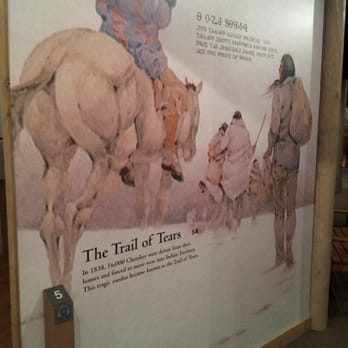
On Wednesday we drove to Tahlequah, the capital city of both the Cherokee Nation and the United…read moreKeetoowah Band of Cherokee Indians. Their reservation spans 14 counties in Northeastern Oklahoma. In 1830, gold was discovered on Cherokee lands. The exact same year, not only were Cherokees legally prohibited from mining for gold on their own lands Andrew Jackson signed the Indian Removal Act of 1830. In exchange for $5 million the Cherokee people would "exchange" their homelands for lands in Oklahoma. Not only were the people who signed the treaty on behalf of the Cherokee not elected officials of the tribe in any capacity, the US government never paid the money out, nor were the Cherokee given a seated representative in the US House of Representatives per the 1835 Treaty of New Echota. More than 100,000 Native Americans, including the Cherokees were forcibly removed from their homes in the Carolinas, Appalachia and Alabama. The Seminoles of Florida even went to war for 7 years against the US government to try to hold onto their land. People were hunted, killed and those who were captured were forced to march a thousand miles on a journey that became known as "The Trail of Tears" due to 4,000 people dying on the forced relocation march. After the Native Americans were forcibly removed, their land and gold mining rights were then given to wealthy white settlers in lotteries. This land became the massive plantations (corporate farms) of the slave-era. I've been to Tahlequah before but they tore down the original museum that I visited in favor of turning this courthouse into a museum. Personally, the trail of tears exhibit was a better exhibit at the former museum. It always stuck with me how they had eyewitness accounts of US soldiers bayonetting pregnant women on the trail. It's just evil.

Photos
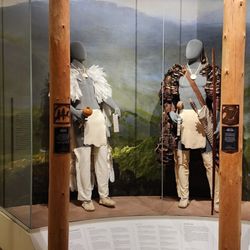
Cherokee National History Museum - Different clan outfits

Different clan outfits

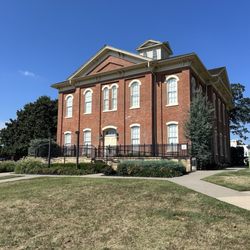
Cherokee National History Museum - Outside

Outside

Cherokee National History Museum - May 2024

See all

May 2024

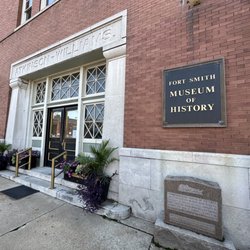
Fort Smith Museum of History - Front Entrance

Fort Smith Museum of History

5.0(3 reviews)
44.6 mi

Very nicely done! We had a flight cancellation on a very rainy Saturday which led us to the…read moremuseum. Glad we went. The staff was very nice and the displays were great. Keep up the good work! Thank you!

Since I'm not from this area, I wouldn't know what to expect. Obviously, the early U.S. Army had a…read morefort here. They say something about defending against an Indian uprising. I could write for days about such a thing, but that takes away from the museum. The museum has a few exhibits for free in the lobby. If you want to see the rest of the first, and the second floor, it's $5.00 for adults, which isn't bad, considering the amount of information and the orderly way in which it's presented. Of course, flash photography is not wanted, as it can cause older items to deteriorate more quickly. They had early maps of the area, including a French map of the Native American Indians, which was quite informative. A handy guide to French would have made it accessible to everyone. They presented many items from the 1800s and early 1900s throughout the building, including vehicles, tools, and clothing. There were newspaper articles explaining events. I was surprised to see the creative use of typography, given the difficulty of manually assembling a page of metallic type. Along with this, they showed a couple of printing presses. On the second floor, they went into later years, up through the 1960s, and touched on subjects more likely to still be on the minds of older generations in the area. I suspect that school kids will go to the museum no matter what, but those who don't know about the history of the area should take the trip. Besides, feeding a museum in order to help preserve your history isn't a bad thing at all.
Photos
Fort Smith Museum of History

See all

Cherokee Heritage Center - museums - Updated May 2026

Loading...
Loading...
Loading...