Cancel

    Open app

    Search

    The Spider Gallery

    5.0 (1 review)
    PriceyArt Galleries
    Closed Closed

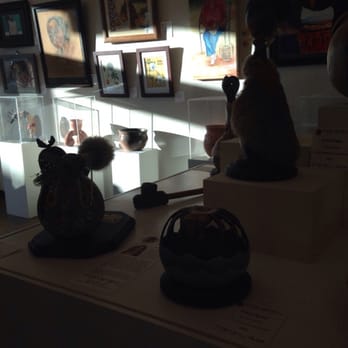
    The Spider Gallery Photos

    Recommended Reviews - The Spider Gallery

    Your trust is our priority, so businesses can't pay to alter or remove their reviews. Learn more about reviews.
    Yelp app icon
    Browse more easily on the app
    Review Feed Illustration

    12 years ago

    Helpful 3
    Thanks 0
    Love this 0
    Oh no 0

    Verify this business for free

    Get access to customer & competitor insights.

    Verify this business

    The Magic Showplace Theater & Rabbit-in-Hat Magic Shop

    The Magic Showplace Theater & Rabbit-in-Hat Magic Shop

    5.0(5 reviews)
    22.7 mi

    A Truly Magical Experience!…read more The Magic Showplace Theater and Rabbit-in-Hat Magic Shop is an absolute gem. From the moment you walk through the door, you're surrounded by wonder, warmth, and an atmosphere that instantly brings out your inner kid. The shows are top-notch--funny, clever, and filled with jaw-dropping illusions that leave audiences of all ages amazed. But what truly sets this place apart is the owner, Clark. He's nothing short of incredible. Clark's passion for magic shines in everything he does--from his engaging performances to the welcoming way he treats every guest who steps inside. He has a rare ability to make everyone feel like they're part of the magic, whether you're enjoying a show or browsing the shop. His knowledge, charisma, and genuine kindness create an unforgettable experience. The Rabbit-in-Hat Magic Shop is equally fantastic, offering a great selection of tricks for beginners and seasoned magicians alike. Clark is always happy to give tips, demos, and guidance, making it the perfect place to learn something new. If you're looking for a unique, charming, and truly magical outing, The Magic Showplace Theater and Rabbit-in-Hat Magic Shop is a must-visit. Clark makes it extraordinary.

    What an Magical Wonder. Walking through the doors to an…read moreamazing showcase of Magic History. Top magician's keeping you on the edge of your seat with amazing magic making you feel like a child again. Highly recommend

    Photos
    The Magic Showplace Theater & Rabbit-in-Hat Magic Shop
    The Magic Showplace Theater & Rabbit-in-Hat Magic Shop
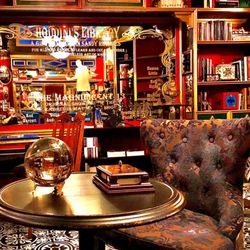
    The Magic Showplace Theater & Rabbit-in-Hat Magic Shop - Houdini's Library within the Magic Showplace Theater in Locust Grove, OK

    See all

    Houdini's Library within the Magic Showplace Theater in Locust Grove, OK

    Cherokee National History Museum - Cool art in the stairwell

    Cherokee National History Museum

    5.0(1 review)
    0.1 mi

    On Wednesday we drove to Tahlequah, the capital city of both the Cherokee Nation and the United…read moreKeetoowah Band of Cherokee Indians. Their reservation spans 14 counties in Northeastern Oklahoma. In 1830, gold was discovered on Cherokee lands. The exact same year, not only were Cherokees legally prohibited from mining for gold on their own lands Andrew Jackson signed the Indian Removal Act of 1830. In exchange for $5 million the Cherokee people would "exchange" their homelands for lands in Oklahoma. Not only were the people who signed the treaty on behalf of the Cherokee not elected officials of the tribe in any capacity, the US government never paid the money out, nor were the Cherokee given a seated representative in the US House of Representatives per the 1835 Treaty of New Echota. More than 100,000 Native Americans, including the Cherokees were forcibly removed from their homes in the Carolinas, Appalachia and Alabama. The Seminoles of Florida even went to war for 7 years against the US government to try to hold onto their land. People were hunted, killed and those who were captured were forced to march a thousand miles on a journey that became known as "The Trail of Tears" due to 4,000 people dying on the forced relocation march. After the Native Americans were forcibly removed, their land and gold mining rights were then given to wealthy white settlers in lotteries. This land became the massive plantations (corporate farms) of the slave-era. I've been to Tahlequah before but they tore down the original museum that I visited in favor of turning this courthouse into a museum. Personally, the trail of tears exhibit was a better exhibit at the former museum. It always stuck with me how they had eyewitness accounts of US soldiers bayonetting pregnant women on the trail. It's just evil.

    Photos
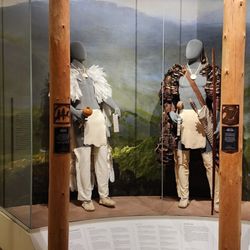
    Cherokee National History Museum - Different clan outfits

    Different clan outfits

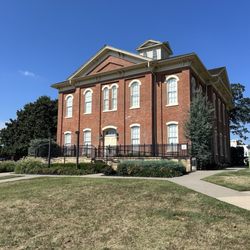
    Cherokee National History Museum - Outside

    Outside

    Cherokee National History Museum - May 2024

    See all

    May 2024

    Cherokee National Prison Museum - That bucket was their "toilet"

    Cherokee National Prison Museum

    4.0(2 reviews)
    0.1 mi

    As a corrections officer this peaked my interest, so I decided to go with the whole family. Loved…read moreeverything about this old prison now museum, it was interesting, informative, kept the kids entertained and best of all it was all free. I definitely recommend checking it out.

    I wish I could give this like a 3.5... It's not quite a 4 but not so much a 3 either…read more The entry fee is $5 and you walk in to a small little "gift shop" of shelves filled with books and local, handmade, and Cherokee gifts including marbles, pins that say "Osiyo" and books from Cherokee writers. The main exhibit is really about 2 rooms that are all open to each other. There are life size scale mannequins with "outlaw" and "prisoner" regalia, as it is a prison museum. There are a few interesting stories as well as a few interactive activities such as pulling the weight of a dumbell that would have been attached to a prisoner's leg. Outside there is a replica of the "gallows" and the space that the prisoners might have lived and worked. The museum doesn't take long at all to get through so if you were bringing a large group, consider doing a tour of multiple historic places in the area (and there are a few within walking distance). The museum is interesting but not exactly enough to keep you entertained for long, although, it's very specific. If I were in Tahlequah again, I would recommend touring but I would likely not drive a far distance to visit. Original Tip: $5 entry, takes about 30-40 minutes to go through at most

    Photos
    Cherokee National Prison Museum
    Cherokee National Prison Museum - Kitchen

    Kitchen

    Cherokee National Prison Museum - Front of Prison "Museum"

    See all

    Front of Prison "Museum"

    Cherokee National Supreme Court Museum - Original documents from the late 1800s

    Cherokee National Supreme Court Museum

    5.0(1 review)
    0.1 mi

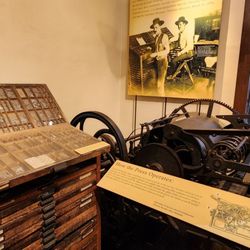
    On Wednesday, after visiting the Cherokee National History Museum in Tahlequah, Oklahoma, we…read morevisited the Cherokee National Supreme Court Museum. The building that houses the museum was built in 1844 and is the oldest still-standing government building in Oklahoma. Not only was this the Cherokee Nation's Supreme Court, but it also housed the printing office of the Cherokee Advocate, a weekly bilingual English & Cherokee-language newspaper and the Tahlequah District Courts. Inside the building is a small courtroom on the ground floor and the printing press and newspaper office on the upper level. Prior to the Indian Removal Act of 1830, the Cherokee Nation had its own courts. According to two separate signs on exhibits in the museum; "In 1817, a group of Cherokees known as the Old Settlers left the Cherokee Nation in the east and moved west of the Mississippi River to the Arkansas Territory where they set up a new government and court system. In 1828, the Old Settlers relocated to Indian Territory and brought their government with them. After the rest of the Cherokee people were forcibly removed from their southeastern homeland to Indian Territory in 1838 and 1839, they and the Old Settlers set about reuniting and created a new constitution which provided for the re- establishment of a legal system." "For many years Cherokee justice was practiced according to Blood Law, also known as Clan Law, an ancient form of tribal law aimed at restoring balance to individuals or tribal life. If something was taken from one clan, it had to be repaid by the offender's clan in order to restore balance. The creation of the modern court system used by the Cherokee Nation today stemmed from the tribe's need to adapt to a new world order and deal with the new United States government. At the same time, it was important to accommodate traditions and customs, so the Cherokees took examples from European and American courts and fused them with their own traditions and views on justice. In 1820, the Cherokees divided their land into eight districts with a judge and a marshal for each. Courts were held twice a year in each district, and exercised both judicial and legislative functions. A Supreme Court was created to determine cases appealed from the district courts. The Cherokee Nation had established a judicial system preceding that of the State of Georgia by ten years. In 1828, the Cherokee Nation adopted a constitution that gave district courts jurisdiction over cases of misdemeanor, theft to the amount of one hundred dollars, and any criminal cases except murder. The circuit courts, which were to sit twice a year in each district, had original jurisdiction over murder trials and cases of theft exceeding one hundred dollars. They had appellate jurisdiction over suits involving sums over twenty-five dollars. The Supreme Court sat for one month annually at the capital. It had original jurisdiction over murder cases; jurisdiction to hear appeals and review decisions of lower courts; and any cases brought before it from the circuit courts. District judges were elected by the people, while circuit and Supreme Court judges were appointed by tribal legislature. Every offender whose case was brought to a Cherokee court was given the right to trial by a jury of six men for minor offenses and twelve men for murder cases. Because the Cherokees had no jail, offenders were kept under guard until trial." What I found extra interesting was that in the exhibit for the Cherokee printing press, there was a sign about the predecessor of the Cherokee Advocate, the Cherokee Phoenix newspaper. This sign talked about a Cherokee editor of the Cherokee Phoenix, Elias Boudinot, who was upset that he was overruled when wanting to print pro-Indian-relocation articles. He ended up leaving the newspaper and was one of the non-elected representatives for the Cherokee Nation in signing an agreement to forcibly removed the Cherokee from their lands to modern day Oklahoma on the Trail of Tears. I definitely felt like this should have been more prominently displayed because seriously WTF?! For the record, he was taken out by vigilantes for selling out his nation and is buried not too far from the museum. Overall, it was a very informative museum despite its small size. According to the visitor book, we were the only people who visited that day. We stayed the last 45 minutes until closing. Visited: May 2024.

    Photos
    Cherokee National Supreme Court Museum - Printing press

    Printing press

    Cherokee National Supreme Court Museum - Courtroom

    Courtroom

    Cherokee National Supreme Court Museum - Old desk

    See all

    Old desk

    Cherokee Heritage Center - Female Seminary

    Cherokee Heritage Center

    4.9(8 reviews)
    3.1 mi

    Great place to visit. They do a really great job presenting a very emotional and evocative portion…read moreof the history of the Cherokee people and the monumental injustices inflicted on them by the American government. Really enjoyed the visit.

    A former classmate from high school, who happenes to be in the military, got so upset when I…read more"liked" a paper that stated US soldiers have and could again put US citizens in internment camps and we should be on guard. This classmate said the US has never locked up its own citizens and would never do such things; to say different would make me a conspiracy theorist. Errrrrr. WRONG. There's a forgotton Holocaust - an American tale. We all know about the Jewish internment camps in Germany and Poland, and the Japanese internment camps here in the USA during WWII, but how many people know of the internment camps for the people of the Five Civilizied Tribes during the 1830-40's right here in America? Unless you grew up in the south, or are part Native American, chances are, you don't know about the Trail of Tears and the death camps. Back in early April, my grandparents, now ex-husband and I drove down to Tahlequah to visit Tsa-La-Gi. It was so nice to go through the living history tour which has a replica village and then another replica town (post ancient Cherokee village) with a schoolhouse, church, etc. Because it wasn't summer and still really cold out, there weren't people cooking and playing games. Our tour guide demonstrated games, archery and a bunch of other cool stuff during the tour. He was really personable and funny. Inside there is both ancient and modern (1500's-1800's) Cherokee clothing, pottery, weapons, etc. I liked the pottery stamps that you could color in the museum (sorta like when you put a leaf under paper and color over it to get the impression.) Past the previously mentioned things in the back of the museum, I learned things I never knew. I always wondered why my Cherokee ancestors didn't put themselves on the 1900's Dawes Rolls - you have to be on it to be apart of the modern day tribes. My grandpa told me that if you were put on the rolls, you were basically a ward of the government. You had no property anymore or rights. You were basically no better off than a slave. You can't buy your freedom when the government has you by the neck. I learned more here as to why my ancestors hid out in the Ozarks rather than lose all the had to the Government. On the wall are the accounts of eye-witness accounts of people watching a soldier bayonette a pregnant lady who fell on the trail, of the diseases and starvation that were rampant both on the trail and in the camps. It was absolutely stomach turning. I took a picture of every single wall board with information on it. Horrific. This is definitely a place, just like the Holocaust museum in D.C., that people NEED to see. We must never get too careless or too delusional to think that this stuff doesn't or can't happen again by our very capable government. We can forgive but we won't foolishly forget or ignore what our own government has done to its own people. If you want an eye-opening history lesson, COME HERE.

    Photos
    Cherokee Heritage Center
    Cherokee Heritage Center - Cherokee Heritage Center

    Cherokee Heritage Center

    Cherokee Heritage Center - Trail of Tears

    See all

    Trail of Tears

    The Spider Gallery - galleries - Updated May 2026

    Loading...
    Loading...
    Loading...