1. Charnwood Museum

0

Loughborough, LEC

Cancel

Open app

Search

Charnwood Museum

4.6 (5 reviews)

Charnwood Museum Photos

Recommended Reviews - Charnwood Museum

Your trust is our priority, so businesses can't pay to alter or remove their reviews. Learn more about reviews.
Yelp app icon
Browse more easily on the app
Review Feed Illustration

3 years ago

Helpful 0
Thanks 0
Love this 0
Oh no 0

15 years ago

Helpful 0
Thanks 0
Love this 0
Oh no 0

17 years ago

Helpful 0
Thanks 0
Love this 0
Oh no 0

18 years ago

excellent museum of local history some interesting artefacts , watch out for the dinosaur as you walk over the bones .

Helpful 0
Thanks 0
Love this 0
Oh no 0

17 years ago

Helpful 0
Thanks 0
Love this 0
Oh no 0

Verify this business for free

Get access to customer & competitor insights.

Verify this business

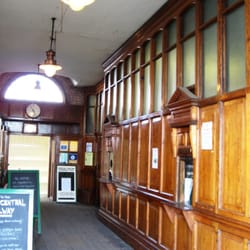
Great Central Railway - Loughborough Station's attractive ticket hall

Great Central Railway

4.0(6 reviews)
0.4 mi

Great Central Railway is great. It is a double track preserved mainline where steam locos pass each…read moreother going different directions. Meals are available on the trains from a griddle to fish and chips to sumptuous dining. The staff are friendly and will give you any help you may need. Snacks are available at all stations as well as other facilities. I don't know of anyone who has not enjoyed their visit as it's a stream of smiling faces when people are leaving.

The Great Central Railway is generally regarded as one of the best of the UK's heritage steam…read morerailways. It is unique in preserving a former section of a main line, and having double track running, recreating the great age of steam-hauled expresses. (Other preserved lines tend to be former branch lines). Its history goes back to the mid-19th Century, and the vision of Edward Watkin. He envisaged a railway running from Manchester and Sheffield in the north of England, and via a new high speed main line, built to the European loading gauge, through London to Dover and then under the Channel Tunnel and thence to France. And all this in the 1860s. Watkin was Chairman of the Manchester, Sheffield and Lincolnshire Railway, Chairman of the South Eastern Railway connecting London with Dover, and also the Metropolitan Railway. A new line was built to link these various companies, and the 'London Extension' from Sheffield down to the Metropolitan line in London. It was the last main line built into London (until the Channel Tunnel link), opened into Marylebone Station in 1899. It was renamed the 'Great Central Railway' and quickly became famous for its fast and comfortable expresses. Alas, the Channel Tunnel vision had to wait nearly another century before becoming reality, but in the meantime the Great Central had become a victim of the 1966 cuts in British Railways, and was the only complete main line to be closed - ironically, the most modern and the only one built to the European gauge. In 1969 some enthusiasts got together to reopen part of the line, and trains started running again in 1973. The railway now runs from Loughborough to the northern outskirts of Leicester. It has a large collection of steam locomotives, from every pre-1947 company as well as British Railway standard designs, and a wide range of preserved diesel trains and railcars which help recreate the early 1960s feel. The stations are delightful: Loughborough recreates a large, busy town station of the early 1960s, Quorn & Woodhouse recreates the railway in wartime of the 1940s, and Rothley, the Edwardian period. Quorn & Woodhouse and Rothley are both excellent examples of the Great Central's standard design of small stations with a single island platform. The line is double track from Loughborough to Rothley, allowing a real taste of how a mainline railway would have felt in the 1960s. It runs through rolling countryside and passes on two viaducts over part of the lovely Swithland Reservoir. All stations have some form of refreshment facilities, and there is a souvenir shop and bookshop at Loughborough. Apart from the trains, additional attractions include the locomotive shed and workshops at Loughborough, and at Rothley the Ellis tearoom and miniature railway, as well as workshops of the Railway Vehicle Preservation group, who aim to preserve rolling stock such as carriages. Their pride is two sets of Travelling Post Offices, and they organise week-ends demonstrating the old automatic mail drop-off and pick-up system, made famous by the 1950s film 'The Night Mail'. The current southern terminus is Leicester North, just south of the site of the former Belgrave & Birstall station. There are plans to extend both further south into Leicester, and northwards to join up with a section of line still extant towards Ruddington and the outskirts of Nottingham. At present there is a gap of over 300m between the two sections, with an embankment and several bridges missing. As you would expect, the line is extraordinarily popular with 'children of all ages'. They run a number of special 'themed' days, some suitable for the die-hard enthusiast, (eg Travelling Post Office demonstration) and others orientated more towards children (eg Thomas the Tank Engine days and Santa Specials). As it is a full working railway, children must be appropriately supervised, and the locomotive shed is messy underfoot - stout footwear would be a good idea, and it is not really suitable for small children. Full details of access and parking can be found on the Line's website.

Photos
Great Central Railway - Interior of the LNER 1937 observation lounge car

Interior of the LNER 1937 observation lounge car

Great Central Railway - Quorn & Woodhouse station - stationmaster's house

Quorn & Woodhouse station - stationmaster's house

Great Central Railway - Travelling Post Office, Rothley station

See all

Travelling Post Office, Rothley station

Belgrave Hall and Gardens - Gothic Bed I adore it.

Belgrave Hall and Gardens

4.0(1 review)
8.4 mi

Another way of escaping the city in Leicester. Most of my escape places are also free…read more The Hall (Grade II* listed) is in the midst of two acres of serene walled gardens that are open to the public. The gardens were an important aspect of the Hall in Victorian times (a status symbol that showed the family's wealth). Belgrave Hall provides an oasis of peace and quiet in a busy city. It was built in the early 18th century, in what was then a small village 3 miles from the town of Leicester. Now city traffic passes, almost unnoticed, just beyond the garden walls. In its current role as a museum, the rooms have been designed to appear as they may have been decorated and used in Victorian times, with the contrasting lifestyles of an upper middle class family and domestic servants. This period was when the Ellis family was resident. The beautifully laid out natural room settings create the feeling of having just missed the occupants of the house. Edmund Cradock, a 'nouveau riche' hosiery merchant, built the Hall between 1709 and 1713 and died soon after its completion. Ellis and his wife Priscilla moved to the Hall with eight of their eleven children seven daughters and their youngest son. The family lived there with their servants the cook, housekeeper, parlour maid,aid-of-all-work, coachman and gardener. The Ellis sisters bought the Hall from their brother in 1868, after he inherited it from their father. Upon the death of the last remaining Ellis sister in 1923, the Hall was sold. Little is known of the next owners, the Simons. The Vann's who lived there from 1767 to 1844, ran a thriving hosiery business from the Hall, employing the local framework knitters as outworkers. They gave generously to many local charities, including Leicester's first free school. John Ellis, who purchased Belgrave Hall in 1845 and his family were also noted for their good work in the community. Ellis, a wealthy businessman, was responsible for bringing the railways to Leicester in 1833. In 1936, the estate was sold to Leicester City Council for £10,500 around a third of its actual value. A number of statues and monuments from lost gardens in Leicestershire are now situated within the gardens. The rock and water garden, botanic garden, eco garden and glasshouses compliment the older, formal grounds. Refurbishment work carried out in 2005 included improved access to the gardens. The rooms show how a house of the period worked in great detail. Free admission.

Photos
Belgrave Hall and Gardens - A reclaimed statue in gardens

A reclaimed statue in gardens

Belgrave Hall and Gardens - Belgrave Hall

Belgrave Hall

Belgrave Hall and Gardens

See all

Abbey Pumping Station

Abbey Pumping Station

4.5(2 reviews)
8.5 mi

I really love the Pumping station and if you're a photographer a good place to take interesting…read morephotos. They often have steam days when the pumps are working and it may have a ghost. Kids love the old style toilets and interesting machinery, totally educational. For a different afternoon out go and see it. It was free last time I went so excellent value.

Based in the old Abbey Sewage Pumping Station, this is what I knew as a child to be the technology…read moremuseum, and is free except for special events. Inside there are buttons to push, handles to crank, ropes to pull, drums to spin, and a plastic poo to flush (this is the best bit as far as the kids are concerend). In adult terms, this means you are looking at how knitting machines work, how electricity is generated, why trams run on rails, and how the moving picture industry started, plus how and why the buildings original use was needed. Outside there are static displays of old industrial machines and equipment, a modern junk-art rocket ship (can you see the alien?), plus a real life tardis. The building also houses one of the countrys operating victorian beam engines, which is in steam on certain special days (Christmas is always lovely with the brass band playing in the upper gallery). Special events include model railway days, steam traction events, and in the summer there is also a small narrow guage steam engine often running that you can ride on for virtual pennies. Parking is in the Space Centre carpark, with some disabled spaces on site on non-special-event days (access from Corporation Road). Access is generally good - there is a small lift into the lower level of the pumping room which you have to call an attendant for, but upper levels are by stairs only.

Charnwood Museum - museums - Updated November 2026

Loading...
Loading...
Loading...