Baker Street Station Photos


Recommended Reviews - Baker Street Station
Start your review...


Reviews With Photos


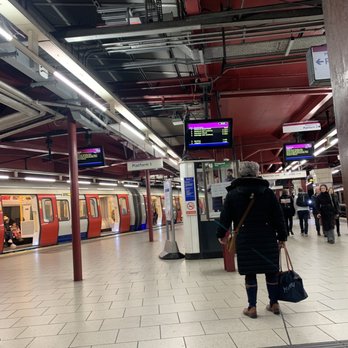
The world's first Underground railway station, Baker Street is where it all began. And for many, it's where many journeys are simply a transfer. Baker street is a major hub on the Underground, servicing the Circle, Hammersmith & City, Jubilee, Metropolitan and Bakerloo lines. As they are of course on different levels, there are a number of escalators and staircases to move up and down. As stations go, it's better than most. It is probably one of the most tourist-popular stations on the Underground, as it's the stop for Madame Tussaud's as well as the nearby Sherlock Holmes Museum. There are many services in the station as well as just above, which has a stop for the tourist bus tours.


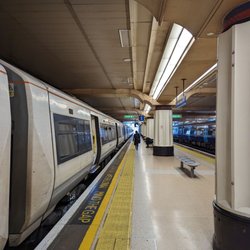
This happens to be a pretty major interchange station, and it is also one of the older stations, especially the platform that happens to be on the circle line. In fact, once you step into this platform you suddenly realise that little has changed since it was first built, and you can almost see the old steam trains making their way through here. Oh, as you can probably work out from the name, this station also happens to be near the house of a certain famous detective. read more


Huge station. You can access almost any part of London from here, as it connects so many lines: - Metropolitan line - Bakerloo - Hammersmith & City - Circle - Jubilee There are a few places to eat or buy something to drink inside the station once you've tapped in. There's a Starbucks and a small shop which sells pastries, sandwiches, drinks and snacks on Platform 1 & 2. There is also a Wenzel's at the top level in the entry area between all platforms. The station is generally clean and the platform attendants are hilarious, telling jokes over the speaker, which makes the commute and waiting time way more enjoyable. I only wish they had more benches to sit and rubbish bins. read more



4 years ago

The world's first Underground railway station, Baker Street is where it all began. And for many, it's where many journeys are simply a transfer. Baker street is a major hub on the Underground, servicing the Circle, Hammersmith & City, Jubilee, Metropolitan and Bakerloo lines. As they are of course on different levels, there are a number of escalators and staircases to move up and down. As stations go, it's better than most. It is probably one of the most tourist-popular stations on the Underground, as it's the stop for Madame Tussaud's as well as the nearby Sherlock Holmes Museum. There are many services in the station as well as just above, which has a stop for the tourist bus tours. read more


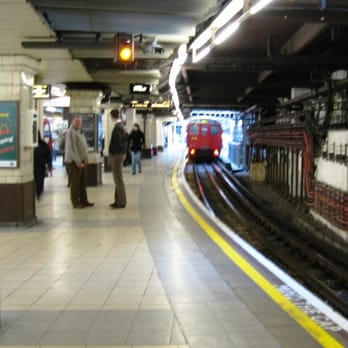
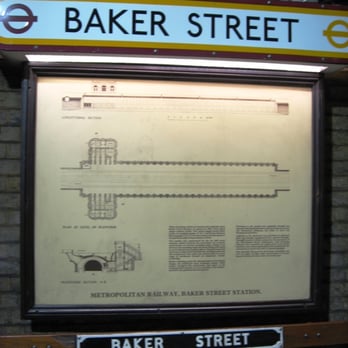
Baker Street is immortalised is so many ways: as the home of Sherlock Holmes, in Gerry Rafferty's iconic 1970's song (that Sax solo!), and as the home of Madam Tussaud's waxworks. The station is also iconic in its own way, however: the Hammersmith & City and Circle line platforms comprise the world's oldest underground station, opened in 1863 as part of the original Paddington to Farringdon Metropolitan Line. Originally partly lit by natural daylight, the shafts have long since been closed, but the platforms still have a wonderfuly Victorian feel to them. Shortly after this line was built, a branch to St John's Wood was added, which became the basis of the Metropolitan's network across North West London and out to Amersham. To help develop its traffic, the enterprising Metropolitan encouraged developers to build housing along the line, and the resulting 'Metro-land' of semi-detached houses with generous gardens set the trend for British suburbs for decades. The Bakerloo line was built as a proper, deep-level 'tube' in 1906 between Baker Street and Lambeth North. In 1939, a branch of this line to Finchley (and later, Stanmore) was opened, which later formed the basis of the new Jubilee line when a new tunnel to Charing Cross opened in 1979, extended to Stratford in 1999, providing Baker Street with the services we see to-day. The sub-surface station as we see it now is, apart from the original 1863 platforms, the result of a substantial rebuilding in 1913 to designs by the architect C W Clark. This provided for two terminating platforms for long-distance Metropolitan trains, as well as two through platforms from which trains join the Hammersmith & City tracks to get to the City at Aldgate. The Metropolitan saw, early on, the potential of the space above its stations, and Clark built the handsome neo-classical block of flats, now known at Chiltern Court, also in 1913. In the main concourse, one can still see the huge beams needed to support the weight of the flats above. The modern station has been refurbished several times, and is in reasonably good condition. Unusually, as well as the familiar shops, it has public toilets. One of the larger stations on the Underground network, its piecemeal growth above a junction has resulted in a complex, and often confusing layout, with lots of staircases and passages. Those leading to the Bakerloo and Jubilee lines have quaint profiles of Sherlock Holmes himself, complete with pipe, as the decorative theme. read more






16 years ago


11 years ago


10 years ago


18 years ago

14 years ago


14 years ago

18 years ago
More info about Baker Street Station
Baker Street Station Reviews in Other Languages
Review Highlights - Baker Street Station


















Why does Yelp recommend reviews?
1 review that is not currently recommended
The reviews below are not factored into the business's overall star rating.

16 years ago
Baker Street Station - trainstations - Updated May 2026
Browse Brands
Browse Articles
Related Cost Guides
People who viewed Baker Street Station also viewed

Westminster Tube Station
26 reviews
Westminster

Knightsbridge Tube Station
8 reviews
Hyde Park, Chelsea

London Fenchurch Street
4 reviews
Aldgate

Tottenham Court Road Station
26 reviews
Bloomsbury

Shoreditch High Street Overground Station
9 reviews
Shoreditch, Bethnal Green

Walthamstow Central Station
4 reviews
Walthamstow

Blackhorse Road Station
3 reviews
Walthamstow

Stepney Green Underground Station
5 reviews
Stepney Green, Stepney

Whitechapel Station
6 reviews
Whitechapel

Sloane Square
8 reviews
Sloane Square, Belgravia