Offering a hand up is not a hand-out. -Clara Barton, public school teacher, civil rights advocate, American Civil war nurse who traveled with Union Army, and American Red Cross "ARC" founder.
Good intentions only go so far. To truly help others, you have to take action in some way. Similarly, you have to be active in your faith in order for it to be truly meaningful.
Saw ARC brochure at a Veterans hospital offered free smoke alarms in homes. A volunteer came to my home who checked and updated all batteries of my existing smoke detectors, checked electrical connections for the hard-wired smoke alarms while reminding me to, "Test your smoke alarms monthly."
No one else does what ARC does: not any government, not other charities. From small house fires to multi-state natural disasters, ARC goes wherever humanitarian need is to provide answer to that need.
95% are volunteers.
Each year ARC responds to some 64,000 disasters. The vast majority are home fires. ARC goal's to reduce fire-related deaths and injuries in the US because on average:
7 people die every day in America from home fire, most impacting children and the elderly. My maternal grandmother was one of them.
36 people suffer injuries as a result of an American home fire every day.
Over $7 billion in American property damage occurs every year from home fires.
ARC began providing services to US military during Spanish-American War in 1898.
More than 400 ARC volunteers, including 296 women nurses, lost their lives in World War I. They were on the front lines of battle. They served in field and evacuation hospitals, on hospital trains, ships and planes.
ARC involvement in World War II preceded entrance of US into war. In 1939, ARC became chief provider of relief supplies for civilian victims.. After 7 December 1941 attack on Pearl Harbor ARC quickly mobilized a volunteer and staff force of what was to be more than 104,000 nurses to fulfill the mandates of its 1905 congressional charter requiring that the organization "furnish volunteer aid to the sick and wounded of armies in time of war" and to "act in matters of voluntary relief and in accord with the military and naval authorities as a medium of communication between the people of the United States of America and their Army and Navy."
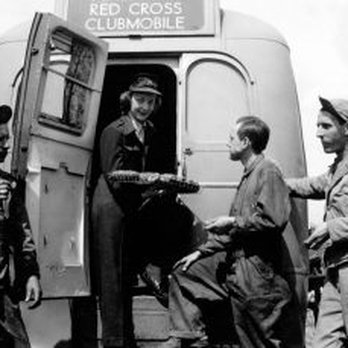
Donut Dollies was popular term used for ARC women who volunteered to work overseas in mobile service clubs called clubmobiles. They provided food, entertainment and a bit of a connection to home to GIs stationed overseas.
On the home-front millions of ARC volunteers provided aid and comfort to GIs and their families, service in hospitals experiencing severe staffing shortages, provided first aid and water safety training, conducted scrap drives, organized Victory Gardens, initiated educational programs, in-home nutrition, and produced emergency supplies for victims of war. ARC also recruited thousands of nurses to Serve in Army and Navy Nurses Corps.
ARC served American prisoners of war as a conduit for communication between prisoners and their families, providing essential care packages to prisoners though many captors thwarted these efforts.
ARC war time activity reached its peak in 1945; 7.5 million volunteers and 39,000 paid staff were supporting war effort. By the time of the end of the war, the American public had contributed over $784 million in support of Red Cross activities.
During World War II, 86 ARC workers, 52 women and 34 men, lost their lives.
ARC volunteers were with GIs during US military actions following WWII:
Korea 1950-1953 where two American Red Cross members lost their lives and many others were injured.
Cuba 1961
Viet Nam 1961-1973 where 480 ARC field directors, hospital personnel and recreation workers served in Southeast Asia. ARC workers brought recreation to an average of 280,500 GIs each month. Five ARC members lost their lives and many others were injured.
Dominican Republic 1965, Lebanon 1982, Grenada 1982, Panama 1982
Gulf War (Kuwait and Iraq) 1991 where ARC volunteers carried 215,000 emergency messages to and from GIs. They aided more than 4,700 GIs and their families with $1.72 million in emergency financial aid and other services. Seven ARC workers received the Bronze Star for meritorious service.
Somalia 1983, Haiti 1994, Bosnia 1994-1995, Kosovo 1999, Afghanistan 2001-2021, Iraq War 2003-2010, Libya 2011, War with ISIL 2012-2019, Syria 2017-present
For 100+ years ARC volunteers have worked at Department of Veterans Affairs "VA" hospitals in medical, recreational and welfare programs; and for decades at VA offices providing assistance to Veterans filing applications for Service and disability compensation.
"I am glad to know that somewhere they have learned their duty to their country, and have come up neither cowards nor traitors." - Clara Barton
This day in history 3 Dec 1946, US States Military Academy, aka West Point or simply as Army, Glenn Davis was Heisman Trophy recipient. read more