Cancel

    Open app

    Search

    Whilden Carrier Cottage Photos

    Recommended Reviews - Whilden Carrier Cottage

    Your trust is our priority, so businesses can't pay to alter or remove their reviews. Learn more about reviews.
    Yelp app icon
    Browse more easily on the app
    Review Feed Illustration

    2 years ago

    Helpful 0
    Thanks 0
    Love this 0
    Oh no 0

    Verify this business for free

    People searched for Landmarks & Historical Buildings 185 times last month within 5 miles of this business.

    Verify this business

    Parrot Jungle Historical Entrance Building

    Parrot Jungle Historical Entrance Building

    5.0(1 review)
    17.0 mi

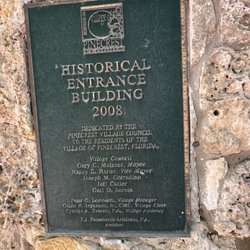
    I love a historic building and this storybook looking structure was once the site of the original…read moreentrance into the attraction Parrot Jungle. 1936 an Austrian named Franz Scherr rented the site of a former nudist colony for $25 a year. He used to visit Monkey Jungle offering unsolicited advice until the exasperated owner told him to open his own jungle. He did just that charging 25 cents to tour his garden and visit his birds. Parrot Jungle did very well for many years especially through the 1970's. Famous visitors include Winston Churchill, US President Jimmy Carter, and Steven Speilberg. During its 66 years of operation, a million people visited the attraction. It was eventually designated a historical landmark making it difficult to make changes to the park to keep up with the changing tastes of consumers. Attendance began to drop due to hurricanes and larger theme parks opening. The decision was made to move the park to Watson Island where it opened in 2003. It has struggled ever since, never finding the following it once had in Pinecrest. Jungle Island closed to visitors during the pandemic and never reopened except for events in the ballroom and camp groups. The land for the park is owned by the city and the operators of the park are unable to pay back the millions of dollars of debts it owes. I have heard many rumors surrounding Jungle Island like plans to turn it into an action park and to build a hotel on the property. What a sad turn of events for the once beloved attraction. Meanwhile back in Pinecrest on December 17, 2002, the Village of Pinecrest, with grant assistance from the Florida Communities Trust and Miami-Dade County were able to purchase the former Parrot Jungle site and turn it into a lovely garden which opened on March 8, 2003. In 2011 this site was added to the National Register of Historic Places as the Parrot Jungle Historic District. Although the parrots are gone the winding paths and beautiful plants remain along with the Parrot Bowl which now hosts community performances. You can still see the original attraction entrance on Red Road as you drive up to the gardens. It was built from Dade County pine, impervious to termites and it had a palm-thatched modeled after the roofs on the Seminole chickee huts. In the 1940s, the roof was replaced with clay tiles and the building front was covered in natural coral rock. According to the historic marker out front, the entrance was damaged by fire in 1994. It is nice to see that although the birds are gone, Franz Scherr's gardens still thrive.

    Photos
    Parrot Jungle Historical Entrance Building
    Parrot Jungle Historical Entrance Building
    Parrot Jungle Historical Entrance Building

    See all

    Special Agent Jerry Dove and Special Agent Benjamin Grogan

    Special Agent Jerry Dove and Special Agent Benjamin Grogan

    5.0(1 review)
    17.6 mi

    This is a memorial marker to Special Agents Jerry Dove and Special agent Benjamin P. Grogan. On…read moreApril 11, 1986, Special Agents Jerry Dove and Benjamin P. Grogan were killed in southwest Miami, Florida, during a gun battle with robbery suspects William Russell Matix and Michael Platt. Agents were conducting surveillance in connection with a series of violent bank and armored car robberies. They observed a suspect vehicle and attempted to stop it which resulted in a high-speed chase. Matix and Platt engaged in a gun battle with agents during which 145 rounds were exchanged in less than 5 minutes. Dove (30) and Grogan (53) were killed and five other agents were injured. Special Agent Edmundo Mireles, Jr. was shot in his left arm but he was able to use his right arm draw his service revolver, and kill Matix and Platt. This incident is regarded as one of the most violent episodes in the history of the FBI. It has been studied in law enforcement training. As a result the FBI and many police forces switched from revolvers to more powerful semi-automatic weapons. The 1988 film In The Line Of Duty: The FBI Murders is based on this event. In 2001, the Village of Pinecrest, Florida, which incorporated in 1996, honored the two fallen agents by co-designating a portion of Southwest 82nd Avenue as Agent Benjamin Grogan Avenue and Agent Jerry Dove Avenue. Street signs and a historical marker commemorate the naming of the roadway in honor of the two agents.

    Photos
    Special Agent Jerry Dove and Special Agent Benjamin Grogan
    Special Agent Jerry Dove and Special Agent Benjamin Grogan

    See all

    Doc Thomas house

    Doc Thomas house

    5.0(1 review)
    14.7 mi

    The non profit Tropical Audubon Society (TAS) has its origins as the Coconut Grove Audubon Society…read more(CGAS), founded April 16, 1915, as Dade County's first Audubon organization. CGAS members met in homes and worked to advocated for bird and wildlife protection, protection of birds hunted for their plumes with the hiring of game wardens, ornithological education for school children and the public, and they also collaborated in the movement to establish Everglades National Park. WWII led to the CGAS becoming inactive in 1942. Led by Charles Brookfield, then employed by National Audubon Society, a new chapter of the National Audubon Society was established in 1947. The Tropical Audubon Society (TAS) has been on the frontlines of conservation and environmental protection issues in South Florida. The mission of the Tropical Audubon Society is to "conserve and restore South Florida ecosystems, focusing on birds, wildlife, and their habitats. The Tropical Audubon Society has been headquartered at the 1932 Doc Thomas House since 1976. It has been designated a Miami-Dade County Historic Site, a Florida Heritage Site, and is listed in the National Register of Historic Places. Arden Hayes Thomas, Jr. was a pharmacist from Indiana who moved to South Miami in 1925, and opened the O. K. Drug Store just months before the Great Miami Hurricane of 1926. His business grew to managing two stores on Sunset Drive and Thomas invested in a 2.5 acres of property on the south side of Sunset Drive in the subdivision of High Pines. He commissioned Robert Fitch Smith, one of the first six graduates of the University of Miami architecture program, to create a home that would look like part of the piney landscape. He created a rustic house in the Florida wood-frame vernacular style of architecture that exemplified the influence of the Arts and Crafts movement. Created out of cypress, oak, pine mahogany, and local limestone, the home has detailed woodwork, a limestone fireplace, and built in features. Smith went on to a storied career as an architect, taught at the University of Miami, and served on the first City of Miami Planning Board. In the 1950's Doc Thomas retired and traveled the world. A life long conservationist and bachelor, Doc Thomas decided to leave his home and the surrounding 2 acres of woodlands to the TAS. He deeded the property to them in December of 1974 and he passed away exactly one year later. Since 1976 the house has functioned as the home of Tropical Audubon Society while the surrounding acreage now serves as the Steinberg Nature Center. I first discovered this delightful nature oasis and historic home in the middle of South Miami while eating lunch at Whisk which is just down the street. The gate is open so you can walk around what feels like a a secret garden. On the first Saturday of the month the Tropical Audubon Society hosts a public tour of the historic Doc Thomas House headquarters which has recently undergone structural repair and restoration. The tour is free although donations are welcome and lasts for 1 hour guided by a Tropical Audubon docent. I was finally able to attend the tour and learned so much more about Arden Hayes "Doc" Thomas and Robert Fitch Smith as we explored the house and near-native Steinberg Nature Center campus. The Steinberg Nature Center contains Pine Rockland, a globally endangered ecosystem. It is only located in south Miami, the Keys, and parts of the Bahamas. Pine Rockland once covered 180,000 acres or 12 percent of Miami but by the time Miami turned 100 in 1996, less than 2 percent remained. Today only fragments of the Pineland remain. It is a critical refuge for endangered plants and animals, some not found anywhere else in the world. I loved getting to see the inside of the house although the furnishings are not original and the bedrooms are now TAS offices. One of the few objects that actually belonged to Doc Thomas is the mantel clock. The docents were so engaging and they made the time fly by. A special thank you to Dan for one of the highlights of my visit, showing me a first edition copy of River of Grass that was signed by Marjory Stoneman Douglas. Come out and learn about this important ecosystem and the pioneers who lived here and built South Miami. The last tour of season will be May 4th. They also have a fundraising Conservation Concert series on the last Saturday of the month with live music, food truck, and area restaurant take out. The next date for that event is April 27th. The house is still undergoing restoration so all donations to this non profit are sincerely appreciated.

    Photos
    Doc Thomas house
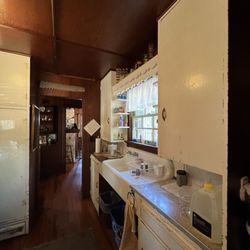
    Doc Thomas house - Kitchen with original cabinets.

    Kitchen with original cabinets.

    Doc Thomas house

    See all

    Segovia Traffic Circles Sculptures - Located on the roundabouts near the golf course and also the original old walls

    Segovia Traffic Circles Sculptures

    4.5(4 reviews)
    12.1 mi

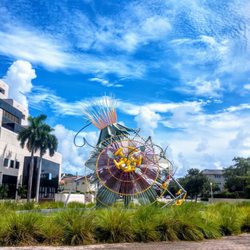
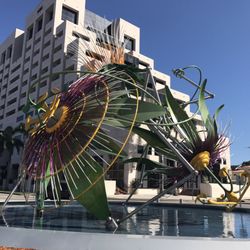
    Coral Gables is known for it's numerous plazas, entrances, and fountains from 1920's. That's why I…read morefind it so interesting to see what current works of art are being added. Anything new needs to harmonize with the beautiful features that George Merrick added in when he created the city. In 2014 the city approved two sculptures to be installed at the traffic circles along Segovia Street. They were designed by New York-based artist and sculptor Alice Aycock. The two installations are the first public art pieces to be added since George Merrick was alive. The sculptures are inspired by the passion flower and are constructed of more than 4,000 pieces of metal. The two sculptures are different. The sculpture on Biltmore is larger and has two flower designs. The Coral Way sculpture is designed to mimic a flower flowing in the breeze. More than 180 submissions were judged before a panel selected Aycock's design. The flowers have received mixed reviews from the community. Many feel that the modern art is not in keeping with the look of the city. A group of residents tried to have the sculptured removed but did not muster enough signatures for the ballot. Some of the complaints are that the sculptures are not Mediterranean and that accidents have increased at the traffic circles since the sculptures were installed. Others complain bitterly that they are not even able to choose a paint color for their house yet the city has moved away from the Mediterranean look of the city without consulting them. The city has decided to keep the sculptures despite the protest of some people who do not care for the look of modern art in their 1920's Mediterranean Revival city.

    Interesting new metal art located near the golf course and situated on two roundabouts. There are…read moretwo pieces one on each roundabout - They are passions flowers. Other people here have told the history about them so I will leave it at that. However what I did read about on the net and thought was amusing - was some local residents were not very happy with them, thinking they did not represent Coral Gables mediterranean image, so they started a petition to get them remove. They did get over a thousand signatures but no where near enough to make an impact and get them removed. Looks like they are here to stay. I was not too keen when I first saw them and had a little chuckle to myself as the largest one is situated in front of a plastic surgery office (HE HE)...(apt? - you decide). However after walking around and actually really looking at them, the location, the area, they started to grow on me!...Let me know what you think - when you go for a look!

    Photos
    Segovia Traffic Circles Sculptures - Located on the roundabouts near the golf course and also the original old walls

    Located on the roundabouts near the golf course and also the original old walls

    Segovia Traffic Circles Sculptures - Located on the roundabouts near the golf course and also the original old walls

    Located on the roundabouts near the golf course and also the original old walls

    Segovia Traffic Circles Sculptures - First one! Passion fruits (these are the vine's flowers) seem to be the rage here in Miami! :)

    See all

    First one! Passion fruits (these are the vine's flowers) seem to be the rage here in Miami! :)

    El Jardin

    El Jardin

    4.3(3 reviews)
    14.3 mi

    I first saw - and entered El Jardin in 1982/83. At that time it contained the office of Father…read moreRoger Radloff, a Catholic priest and Jungian psychologist which he used in relation to a private practice that he maintained in addition to being the "shrink for the diocese" as he put it. His assistant at that time was Eugene Ritter. I believe Radloff also offered services to students at the adjoining Carrollton School, which owned the gatehouse. As with all Miami revival architecture, El Jardin is at one with the earth, looks organic, and is built with color, shapes and textures as well as stone.

    I went to coconut Grove to see as many historical places as possible, and spotted this one. See…read moreinfo I got from the net regarding it. El Jardin is a house located at 3747 Main Highway in Miami, Florida. It is listed on the U.S. National Register of Historic Places. El Jardin is now home to Carrollton School of the Sacred Heart in Miami, Florida. It was added to the U.S. National Register of Historic Places on August 30, 1974. Built in 1918 along a ridge of oolitic limestone, El Jardin expresses the broad training of its architect, Richard Kiehnel of Kiehnel and Elliott, and the experience of its owner, John Bindley, then president of Pittsburgh Steel. Kiehnel, in a September 1928 article for Tropical Home and Garden, referred to the house as a "progenitor of the Modern Mediterranean style home." Kiehnel relocated to Miami from Pittsburgh and became the architect for many landmark buildings, including the Coral Gables Congregational Church, Miami Senior High, and the Coral Gables Elementary School.

    Photos
    El Jardin
    El Jardin
    El Jardin

    See all

    Marjory Stoneman Douglas Historic Home

    Marjory Stoneman Douglas Historic Home

    4.3(3 reviews)
    14.9 mi

    I love discovering old places, and if they are abandoned even better for me! It is surely worthy of…read morea trip - lets hope they GET ON WITH RESTORING IT, and stop wasting money on just maintaining it!! (its been owned by the state since 2007 after all!!!) Here is some more information and history about this house (sourced from https://www.visitflorida.com/en-us/things-to-do/arts-history/marjory-stoneman-douglas-house.html) Almost 68 years after Marjory Stoneman Douglas' "The Everglades: River of Grass" changed the popular conception of the Everglades from worthless swamp to treasured ecosystem, the Stoneman Douglas house in Miami's leafy Coconut Grove neighborhood will be designated a national historic landmark. During his first visit to Everglades National Park in April 2015, President Barack Obama declared the protective designation for the conservationist's modest 1926 cottage at 3744 Stewart Ave. No plans have been announced yet for opening the stucco-covered, wood-frame Stoneman Douglas house to the public, although fans still can go by the historic one-story home, now surrounded by million-dollar mansions. Preservationists and environmentalists have argued for years with neighbors over the fate of the bungalow and concerns that turning it into an education center or attraction would overwhelm the area with traffic and violate residential land use codes. A plan to move the house three miles from its South Grove location to Fairchild Tropical Botanic Garden was scrapped in 2006. The Stoneman Douglas house and property have been owned by the State of Florida and since 2007 has been maintained by the Florida Park Service as a lasting memorial to a remarkable "woman who saved the Everglades." As a 34-year-old divorced woman living with her father, buying her own house represented independence to Douglas. In her autobiography, "Voice of the River," she wrote about her desire to have a place of her own. I didn't need much of a house, just a workshop, a place of my own. All I wanted was one big room with living quarters tacked on. I knew an architect, George Hyde, who drew up some plans. He mostly built factories, which was fortunate, because I hoped my little house would be as stout and as sparse as a factory with not much to worry about. Because she never learned to drive, the house had no driveway (or air conditioning, electric stove or dishwasher). Part Tudor Revival and part Medieval Revival in design, the house, created by well-known architect George Hyde, is noted for its hip roof, half-timbering, post-hurricane wood floors, elegant detailing, and cast bronze hardware. Starting out as a young writer working for her father at The Miami Herald in 1915 following her brief marriage, Marjory Stoneman Douglas eventually produced more than 100 short stories for popular magazines. "River of Grass," published in 1947, was her most influential work. Later in life, she became a relentless crusader for the natural preservation and restoration of the nature of South Florida. She recognized that the Everglades was a system that depended not only on the flow of water from Lake Okeechobee into the park, but also upon the Kissimmee River which feeds the lake. To add a voting constituency to her efforts, in 1970 she formed the Friends of the Everglades, and was active as the head of the organization. Dubbed the "Grande Dame of the Everglades," she received the Presidential Medal of Freedom. Upon her death at the age of 108 in 1998, The Independent in London stated, "In the history of the American environmental movement, there have been few more remarkable figures than Marjory Stoneman Douglas." Today, Everglades National Park, the largest subtropical wilderness in the United States, protects over 1.5 million acres. It's the third-largest national park in the lower 48 states, behind Yellowstone National Park and Death Valley National Park. There are three ways to access the park by car. The main entrance in Homestead connects visitors to the Royal Palm Area and the Flamingo Area of Everglades National Park. The Shark Valley entrance is in Miami and the Gulf Coast Entrance is in Everglades City.

    Marjorie Stoneman Douglas lived in this home in Coconut Grove. It was built in 1926 by George Hyde…read moreand is designed to look like an English Cotswolds country cottage. The house looks like it is out of a fairy tale. The house is extremely small, barely 900 feet. Marjorie considered it more of a workshop than a home. It is a single story wood frame T shaped structure with a stucco, brick, and half-timbered exterior walls and a sloping roof covered in wood shingles. The interior has hardwood flooring, plaster walls, and plaster ceilings with exposed beams. The interior has one large room that used to be dominated by Marjorie Stoneman Douglas's desk. The other rooms are a little bedroom and a tiny kitchen that only held a hot plate and toaster. Furnishings in the home were very simple. The house didn't have a driveway because she never learned to drive or central air conditioning. Marjorie did much of her writing in the home including the 1947 book The Everglades: River of Grass which spawned a movement to save the Everglades from development. The state of Florida purchased the house in 1991. Marjory was allowed to live out the rest of her life in her home which she did until she passed away at the age of 108 in 1998. The house was designated a national landmark in 2015. The house sits vacant as the people in the neighborhood have fought any attempts at turning the house into a museum fearing the traffic it would bring to the area. With the shooting that took place at the high school named in Marjorie Stoneman Douglas's honor in Parkland her name has been thrust back in the spotlight and there is renewed interest in finally doing something with the house. It seems like the neighbors may finally be coming around to allowing access to the house on a limited basis. Before that can happen the state needs to repair termite damage and mold caused by an air conditioner leak. Some of the ideas for the house are to turn it into a museum to honor Marjory or to allow a writer to live there in residence. A plan that has been scraped is to move the house to Fairchild tropical Gardens where there is a statue of Marjory Stoneman Douglas sitting on a bench. I am a long time Marjory Stoneman Douglas fan. As someone who loves the Everglades I appreciate her and everything she did to save it from development. I have seen many lovely pictures of her outside her home usually with a cat. Visiting her house was a thrill. I especially loved discovering the seahorse on the outside fireplace and the hand shaped doorknocker on the front door. I truly hope the neighbors and the state can come to an agreement to allow people access to the property. Right now you can easily park in front of the house and take a peek in the windows. Marjory Stoneman Douglas created a lasting environmental legacy and her home deserves to be protected and maintained. Maybe even more so after what happened in Parkland. The house belongs to all of us and we should be able to pay our respects to her there.

    Photos
    Marjory Stoneman Douglas Historic Home
    Marjory Stoneman Douglas Historic Home
    Marjory Stoneman Douglas Historic Home

    See all

    Whilden Carrier Cottage - landmarks - Updated May 2026
    Loading...
    Loading...
    Loading...