Cancel

    Open app

    Search

    Water Tower Photos

    Recommended Reviews - Water Tower

    Your trust is our priority, so businesses can't pay to alter or remove their reviews. Learn more about reviews.
    Yelp app icon
    Browse more easily on the app
    Review Feed Illustration

    11 years ago

    Helpful 1
    Thanks 0
    Love this 1
    Oh no 0

    18 years ago

    Helpful 0
    Thanks 0
    Love this 0
    Oh no 0

    Verify this business for free

    People searched for Landmarks & Historical Buildings 527 times last month within 5 miles of this business.

    Verify this business

    The Whittington Stone - Dick Whittington Stone and Cat, Archway, London

    The Whittington Stone

    4.1(7 reviews)
    2.0 miArchway

    Lovely afternoon with friends. Great food and super friendly staff would highly recommend Thank…read moreyou for a great afternoon

    Dick Whittington was a real person,who lived from about…read more1350 to 1423, and he was indeed Mayor of London. There are many variations of the story based on a play produced in 1606 with later additions and evolution over hundreds of years.He was never actually 'Lord' Mayor, as that title was not used until a much later period, but the Mayor was a very important position: the holder was head of government for the City of London.Usually the story is 3 times Lord Mayor. He was Mayor 4 times. Near the foot of Highgate Hill is the famous Whittington stone, which is supposed to mark the point where Dick Whittington, on his way out of London, heard the sound of bow bells chiming 'turn again Whittington, Lord Mayor of London' and decided to return to the city. The cat is harder to explain; there is no evidence that Dick Whittington ever had a cat. Maybe the association with the animal arose from the type of boat he used for trading, known as a 'cat'. The present sculpted cat on the top of the stone was not added until 1964. The story first appeared nearly 200 years after Whittington's death. Other characters were added, and Dick Whittington became a favourite pantomime in the 19th century. Many legends surround Old Highgate and Hampstead, and there is an old belief that if Whittington's Stone is ever removed or if any harm should befall it, great change and disaster will fall upon the neighbouring area. Of course, this myth is probably based upon the fact that the Stone is one of Highgate's oldest landmarks, and therefore, it would be bad luck to remove it. The real Richard Whittington was apprenticed to the Mercers' Company in the City of London. He became a successful trader, dealing in valuable imports such as silks and velvets. All his goods would have entered London through the river quays. Whittington was three times Master of the Mercers' Company and four times Mayor of London. Richard II and his successor Henry IV were important customers for Whittington. He supplied silks for the wedding dresses of the daughters of Henry IV. Richard Whittington's fortune was used for many charitable purposes, including almshouses, a library, and also public works such as improvement to the water supply and a public lavatory. The Whittington Charity still exists, and provides housing and financial help.

    Photos
    The Whittington Stone
    The Whittington Stone
    The Whittington Stone

    See all

    Crossbones Graveyard

    Crossbones Graveyard

    4.6(5 reviews)
    4.2 miBorough

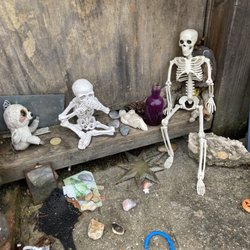
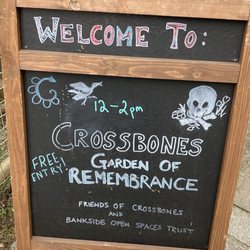
    This little garden was on a list of strange/offbeat attractions to see on my trip to London because…read moreof the dark history around it. It's basically a garden grown atop a mass grave for poor, unmarried women, sex workers, and children. Small but lovingly cared for by volunteers, it is only open from noon to 3PM on weekdays during the summer. There is some artwork and little memorials. It's a little out of the way, but if you're in the area it's a nice quick stop to pay tribute to the forgotten women and children.

    Another Halloween visit? This one holds a celebration here…read more Cross Bones Graveyard was a mediaeval burial ground, situated in St Saviours parish, now Redcross Way SE1. There is a long established tradition that it was a final resting place for Winchester Geese, ie prostitutes, from the legalised brothels or 'stews' of Bankside. This dates back to the days when the Bishop of Winchester ran Bankside and licensed the Geese. Recent archaeological digs for the Jubilee Line extension have uncovered evidence of a highly overcrowded graveyard where bodies are piled up on top of each other and tests have shown that many of the bodies are women and children with diseases ranging from smallpox, TB and pagets disease to osteoarthritis and vitamin D deficiency. This is Cross Bones, an unconsecrated graveyard going back to medieval times. The Tudor historian John Stow refers to it as a burial ground for 'single women' - a euphemism for the prostitutes who worked in Bankside's legalised brothels or 'stews'. In his 1603 Survey of London, Stow writes: 'I have heard of ancient men, of good credit, report that these single women were forbidden the rites of the church, so long as they continued that sinful life, and were excluded from Christian burial, if they were not reconciled before their death. And therefore there was a plot of ground called the Single Woman's churchyard, appointed for them far from the parish church.' The burial registers of St Saviour's parish don't distinguish between burials in Cross Bones and those in the churchyard adjoining what is now Southwark Cathedral. However, the long-established local tradition - that Cross Bones was a prostitutes' graveyard - is restated in the Annals of St Mary Overy (1833): 'There is an unconsecrated burial ground known as the Cross Bones at the corner of Redcross Street, formerly called the Single Woman's burial ground, which is said to have been used for this purpose' Such women were condemned to be buried in unhallowed ground. Yet many were actually licensed by the church. For some 500 years, the Bishop of Winchester exercised sole authority within Bankside's 'Liberty of The Clink', including the right to licence prostitutes under a Royal Ordinance dating back to 1161. These women became known as 'Winchester Geese'. Cromwell and the Puritans shut down the Bankside pleasure quarter, with its bear-pits, theatres, taverns and stews. By Victorian times, the area around Cross Bones was known as The Mint - an overcrowded, cholera-infested slum, and a notorious thieves quarter. When William Booth was conducting his survey of poverty, his researcher George Duckworth described it as: ' a set of courts and small streets which for number, viciousness, poverty and crowding, is unrivalled in anything I have hitherto seen in London.' Duckworth walked around The Mint with a policeman who told him: 'Police don't go down here unless they have to, and never singly.' Around this time, Cross Bones witnessed many a pauper's burial. It was also the haunt of body-snatchers, seeking specimens for the anatomy classes at nearby Guy's Hospital. The graveyard was finally closed in 1853, on the grounds that it was 'completely overcharged with dead' and that 'further burials' would be 'inconsistent with a due regard for the public health and public decency'. In 1883, it was sold as a building site, prompting Lord Brabazon to write to The Times: ' with a view to save this ground from such desecration, and to retain it as an open space for the use and enjoyment of the people.' (10th November 1883) The following year the sale was declared null and void, under the Disused Burial Grounds Act (1884). Subsequent attempts to develop the site were fiercely resisted by local people. The land was briefly used as a fair-ground until an action was taken against the showmen for abatement of the nuisance caused by steam organs and noisy music. Apart from these minor intrusions, the graveyard slept peacefully and unmolested for the best part of a century. Then, in the 1990s, London Underground built an electricity sub-station to supply power for the Jubilee Line Extension. Prior to the work, Museum of London archaeologists conducted a partial excavation of the site, removing some 148 skeletons. By their own estimate, these represented: 'less than 1% of the total number of burials that were made at this site.' Some were exhibited at the Museum's 1998 London Bodies exhibition, including: ' a young woman's syphilitic skull with multiple erosive lesions, from Red Cross Way, Southwark, 18th century'.' 'For tonight in Hell, they are tolling the bell For the Whore that lay at The Tabard And well we know how the carrion crow Doth feast in our Cross Bones Graveyard.' They have since conducted many rituals and community events at the graveyard. The rituals are simple, inclusive and non-dogmatic, emphasising respect for 'the Ancestors', and honouring the spirit of

    Photos
    Crossbones Graveyard
    Crossbones Graveyard
    Crossbones Graveyard

    See all

    Sky Garden - Sky Garden_Yelp_Sanju-2

    Sky Garden

    4.3(350 reviews)
    3.7 miAldgate

    Sky Garden ended up being such a fun experience while we were in London…read more We started at the restaurant on the 27th floor and ordered a bottle of champagne for my friend's birthday. They gave us a really nice birthday discount which was unexpected and appreciated. The service the whole time was fantastic and the views were honestly incredible. After that we went down to the 26th floor and stayed there for a while because the vibe was just really good. Live music, more amazing views, people hanging out and enjoying themselves... it felt very "London night out" in the best way. Touristy? Sure. Worth it? Absolutely. Definitely something I'd recommend making time for if you're visiting London.

    The Sky Garden is an absolute masterclass in how to waste people's time while pretending to run a…read more"reservation system." We had tickets for 12:45. In any remotely competent operation, that means you show up at 12:45 and go inside at 12:45. Not here. Here, your reservation is basically a polite suggestion that no one intends to honor. There is zero clear signage, so instead of simply following directions like a normal human being, you are forced to stand in a line just to ask someone what you are supposed to do. And who is handling this? One single, overwhelmed employee who is somehow responsible for scanning tickets and answering every random walk up question. One person. For a major tourist attraction. It is not just inefficient, it is absurd. After wasting time in that line, you are then sent to another, much longer line. For your "timed entry." So at 12:45, your actual reservation time, you are not entering. You are standing in a slow moving queue wondering why this place even bothers issuing tickets with times on them. Let's call it what it is. If you cannot honor reservation times, do not offer reservations. This system does not manage crowds, it creates them. And here is the part that really pushes it over the edge. We missed another reservation because of this disaster. Not because we were late. Not because we did not plan. But because this place is so poorly organized and so wildly inefficient that it derailed the rest of our day. That is not just annoying, it is completely unacceptable. This is not some small oversight. This is a fundamental failure in basic operations, communication, and respect for visitors' time. It is almost impressive how badly it is handled. By the time you finally get inside, it honestly does not matter how good the view is. The experience has already been ruined by the chaos, the delays, and the sheer incompetence of the system. If you value your time, skip it. Or go in fully expecting your "reservation" to mean nothing and your schedule to take the hit.

    Photos
    Sky Garden
    Sky Garden - Me!

    Me!

    Sky Garden - Upstairs bar

    See all

    Upstairs bar

    Banksy Graffiti Artist

    Banksy Graffiti Artist

    4.3(6 reviews)
    2.7 miHoxton

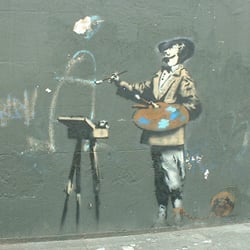
    Here Banksy rather humorously juxtaposes the cliché artist, with moustache, beret and palette,…read moreworking on a decidedly less high brow art work depicting a scribble of a huge male member. The artist is also wearing a ball and chain, with a dollar sign on the ball. I'm not sure what conclusion I'd want to draw, but I guess the piece certainly summarises the debates about Banksy himself. Art or just daubs? Pretensions of grandeur? Destroyed by money, or elevated beyond his natural position by the hype? A couple of changes have been made. The council (apparently) have partially obscured the male member, though it's still pretty clear what it's meant to represent. As for the person who's added their opinion that Banksy is a **, I don't think they've given much thought to what they are doing. Their banal addition rather demonstrates they are the one with pretensions of grandeur if they think they can comment! This is on the side of a restaurant on the junction of Shafton Road and Victoria Park Road.

    I've found this piece of art yesterday night (Feb 21st 2012) by accident as I was surfing Hackney…read moreby car in search of graffiti. When I saw it I almost had no doubt it was made by Banksy, and as it took me a good hour to find this first and only painting in Hackney, I interpreted it not only as the sign of the end of free art this would be no news! but also as the end of street art. All in all this classic looking artist is not trying to paint a beauty on a canvas, but a rebel sign on a public wall, while his leg is locked with this ball with the money sign. So when I associate all this with the fact that all Hackney walls are now purified from graffiti, I'm just left with the impression that art was finally killed, both indoor and in the streets. Ciao, Nicola Principato

    Photos
    Banksy Graffiti Artist

    See all

    Water Tower - landmarks - Updated May 2026

    Loading...
    Loading...
    Loading...