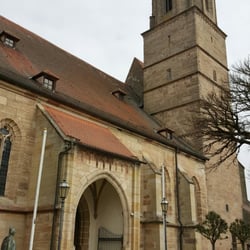
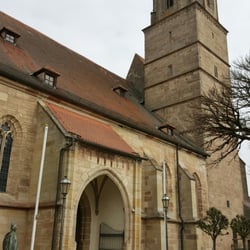
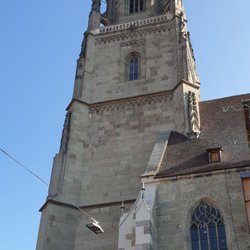
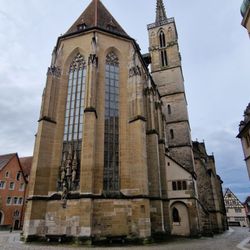
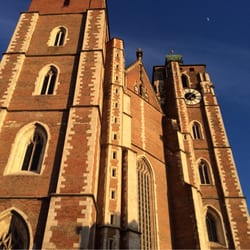
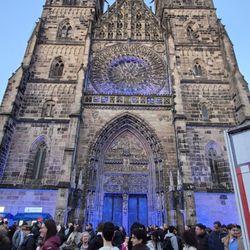
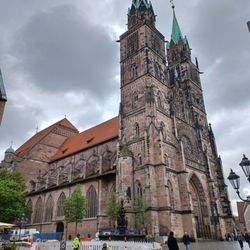
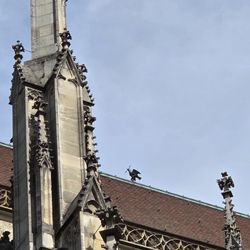
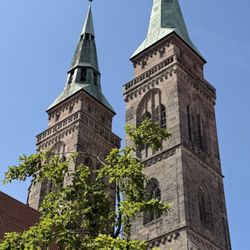
St. Gorgeskirche is a late Gothic hall church built between 1427 and 1505 with its 89.9-meter tower…read moreabove the west portal, popularly known as "Daniel," can be seen from some distance, is the town's landmark.
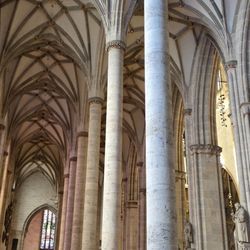
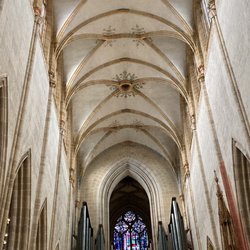
The council of the imperial city of Nördlingen decided to build the Georgskirche on October 17, 1427. The choir of the hall church was completed in 1451, and in 1454 construction of the tower began. The high altar by Friedrich Herlin was completed in 1462, and the tower in 1490. With the completion of the vault in 1505, the construction, which consists largely of suevite, was completed. Because Nördlingen joined the Reformation under Kaspar Kantz, St. Georg became the Protestant town church in 1523/1525. The 93-meter long and over 20 meter high nave makes St. Georg one of the largest hall churches in southern Germany. The building consists of a three-aisled choir and a three-aisled, twelve-bay hall with twelve central columns.
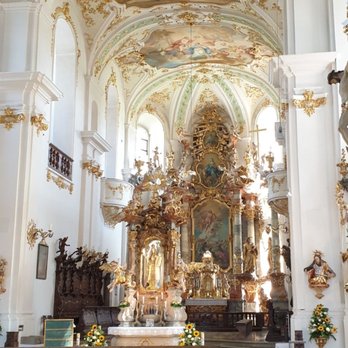
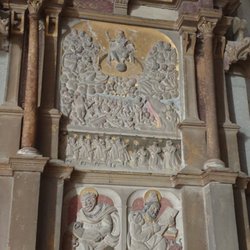
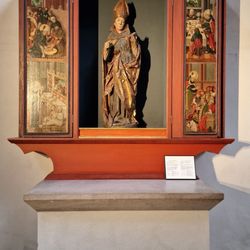
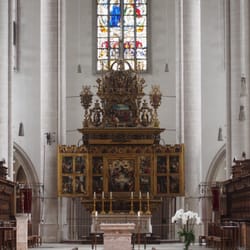
The baroque high altar is decorated with late Gothic wooden sculptures. It is a crucifixion group with Mary and John and two mourning angels, flanked by St. George with the defeated dragon at his feet and Mary Magdalene with the anointing vessel in her hand. These figures, which can be seen today in the Nördlingen City Museum, were originally in a wooden shrine with movable wings that was built around the same time and painted by Friedrich Herlin. The altar was given its baroque appearance in 1683. The housing of the late Gothic wooden shrine was only discovered under the baroque casing during the restoration in 1971-1973. Today it stands on the north wall with the painted rear front (eight Passion scenes of Christ and the Last Judgment ) to the front.
The late Gothic stone pulpit has a plinth with lush, intertwined ribs and a staircase with an openwork tracery parapet. The four evangelists with their symbols are depicted as reliefs on the pulpit. In between, the Man of Sorrows, Mary, Mary Magdalene, John the Evangelist and St. George can be seen under canopies.
The baroque sound cover, on which Christ is enthroned with the globe, was made by Johann Michael Ehinger in 1681. The wooden sound cover is decorated with putti and angel heads.
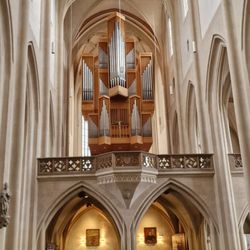
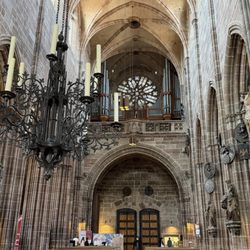
First restoration happened in the years 1877 - 1887. On March 30, 1945 at 9:25 p.m., an aerial bomb destroyed the "Steinmeyer Organ" set up in 1889. On February 2,1974 a fire destroyed the old baroque organ from 1610.