Cancel

    Open app

    Search

    Viking Tours

    4.0 (2 reviews)

    Viking Tours Photos

    Recommended Reviews - Viking Tours

    Your trust is our priority, so businesses can't pay to alter or remove their reviews. Learn more about reviews.
    Yelp app icon
    Browse more easily on the app
    Review Feed Illustration
    Photo of Car T.
    1
    62
    41

    9 years ago

    Helpful 0
    Thanks 0
    Love this 0
    Oh no 0

    13 years ago

    Helpful 0
    Thanks 0
    Love this 0
    Oh no 0

    Verify this business for free

    Get access to customer & competitor insights.

    Verify this business

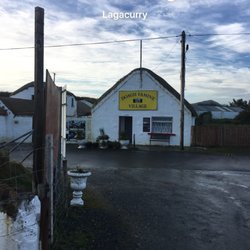
    Doagh Famine Village - Outside

    Doagh Famine Village

    2.0(1 review)
    32.0 km

    We got a tour from a local guide as part of the 8 Euro a head entry fee. You pay in the shop and go…read morethrough into the 'village'. Our guide showed us 3 types of seaweed and 2 dead flatfish, which he had preserved in murky salt water. He claimed these ex-fish had been in the water 16 months without stench. I asked myself, so what. The guide was a friendly enough soul but the story of how the Irish famine came about is a historically & politically complex one to be dealt with respectfully and delicately which isn't reflected much here at all. It's a ruse to draw us in. He didn't mention the Gombeen Man, a spiv wheeler-dealer or businessman who is always looking to make a quick profit, often at someone else's expense or through bribes. The term referred originally to money-lenders. It became associated with those Irish shopkeepers and merchants who exploited the starving during the Irish Famine by selling much-needed food & goods on credit at ruinous interest rates. Its origin is the Irish word "gaimbín", meaning monetary interest. It began to dawn on me that this place isn't much to do with the Irish famine at all nor does it go through 1,000 years of Irish history unless it's a fleeting journey with few stops and fewer facts. The tour starts in a house where the guide Mr Pat Doherty said he lived in until the 1980's. It was here he introduced us to the dead fish and seaweeds. He spoke of commerce & trade. He gave a naive, almost simplistic, interpretation of Ireland joining the 'free' trade European market espousing this as a chief reason why he and his fellow country folk no longer lived in hovels, eating seaweed and boiled limpets, surviving without running water or electricity. He discussed NAMA. According to him, its an Irish government - sponsored bunch of banking gombeens appointed by the Irish government to do its dirty work post an economic banking collapse caused by a different bunch of banking gombeens who lent money to folk at exorbitant rates who couldn't pay the debt back; so NAMA can take huge salaries and the blame for the dirty work to clean up all the nasty crooked stuff and the political gombeens who appointed them (and who failed initially to properly regulate the first set of banking gombeens) sidestep blame for the punitive financial brutality inflicted on Irish people by NAMA gaimbíns for the Government. He's not so far out about this avoidable mess, NAMA's mischievous origins and questionable divisive activities; let's say he certainly has the gist. We also went into an 'Irish wake house' with a dummy body in a coffin where he began telling stories of traditions & superstitions around death across Europe to do with salt, plates atop dead bodies, wailing women and fear of being buried alive. All fascinating stuff for about a minute but what's this got to do with the Irish Famine or 1,000 years of Irish history. This private sector place risks doing a disservice to the brutality of the Irish Famine ignoring the role played by Irish people who condemned their fellow citizens to appalling starvation. This place edges close to being a gaimbín creation itself. Maybe they'll open a NAMAland where they show landlord evictions. It would have a symmetry. There's also replicas of a 'Meeting House', an Orange Hall, a naff ghost House, a travellers halting site and a republican 'Safe House'. The latter has 'secret rooms' and images of Mr G Adams, the now deceased Mr I Paisley (snr) and Mr M Maginnes with various United States political giants; President William Jefferson Clinton and Mr George Mitchell. All nearly moderately interesting stuff for a few minutes but once again nowt to do with the Irish Famine. When you pay the entry fee you get a coupon for 'free' tea or coffee in the adjacent Kitty & Sean cafe. The 'free' coffee offered by these gaimbín merchants is powdered; it isn't proper coffee (they sell proper coffee at a premium price but offer no discount for your coupon if you want real coffee) and food prices here may take the smile off your face. I suspect these prices have much to do with why the locals live so well these days so gaimbínism isn't too far away here.

    Photos
    Doagh Famine Village - Inside the shop

    Inside the shop

    Doagh Famine Village - The surrounding beauty

    The surrounding beauty

    Doagh Famine Village - Inside the village

    See all

    Inside the village

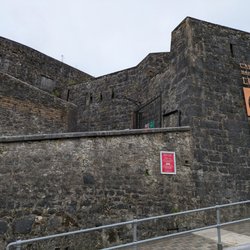
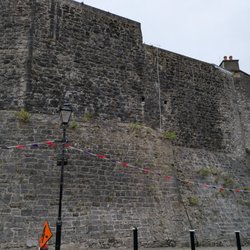
    Athenry Castle - Athenry Castle

    Athenry Castle

    4.7(7 reviews)
    55.8 km

    Located about 15 miles east of Galway off the M6, the Athenry Castle dates back to the 13th…read morecentury. Stone walls, a keep and the restored hall are impressive and a fabulous opportunity to look back into medieval life. Check the doorways and arches and battlements and enjoy the castle's impressive artistry. The structure stands at a ford on the Clareen River. After the castle, walk the grounds. Impeccably maintained and there is free parking. Lots of opportunity for photo ops. The Priory down the street is also impressive. If you stop and listen carefully, maybe you can hear the voices of those who were here before? [Review 1966 of 2024 - 147 in Republic of Ireland - 22988 overall]

    I could not get enough of Athenry Castle. I am from Chicago, where we have 150ish years of history…read more Ireland has thousands of years of history. Athenry Castle brought history classes to life for me. When I talked with locals, they said the castle has always been there for them so they take it for granted. I walked the grounds on more than one occasion and simply could not get enough of this seemingly ancient building with so much history and energy surrounding it. Athenry Castle is worth a stop, not just for the castle, but the town arch and fences which were all part of the original layout. You can also walk the grounds, check out the cemetery and let the kids burn off any energy in the playlot that is right there.

    Photos
    Athenry Castle - Athenry Castle

    Athenry Castle

    Athenry Castle - Athenry Castle

    Athenry Castle

    Athenry Castle - Athenry Castle

    See all

    Athenry Castle

    Claddagh Arts Centre and Katie’s Claddagh Cottage - Tea room and art gallery.

    Claddagh Arts Centre and Katie’s Claddagh Cottage

    5.0(1 review)
    76.8 km

    Tour cost: 5 Euros (includes tea and scones)…read more Full disclosure: I usually run in the opposite direction from anything in Ireland that has even a whiff of "tourist trap" to it. If there's even a chance that someone is going to be getting off a tour bus with a fanny pack singing Danny Boy, it's a hard no for me. Such was my initial concern when hearing about the Claddagh Arts Centre. As much as I longed to visit the place where Claddagh rings originated (quite literally, they were first made during the 17th century in the village where the Centre now stands as the sole remaining dwelling), I had visions of when I visited Amsterdam and got swarmed by merchants hocking diamonds. I assumed this was a touristy spot where the sole purpose was to get you to buy a new ring. I couldn't be happier that I did a bit of research instead of discounting it. The Centre- and the people who run it- have "sales" as the very last thing on their minds. Their true purpose is to educate visitors on the little-known history of how this once-thriving, rural village on the outskirts of the city was forced to abandon its beautiful, traditional, simple life as modernization and the trawler industry in the bay took over. All that is now left of Claddagh village is the one thatch cottage and outbuilding/cafe that houses the Centre. Once inside, you are transported to another century in Ireland. Far from kitschy knick knacks, each item within is an authentic antique from the era, demonstrating exactly what it was like to live in another time. Anna, who gave us our tour, offered a poignant, powerful and thorough recounting of the trials and triumphs of the villagers, instilling in me a new respect for the rings I have worn since my youth. In my many visits to Galway over the years, I had never before had an inkling of this part of its past. After the voyage back in time, we made our way to the art studio and cafe behind the cottage. Wow. It was filled with the most gorgeous work in various mediums from local craftsmen, using materials found around Connemara. Spectacular stuff. And no sales pitch. In fact, Anna seemed surprised that I even inquired about pricing. Her main concern was kitting out the wood table with a feast of tea and scones. By this stage, the latest Claddagh ring I've been wearing for the last few years, one purchased at some point from some random place, seemed almost like an imposter. Expecting to see rows and rows of rings for sale, I was instead shocked (pleasantly) to find just a humble little tray with a dozen or two. There was no fanfare around it. Sales were truly an afterthought to the people here who are so intent on keeping the Claddagh village story alive. Anna apologized for the small selection and explained that they only carry authentic, vintage rings- as in real, historic Claddaghs. Thus, their inventory was sparse. Figuring that meant I would be priced out of owning one of these treasures, I cast a glance at them just for a chance to see what a "real" Claddagh looked like. And immediately fell in love with one. Its simplicity was so perfectly attuned to its heritage. I checked the price tag. 57 Euros. About $64. Otherwise stated: half the price for this antique than what I had paid for the random one on my finger. It came home with me. I honestly cannot put into words the joy it brings me the twenty times a day I glance down at it. The hour or so spent at the Claddagh Village was a vacation highlight for me in a city where I thought I already knew the best spots. Located just a five minute stroll from the Spanish Arch, it took us on a journey of a hundred+ years. Oh. And it's only 5 Euro per person for the tour, tea and scones. I know. Right? Go visit them when you find yourself in Galway. If you're there in the off-season and hours are limited, ask for a private tour (same cost) as we did. Claddagh Arts Centre & Katie's Claddagh Cottage 26 Fairhill Road Upper, The Claddagh Galway, Ireland Web: https://claddaghdesigns.ie Facebook: https://www.facebook.com/CladdaghArtsCentre/

    Photos
    Claddagh Arts Centre and Katie’s Claddagh Cottage - Tea room and art gallery.

    Tea room and art gallery.

    Claddagh Arts Centre and Katie’s Claddagh Cottage - Tea room and art gallery.

    Tea room and art gallery.

    Claddagh Arts Centre and Katie’s Claddagh Cottage - Tea room and art gallery.

    See all

    Tea room and art gallery.

    Emo Court - photo from website

    Emo Court

    4.5(4 reviews)
    60.2 km

    Not where baby Goths go to stand trial, but a beautiful mansion designed by James Gandon of Four…read moreCourts fame in 1790. The playground of various earls until the 1930s, it was taken over by the Jesuits and eventually handed over to the State a few years ago. One of the most impressive features of Emo is its wonderful gardens, which have been rejuvenated in recent times; they include formal areas, woodland walks, a rake of rare trees, an impressive lake and an abundance of statues. Some of these statues were actually pulled from the lake when the State took over the estate, and it is suspected that they somehow made their way their during the time that the Jesuits were running the place. "Brother, there seems to be an effigy of a naked faun down by the old stables." "I think I know the perfect spot for it. Grab a shovel." The house itself is open to the public from Easter to September, but you are free to roam the gardens all year round.

    A lovely house worthy of a visit in the Midlands of Ireland. The house has a history stretching…read moreback to the 18th century, and had an interesting variety of owners- rich English and American gentlement, and the Jesuit Order, before being passed to the Office of Public Works of the state. As with most OPW properties, visiting prices are very reasonable, and the tour guides are interesting and informative. They clearly are passionate about what they do, which is excellent. Something that sticks out for me from the tour was that the Jesuits removed many artworks which were sexual in nature, left behind by previous owners, to avoid tempting the members of the order. I found this quite funny. However, they were good at keeping the art safely stored away to be recovered again in later years. The gardens at Emo Court are also beautiful, and extensive. You can freely roam around in them all year. I particularly like the lake, with many different water birds living there, and a lot of fish. Well worth a visit.

    Photos
    Emo Court - Photo from website

    See all

    Photo from website

    Clonmacnoise - Original high cross

    Clonmacnoise

    4.7(15 reviews)
    11.6 km

    Our first day tour stop on the way to Galway was the Clonmacnoise Monastic Site, another Irish…read morelocation loaded with History. As we pulled in, a derelict Norman Castle greeted us from the parking lot. St Ciarán founded his monastery on the banks of the River Shannon in the 6th Century. The monastery flourished and became a great seat of learning, a University of its time with students from all over Europe. It was also noted for its illuminated manuscripts and skilled craftsmanship. The monastic ruins were abandoned in the 13th Century. The ruins include a Cathedral, two round Towers, three high crosses, nine Churches and over 700 Early Christian grave slabs. The original high crosses, including the magnificent 10th century Cross of the Scriptures are on display in a purpose built visitor centre adjacent to the monastic enclosure. The visitor centre is a must, with the introduction video recommended. One thing I picked up here was learning the difference between a cemetery and a graveyards, of which the latter are always linked to the adjacent Church. Another attraction (beside the pretty view of the River) is the small pavilion where Pope John Paul II hosted Mass in September of 1979. There was a certain peace to this place as Gayle and I walked along.

    It's wild to think about just how old this site is...my mind can barely fathom it. But the…read morebeautiful remains of old churches, lookout towers and grave markings all tell a story. There is a lot of history here and absolutely worthy of a visit and some respect for the people who have lived and died here. The tour guides will share some interesting stories and facts; all worth hearing and appreciating. Be sure to visit the museum to learn a little more and to see the original crosses (replicas replaced them outside to protect them from weather).

    Photos
    Clonmacnoise
    Clonmacnoise - Last Person Buried at This Monastic Site

    Last Person Buried at This Monastic Site

    Clonmacnoise - Cemetary

    See all

    Cemetary

    Viking Tours - historicaltours - Updated May 2026

    Loading...
    Loading...
    Loading...