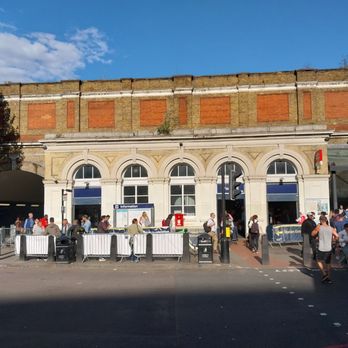
Vauxhall is one of London's less charismatic stations, especially at street level: it is purely functional, and very busy. In the past, in the days of steam, it was a favourite of railway photographers as expresses from Waterloo were puffing hard as they accelerated out of London, and the curves at Vauxhall made for a fine shot. Amazingly, it is the UK's 28th busiest station, outclassing the stations of many major cities, with nearly 10.5 million passengers every year.
One saving grace architecturally is that it has retained its traditional style platforms canopies and awnings. At street level the building is in what one might call 'Banker's Classical' style, with round-arched windows flanked by fluted pilasters in Portland stone - although the general mess of the area (made little better by the new bus station) rather obscures this.
The station has its roots in the London and Southampton Railway, authorised in 1834 and opened to a terminus at nearby Nine Elms, just to the south, in 1838. It was renamed the London and South Western Railway in 1839 and was extended on a long brick viaduct to Waterloo on 11 July 1848, and a station was provided at Vauxhall to replace Nine Elms.
At that point, Nine Elms was demoted to being purely an engine depot, and it remained so until the end of steam on this line in 1967.
The station was also close to the famous Vauxhall Pleasure Gardens, which were at the height of their popularity in the mid 1800s, with attractions such as balloon ascents, concerts, illuminated fountains and fireworks. Although long gone, Vauxhall is said to have inspired the Tivoli Gardens in Copenhagen.
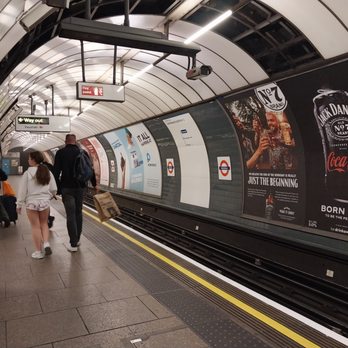
The only major change in its existence has been the addition of the Victoria Line, extended from Victoria to Brixton via Vauxhall on 23 July 1971. The underground station has never properly been integrated with the main line station, although a subway emerges just by the entrance. There are a few kiosks around, selling confectionery, tobacco and newspapers.
Despite its size, the station has always had fairly basic facilities, with a ticket office - but no toilets - as it is really only a suburban station: no long distance trains call here. But it has an excellent and frequent service to most of London's south western suburbs, and trains every few minutes to Waterloo itself.
It has always been a favourite with train spotters as every train from Waterloo passes through, including, until last year, the Eurostars, before they moved to St Pancras - not that modern trains can compare to the likes of the famous 'Atlantic Coast Express' or the glamorous Southampton Boat Trains.
At night, the area can take on a decidedly seedy atmosphere - not one of London's nicest corners.
Useless fact: the Russian word for station sounds like 'Vauxhall' - the pleasure gardens of the same name near St Petersburg were the destination of the first railway line in Russia, and the word apparently stuck. read more