Cancel
Open app
Search
Sign Up
Log In
Nearby
Bookmarks
Start a Project
Add a Business on Yelp
Add Review
Directions
Add Photo
Start your review...
Get app
4 years ago
Whilst roaming around Nunney, you will probably notice this fine building. Built in 1805, This Wesley Chapel was converted into a private dwelling in 1996. read more
See all
Frome BA11
United Kingdom
Hours
What time does The Wesley Chapel open?
What time does The Wesley Chapel close?
Having lived in the West Country for almost six years, I've forgotten what it feels like to be a…read moretourist in Somerset! I'm so used to the winding back roads of Bath, the independent shops and the local way of life. So when my friends came down to escape the Big Smoke for the weekend I took full advantage of being a tourist for the day! We scratched off a couple of options; bus tour? 'We get on a bus everyday!' Trip around the Baths? 'I've already been on a school trip!' Boat trip? ... A resounding yes! With plenty of trips to choose from, we ended up going on the next one that was leaving the lock, and I'm really pleased we did. The hour round trip cost just £6 for a guided tour and some bread to feed the ducks. We saw the first corset factory in England, the lowest bridge in Bath and everything in between. An informative and fun way to spend an hour for locals and tourists alike!
No, not the much loved children's TV program (although Florence and Zebedee wouldn't look out of…read moreplace here) but a roundabout of bizarre sculptures made out of roadsigns. This affectionately known Splott landmark even has a claim to fame, it featured in a 2008 'Roundabouts of Britain' calendar! The quirky roundabout was designed by artist Pierre Vivant. If you're a roundabout lover like me check out www.roundaboutsofbritain.com!
I bloody love this round about! It usually at this point i'm lost somewhere between the bay and the…read morecity centre and then i see this magical is-ore. Made out of road signs by an artist (not a piss) called Pierre Vivant it really is something to behold. Now, careful if you want to go having your picture taken on here, its pretty tricky round about seen's as its a busy one. I don't want to be the cause of any mishaps or worse still, deaths! Now obviously it's not one of Cardiff main attractions and if you're reading this from across the waters you're better off just checking out on yelp other than booking flights over. Its nothing spectacular but is definitely worth mentioning for its quirkiness. One of the prettier round about's the city has to offer!
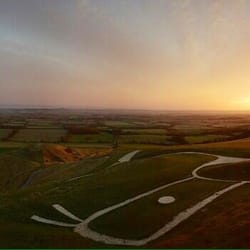
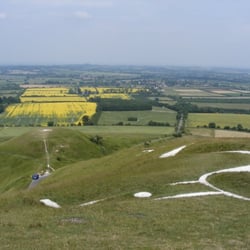
NO IDEA if the map is right here so directions given Wantage (12km ENE)…read more A place of legend and a good day out if you combine it with the other places in the area..see my Wayland's Smithy. Picnic here..spend the day..the views are beautiful. We have to speculate here. It is called a horse but is it really a dragon? Only you can decide. The area would be quite difficult for the disabled. The Uffington white horse can be seen from up to twenty miles away in good conditions. It can be seen close up from the top of nearby Dragon Hill, but is perhaps best viewed from three or four miles away The steep combe below the horse is known as the 'manger'. The ice-cut terraces to west are the 'Giant's Stair'. 'Dragon Hill' a natural outcrop with an artificially flattened top is just to the North. While the great expanse of 'Uffington Castle,' a hillfort dating from 700 bc, guards the southern approaches. Further a-field are the 'Blowing Stone' and 'Wayland's Smithy'. It is the largest of the horses being some 374 feet in length and 110 feet in height, constructed of trenches which are 5 to 10 feet in width and 2 to 3 feet deep and filled with chalk, this is a few feet above the natural chalk of the hill. The horse is in excellent condition being maintained by the National Trust. The edges are well defined partially consolidated with concrete (although well hidden) and the top edge reinforced with polypropylene netting. The Uffington white horse, one of only four that face to the right, is high on an escarpment of the Berkshire Downs below Whitehorse Hill ten feet or less wide, and its length of around 365 feet makes it over twice as long as the longest of the Wiltshire horses The horse can be found 1.5 miles due south of Uffington village on the Berkshire downs ( now in Oxfordshire). It is situated facing NW near the top (at approx. 800 ft) of a very impressive steep escarpment below the Ridgeway long distance footpath, Whitehorse hill and the Saxon hillfort of Uffington castle and above Dragon hill. There is convenient parking nearby at Woolstone hill and at Whitehorse hill. This high locale makes the horse difficult to view from close quarters it is seen rather better from most areas of the Vale of the White Horse. The White Horse is a highly stylised prehistoric hill figure, 374 feet (110 m) long, cut into the turf of the upper slopes of White Horse Hill The figure has been shown to date back some 3,000 years, to the Bronze Age. The horse is thought to represent a tribal symbol perhaps connected with the builders of Uffington Castle. The Uffington Horse is the symbol of Wessex Hall at the University of Reading, adopted in 1920 and still in use. Dragons Hill A bare patch of chalk upon which no grass will grow is purported to be where the dragon's blood spilled. Dragon Hill and is said to be the site where St. George, England's patron saint, slew the dragon. The blood from the dying dragon so poisoned the ground beneath that grass never grows there leaving the chalk scar we see today. Pillow Mound.Between the castle and the Horse lie a number of burial mounds, the most obvious being the Pillow Mound. These date from the Neolithic and Bronze Ages and are unusual in that they were reused for Romano-British and Anglo-Saxon burials. The Giants Stairs are a reminder of how the valley was created by scouring melt-water during the retreat of the last Ice Age. A terrace along the lower edge of the western slopes is thought to be the remains of medieval farming practice.
Went to Uffington's National trust white horse hill, 6 miles fro faringdon yesterday! and the views…read morefrom this English land mark are fantastic on a clear day! you can see Swindon city, Faringdon and all the oxfordshire village's, and oxford. and on the way up you see the chalk horse embedded into the hill side, and you also see dragon mound were it is thought that st George slayed the dragon! and on top of the hill are the remains of Uffington Castle, and a short walk from there an ancient burial ground. Car park £1 for two hours £2 for 4 hour's A great place to take a picnic.
The Manger
White horse hill
King Bladud's Pigs in Bath was a 2008 public art event which aimed to get locals and tourists…read moreinterested in the heritage of Bath. At one point, pigs took over the city with 106 fully sized painted pigs dotted in every street, park and underpass. I won't bore you with history, but the history behind the project dates back to 863BC when Bladud and his pigs were travelling the country in search for a new residence when he, and his beloved animals, contracted leprosy. But, whilst travelling through Bath Bladud's pigs rolled in the hot mud around Bath's springs and were miraculously cured! Sadly, all the pigs have now been auctioned for charity, but you'll still be able to find one or two dotted around so keep your eyes peeled! The workshop which made the pigs is still there selling posters, cards and mini pig statues.
A wonderful step back in time to the rich, snobby, yuppy, elitist, wealthy lifestyle of the English…read moreElites during the Victoria Era. The Georgia architecture is gorgeous and imposing. The interior rooms are recreated in the 19th century Victorian styles with the art, furniture, and decor. The voice actors breath new life and add an amusing storyline that continues in each room you visit...fascinating! Friendly staff all around, whom all seemed very happy at their jobs and supporting this historical site. £16/$22 for entry, and worth it!
This is a walk-on tour of a museum home to give you a idea of a day in the life of a guest family…read more You follow the numbered footprints, room to room and see tables , chairs , beds , clothing , dishes as they would have been on a given day. There is a audio description of family engagement that comes on by cue. You are kind of alone in each room as the entrance person sends guests thru on a timing schedule. But some people are in a rush and catch up. A very eye opening look at dishware and items from 300 years ago. The ticket was a bit expensive for two, but the crown does not support this museum and your entrance is Valid for one year, should you return. They offer a senior rate. We did enjoy it, it's really not for kids. A LOT of things not to be touched or moved. All within reach. It's a real home from the 1700's.
A beautiful island with some very rich history A very nice…read moreday trip or afternoon out can be had here If not a little pricy.
Brownsea Island has a very interesting history but is probably most famous as the birthplace of…read moreBaden-Powell's Scout movement. Scouts and Guides from all over the world still visit the island today although, as naked flames are banned on the island, no more camp fires, I'm afraid. The island is accessible by ferry from several places on the mainland, including Poole Quay and Bournemouth Pier and there is an entry fee of about £5 but it's worth it. Once there you are free to wander around the woodland areas on your own. We took some kind of squirrel tour and our guide was a mine of information about the island and where best to spot the shy red squirrels. And we saw quite a few of the little darlings, if only fleetingly. We also had sightings of other animals and fowl whose antecedents had been domesticated but set free by one of the island's eccentric owners in the 1930s, I think. On the day that we went it was a bit rainy at times but we still had a great time. There is the customary National Trust gift shop where you can stock up on all the squirrel and scout related items that you need while you're waiting for the ferry back to the mainland and, of course, a tea room. I would go back just for the squirrels. Aaaah.
On the beach at Brownsea Island
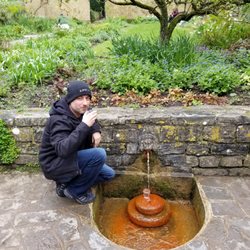
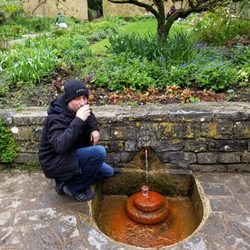
Absolutely worth a visit for any fans of Arthurian legend! The water of the well *does* taste like…read moreblood; due to a high concentration of iron particles, or is the Holy Grail, filled with the blood of Christ, truly buried here? You decide! Although, having drank from the well myself, as far as I am concerned (according to Indiana Jones and the Last Crusade logic), I am immortal until proved otherwise. The gardens themselves are compact, serene and filled with little hidden gems everywhere. Wander. Rest. Contemplate. Fun fact: one of the thorn bushes here was reputedly planted by Joseph of Arimathea during his pilgrimage here, using a piece of the Crown of Thorns. Regardless of the veracity of this rumor, the plant that has grown from that seedling has been used to coronate the Kings and Queens of England for generations.
Definitely worth a visit. It's got great energy and lots of beauty. I try to hit it every time I am…read morehere. Suggestion- sit by the yew tree!!!
Justin Lee Collins, Bill Bailey, Pieminister. There are some names that are just inherently…read moreassociated with Bristol. But arguably the most famous of them all is Banksy: graffiti artist extraordinaire. Banksy has left his tag all his beloved city but my favourite mural can be found at the bottom of Park Street. Opposite College Green on the side of a building you'll see one of his funniest pieces: the story of a lover hanging on to the window ledge for dear life while the suspecting husband looks on. You may need to wait for a minute or two while eager tourists have their photographs against it - but it's definitely worth the wait. Sadly, vandals couldn't stand the witty talent of Banksy and felt the need to deface it with putrid blue paintball shots. The city council have done an excellent job at restoring it back to its former glory, so don't let it put you off visiting. And, if you like this, you'll love the rest of his Bristol collection. Just pop down the road to Fopp and pick up a guide to Banksy's Bristol.
Banksy shows that street art can be thought provoking, beautiful and fun. One of the pieces that…read moresays Welcome to Bristol is the Mild Mild West Giant Teddy Bear vs policemen. Bristol has long had a reputation of musical cool for not only putting out some of the best drum and bass in the country but Trip Hop was known as the Bristol sound. Banksy has most certainly put Bristol on the map as the hub for exciting new urban art. Whereas in London the exciting arts movement tends to move around so that poor artists are pushed further and further into the recesses of deeper darker London, throughout Bristol, North and South pockets of artistic communities have emerged. Bedminster for example has some gorgeous pieces by Cheo and there are Arts Trails that take place all over the city. Banksy is not only responsible for fantastic pieces of art but for helping legitimise creativity all over the city and showing that grafitti doesn't have to be crappy tagging and vandalism but art that enhances the environment.
Banksy's 'Girl with a Pierced Eardrum' take on the 'Girl with a Pearl Earring'
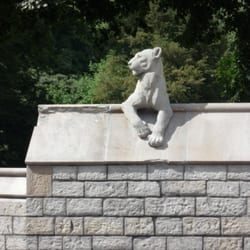
Fifteen stone animals with glassy eyes slumped over a wall pose ready to pounce…read more.. Whether new to Cardiff or just never knew it was there before, this special wall needs to be seen. But be quick these curious creatures look suspiciously as though they are trying to escape Bute park and find a spot of lunch in the Hayes! The animals were originally crafted by Victorian artisan Thomas Nicholls. They were painted, although the paint has since faded and the stone work is currently being cleaned and restored. This wall needs to be seriously bigged up because although connected to Cardiff Castle many visitors won't venture this far to the castles right and so will never see this curious site.
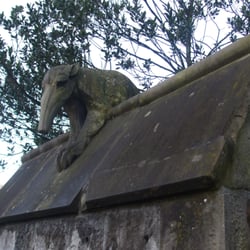
This wall next to Cardiff Castle is an oft-forgotten part of the city centre. You just have to head…read morea bit further down the road and you'll see a fantastic set of various animals like lions and racoons and leopards and baboons clammering over the castle wall. They're only just above head height so you can get a proper look at them. An exciting revelation occurred recently where the aardvark whose nose had been stolen got a brand new one. Sources say he is delighted. The reason I love this wall is because it inspired a lot of ideas that end up in 'Griffin's Castle', a book I remember reading when I was younger by Jenny Nimmo. In this book these stone statues all come to life, and it's an idea that's stuck with me every time I pass the animals on the wall. I swear sometimes I pass by and they're in different positions, but that's almost certainly my imagination.
The Animal Wall at Cardiff Castle
"The Ant Eater" at the Animal Wall. Interesting history about the reconstruction of his nose.
I love this place!! During my trip to England we had the pleasure of driving through the town of…read moreBurley, where the animals roam wild (primarily horses). This place was snuggled in the middle on town - and it was here that I had some of the BEST clotted cream tea ever! The service was excellent, this place was very quaint and clean, and there's an outside patio too. Before arriving here we had sampled clotted cream tea at a few other places, but when we tried it here it was excellent - a cut above the rest. The quality was superb. Definitely one of the most memorable and enjoyable places I visited during my tour of England, I highly recommend taking the time to visit this town and their lovely tea room and restaurant.
Brands by name
Articles by date
The Guard House
1 review
The Old Post Office
The Old School House
The Old Mendip Hospital
The Round house
Shepton Mallet Market Cross
Tithe Barn
Magdalene alms houses
Greenbank Cemetery
Priory Health Park