The High Lighthouse Photos


Recommended Reviews - The High Lighthouse
Start your review...



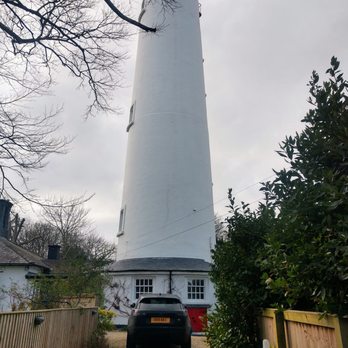
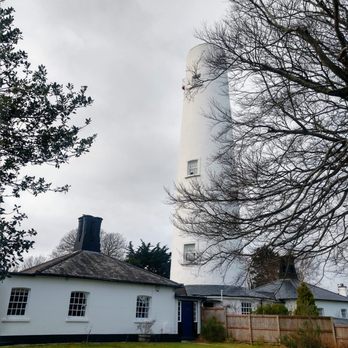
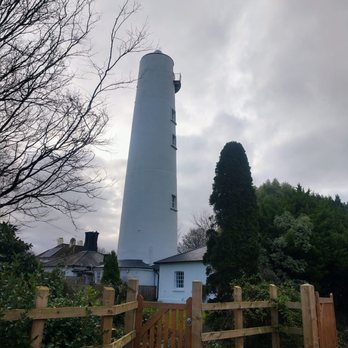
The High lighthouse or pillar lighthouse is one of three lighthouses in Burnham-on-Sea, Somerset, England. A Grade II listed building, it is no longer functional as a lighthouse and has been converted for use as a private dwelling. The 30-metre (98 ft) pillar or High Lighthouse was designed and built by Joseph Nelson for Trinity House, and was first lit on 1 December 1832. It was equipped with four oil lamps, which shone through a window set behind a half-gallery on the uppermost storey (at a focal height of 91 ft (28 m) above mean high water springs). The High lighthouse was designed to be used in conjunction with a new Low lighthouse, which was commissioned on the same date (and is still operating as of 2020). These new lights replaced the original Round Tower Lighthouse (which itself had been built to replace the light kept burning in the tower of St Andrews Church to guide fishing boats into the harbour); it was decommissioned on the same day that the new lights were brought into service. The ground floor of the High lighthouse was 5 metres (16 ft) in diameter and the top room 3 metres (9.8 ft). Cottages at the base of the tower provided accommodation for the keepers who attended the two lights. The High Lighthouse was painted plain white. In 1890, in order to make the lighthouses more conspicuous by day, a red vertical stripe was added to the High Lighthouse. The High light was visible for 16 nautical miles (30 km; 18 mi), and was given an arc of visibility north of the line of transit, so as to provide a fix for vessels navigating between the Culver Sand and Steepholm (two hazards in the middle of the Bristol Channel). The High lighthouse displayed an 'intermittent' (i.e. occulting) light (being bright for three-and-a-half minutes, then obscured for thirty seconds).At the time, it was the only Trinity House lighthouse listed as having an intermittent (as opposed to either fixed or revolving) light, this new light characteristic having first been introduced at Scotland's Tarbat Ness Lighthouse in 1830. The means of providing the High light's intermittent character was described in 1861 as a clockwork mechanism which raised and lowered a shutter behind the light-room window so as to obscure the light for 30 seconds every four minutes.At the time the light source was four fixed Argand lamps, with 21-inch parabolic reflectors. The mechanism for eclipsing the light had been transferred to the High Light from the old lighthouse, which had latterly displayed a similar intermittent light. In 1884 the High light was upgraded and its occulting characteristic was altered to two two-second eclipses every minute. When electricity was brought to Burnham in 1927 a 1000-watt incandescent light bulb was installed in each lighthouse (replacing the paraffin vapour burners then in use) which rendered the keepers redundant.(Burnham was the first Trinity House lighthouse in England to be converted from manned to unmanned automatic operation, following the automation of their lighthouses at Trwyn Du and St Tudwal's Island in Wales five years earlier.)[18] A submarine cable was laid between the two lighthouses and the characteristics of the two lights were synchronised (being controlled by a 'motor driven character machine' installed in the High lighthouse, which controlled both light circuits together). Both lights were given an occulting characteristic, the Low light occulting every 2.5 seconds, the High light every 5 seconds. In each location the lamp was set within a sectional fixed optic, backed by a dioptric mirror. An automatic lamp changer was provided: in the event of a lamp failure the spare bulb was brought into operation and if it also failed an acetylene lamp would be automatically lit. As of 2 December 1969, the characteristic of the High light was altered to one white flash every 7.5 seconds. At the same time, a subsidiary sector light was introduced, shown from a lower window in the same tower (focal height: 79 ft (24 m)) to indicate the correct bearing for the deep-water channel; it was a fixed light with red, white and green sectors.The new sector light rendered the Low lighthouse surplus to requirements and it was therefore deactivated on the same date. Burnham High Lighthouse was put up for sale by Trinity House It was bought by a member of the Rothschild family, who owned it until 1996 when it was bought at auction by Patrick O'Hagan. Conversion for residential use included the removal of the 6th floor and the construction of stairs where there had previously only been ladders.In 2018, having once more been put up for sale, the lighthouse was bought 'by an anonymous buyer read more