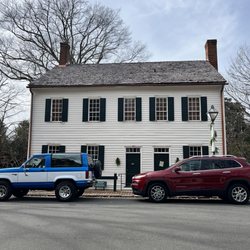
Located in the same area as the Forsyth County Courthouse and around the corner, the equestrian…read morestatue of RJ Reynolds, this marker points out the original home of one of the city's core businesses.
The marker has the same text on both sides. It reads, "The Little Red Factory, also known as the Old Red Factory, was built in 1875 by Richard Joshua (R.J.) Reynolds as the first home of the R.J. Reynolds Tobacco Company. Situated on land purchased from the Moravian town of Salem, this modest two-story structure was strategically located at the nexus of two key commercial advantages: the thriving flue-cured tobacco market and a newly constructed railroad line. R.J. Reynolds emerged as a prominent figure in the community, and the Reynolds family played a pivotal role in shaping the history and growth of Winston-Salem."
Winston-Salem's growth is tightly linked to the rise of R.J. Reynolds, who arrived in 1874 and launched his business in the Little Red Factory, a small bright‑red building that quickly expanded as demand for tobacco surged. By the 1890s, Reynolds had built Factory Number 256 over the original site, absorbed most local competitors, and turned his company into a national powerhouse with brands like Prince Albert, Camel, Winston, and Salem, while also reshaping the city's skyline with projects such as the 1929 Reynolds Building. The company became one of the region's largest employers through the mid‑20th century, but later faced mounting health‑related scrutiny, regulatory pressure, and declining cigarette consumption, eventually merging with Nabisco in 1989 and relocating its headquarters to Atlanta in 1999. Although Factory Number 256 was destroyed in a major 1998 fire, the legacy of R.J. Reynolds remains deeply embedded in Winston-Salem's industrial, economic, and architectural history.
[Review 617 of 2026 - 4705 in North Carolina - 25798 overall]