Cancel

    Open app

    Search

    St Winefride's Well

    4.5 (2 reviews)

    St Winefride's Well Photos

    Recommended Reviews - St Winefride's Well

    Your trust is our priority, so businesses can't pay to alter or remove their reviews. Learn more about reviews.
    Yelp app icon
    Browse more easily on the app
    Review Feed Illustration
    Photo of David J.
    96
    2344
    11912

    14 years ago

    Helpful 0
    Thanks 0
    Love this 0
    Oh no 0

    11 years ago

    Helpful 0
    Thanks 0
    Love this 0
    Oh no 0

    Verify this business for free

    Get access to customer & competitor insights.

    Verify this business

    St Mary's Church

    St Mary's Church

    5.0(1 review)
    6.8 mi

    Cilcain has one of Clwyd's most interesting double-naved churches, best known for the astonishing…read morehammer beam roof decorated with large carvings. History First mentioned in 1291, the church is probably of late 12th or 13th century origin. The oldest part is the north nave, now used as a meeting area. The tower and south nave were added in the 15th century, at which point the windows of the north nave were also renewed in Perpendicular style. The south nave probably replaced an earlier aisle. The origin of the south nave's roof is uncertain: the bays do not match those of the arcade, and the scale of the angels implies it was almost certainly intended for a loftier building, but there is little evidence for a local tradition that the roof came from Basingwerk abbey. The north nave was burned down in 1532, possibly during a service of plygain, a Welsh night-long carol service, traditionally lit with large numbers of candles brought by the congregation. It remained roofless until 1746 when it was rebuilt at the expense of the incumbent. Restoration was carried out in 1786-7, 1845-5 and again in 1889, when the walls were scraped, the south porch rebuilt and the north nave screened off from the south nave. Brickwork at the top of the tower was also replaced with stone. The church The main part of the church is now the south nave: the north nave or aisle is not generally open to the public. Immediately the visitor is struck by the stark nature of the scraped walls, which render the interior dark: as one's eyes grow accustomed to the gloom, the amazing ceiling reveals itself. It is carried alternately on hammer beams and braced arch trusses and moulded throughout. The beams are decorated by angels each carrying shields depicting the instruments of the passion: roof bosses and the trusses have more carvings, including grotesque faces, animal heads, a pair of monkeys and a delightful pair of men in 15th century secular dress, possible the craftsmen who built it. They stare coyly from with side of a corbelled buttress, like a comedy duo. To the north, the former Decorated arcade has been filled with wooden glazed panels. The East Window has 16th century glass panels depicting the Crucifixion. Other fittings of interest include a fragmentary Norman font, and a collection 14th century sepulchral panels at the West end, one of which depicts, rather crudely, a lady with an elaborate medieval headdress.

    Photos
    St Mary's Church
    St Mary's Church
    St Mary's Church

    See all

    Parish Church of St Michael

    Parish Church of St Michael

    5.0(1 review)
    4.2 mi

    The ancient village of Caerwys has an attractive church, hidden from the main road, in a large and…read moreexpansive churchyard. It has some interesting and historic furnishings. History Caerwys was laid out as a planned town by Edward I as part of his policy of embedding his conquest of Wales, receiving a charter in 1290. However, it is evident that there was a church here before then: in 1244 it was nominated as a meeting place between Henry III and Prince David of Gwynedd. The oldest part of the church is the tower, dating from the late 13th century. Dating the rest of the church is difficult, but the south nave has 14th century elements and the north nave features from the 15th, although it may date from an earlier period. The porch is a 19th century addition. Many of the features were restored in the 19th century. The church The church is dominated by its robust west tower, but also has the curious feature of a double nave, a speciality of the Vale of Clwyd area. Inside, the windows date from the 14th to 15th centuries, with some Victorian renewal. There is a two-bay arcade in the chancel leading through into the north nave, now effectively used as an aisle and separate chapel. The oldest furnishing is a wall tomb in the south chancel wall, with a 14th century cusped arch containing an effigy of earlier date. This is reputed to be of Elizabeth Ferrers (1250-c. 1300), wife of Dafydd, the last independent Prince of Wales. A window above has a small quantity of mostly jumbled late mediaeval glass, although the top light has two angels or saints carrying heads of wheat, surrounded by various floral emblems, including a Tudor rose. The chancel is screened off with some attractive woodwork panels, dating from the 17th century, and more, and possibly earlier woodwork forms a dado in the north nave. This includes two splendid facing dragons. Panelling from the box pews also lines the walls, one recording that it was the pew of Sir Thomas Mostyn, Baronet. The font is dated 1661 and is framed by some broken sepulchral panels of 14th century date, and some later tomb slabs. The door into the tower from the north nave is the original ancient main door.

    Photos
    Parish Church of St Michael
    Parish Church of St Michael
    Parish Church of St Michael

    See all

    St James & Emmanuel - Inside Emmanuel church.

    St James & Emmanuel

    4.5(2 reviews)
    42.0 miDidsbury Village

    I've never been to a regular service at Emmanuel Church, Didsbury; but I did once take part in…read moreRadio 4's Daily Service, which is often recorded at this church. (It was about 7 years ago and -- draw your own conclusions -- I've never been asked back since). The church facilities were fantastic -- it seemed more like a recording studio than a church, but then I suppose that's what it was when I was there I understand that the regular services are informal and family-orientated, and if that's your cup of tea I'd recommend a visit -- if only so that next time you hear a Radio 4 service you know where it's coming from!

    St James and Emmanuel church as an entry on Yelp is slightly misleading because it's a church with…read moretwo buildings. St James is an ancient traditional CofE church to the south of Didsbury and is popular for weddings. Emmanuel is a flexible Victorian church in the centre of Didsbury and has the BBC studio. Both buildings have separate entries on Yelp, but both church buildings constitute the parish of St James and Emmanuel, Didsbury. St James & Emmanuel is a lively but thoughtful church where people of strong faith can be challenged and supported, but people who are exploring and uncertain about their beliefs can explore issues without feeling pressurised or excluded.

    Photos
    St James & Emmanuel - Blossoms of the tree on a beautiful day, with the church tower behind it

    Blossoms of the tree on a beautiful day, with the church tower behind it

    St James & Emmanuel - St James Didsbury

    St James Didsbury

    St James & Emmanuel - St James, Didsbury, churchyard

    See all

    St James, Didsbury, churchyard

    Parish Church of St Margaret

    Parish Church of St Margaret

    5.0(2 reviews)
    11.3 mi

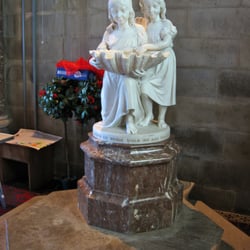
    St Margaret's is one of Wales's outstanding Victorian churches, known locally as 'The Marble…read moreChurch' because of the profusion of marble used in its interior decoration. History The church was built to designs by John Gibson, pupil of Sir Charles Barry, and paid for by Lady Margaret Willoughby de Broke in memory of her husband, Henry Lord Willoughby de Broke. Lady Margaret was the daughter of Sir John Williams, Baronet of Bodelwyddan, and returned to Bodelwyddan after the death of her husband, determined to create a separate parish for Bodelwyddan from neighbouring St Asaph. The cost was the then phenomenal sum of £60,000. The foundation stone was laid on the 24th July 1856; and the new church was consecrated by the Bishop of St. Asaph on the 23rd August 1860. The church Executed in a florid Decorated Gothic style, the church is dominated by the spire, which rises over 200ft. The exterior is dazzling white, thanks to the use of the local limestone, and is a familiar landmark alongside the A55, which unfortunately runs all too close by. Inside, the plan is an aisled nave with a large chancel, the arcade columns composed of the deep red marble which give the church its name. More marble decorates the chancel, which is lined with stalls, as in a cathedral, with heavily decorated canopies with ogee arches. Capital, corbels and arches throughout are elaborately carved, as are the tall oak roofs. The guide book states that fourteen varieties of marble are used in the church. The furnishings are similarly lavish; the rather intimidating eagle lectern is supported on a thick and heavily carved column, intended to represent a crag; similarly, the pulpit is heavily carved, with images of Christ and the four Gospel Saints. The font in Carrara marble depicts two young sisters holding a shell, and is rather sentimental to modern eyes. The stained glass is by O'Connor and T F Curtis, with a single window attributed to Burne-Jones.

    these pictures were taken on recent visits to saint margarets. i have to say it is the best place i…read morehave been to in years

    Photos
    Parish Church of St Margaret
    Parish Church of St Margaret
    Parish Church of St Margaret

    See all

    St Mary's Church - Shrewsbury

    St Mary's Church - Shrewsbury

    5.0(1 review)
    43.9 mi

    Now in the care of the Churches Conservation trust, St Mary's lies in a lovely leafy close in the…read morecentre of mediaeval Shrewsbury. From the outside, the 222ft spire dominates the town. But inside, you find a superbly well preserved church, with a Norman tower, a nave in the transitional style of the early 1200s, and elements from the major gothic styles - Early English, Decorated and Perpendicular - represented in the aisles, transepts and chapels. But the real glory is to be found by looking out, up, and down. The windows contain an outstanding collection of mediaeval stained glass, some of it local, but most brought here from Europe in the mid-19th century. The prize goes to the 14th century Tree of Jesse window - the most complete in England - whose colours are still vibrant. But there's also important glass from Belgium, Germany (from Altenburg Abbey and Trier Cathedral) and Holland, from the 15th to 17th centuries. Look up, at the 15th-century coffered wooden roof, decorated with animals, birds and angels. And before you leave, look down at the superb collection of early Victorian encaustic tilework, beautifully restored. Covering almost the whole of the floorspace, they combine a range of vigorous geometric patterns with bold colours. Finally, in the Trinity Chapel, there's a manificent tiled reredos featuring colourful opus-sectile mosaic work. All in all, a veritable feast of pre-20th century crafts and design.

    St Winefride's Well - religiousorgs - Updated May 2026

    Loading...
    Loading...
    Loading...