Cancel

Open app

Search

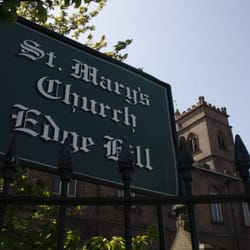
St Mary's Church

5.0 (1 review)

St Mary's Church Photos

Recommended Reviews - St Mary's Church

Your trust is our priority, so businesses can't pay to alter or remove their reviews. Learn more about reviews.
Yelp app icon
Browse more easily on the app
Review Feed Illustration
Photo of David J.
96
2344
11912

14 years ago

Helpful 0
Thanks 0
Love this 0
Oh no 0

Verify this business for free

Get access to customer & competitor insights.

Verify this business

Parish Church of St Peter

Parish Church of St Peter

5.0(1 review)
6.9 km

St Peter's is a tale of two churches: one up the hill, towards the old Llanbedr Hall; and a…read moreVictorian replacement in the centre of the village. History The original church on the site of the original village, dates back to at least 1254, when it was mentioned in the Norwich Taxation. A simple, unaisled building, it became a ruin when the new church was erected in 1862-3 in the centre of the new village. The new church was designed by the Shrewsbury architectural firm of Poundley and Walker and was paid for by the Lord of the Manor. More recently, access to the old church was the subject of a local dispute, resolved only in 2009 when a planning inspector designated the part of the driveway to Llanbedr Hall as far as the church a public footpath. The old church This is now a roofless ruin, but it was a simple, single-celled building with a bell-cote, which is well preserved. Aside from some Gothic doorways, little else is discernible, as the red sandstone has weathered badly. There are, however, a number of tomb tablets in the church, and the graveyard has many tombs and superb views over the Vale of Clwyd. The new church This is closer to the centre of the present village and has a large porch, single unaisled nave and chancel. The exterior is boldly decorated with bands of coloured stone and coloured roof tiles, some strong carving and it has a particularly vigorous spiked turret. Inside, the nave is plainer, but has some interesting and attractive Victorian stained glass, and the chancel has good encaustic tiles. There are some wall tablets brought from the old church, as well as an interesting fragment of a 14th carved tomb from the old church, showing a man with curled hair. Recently restored to their rightful place behind the altar are tablets of illuminated-style script with the Creed, Lord's Prayer and the Ten Commandments in Welsh. The church is open during daylight hours for prayer and visits, and has regular services in both traditional and modern styles.

Photos
Parish Church of St Peter

See all

Parish Church of St Tyrnog

Parish Church of St Tyrnog

5.0(1 review)
6.9 km

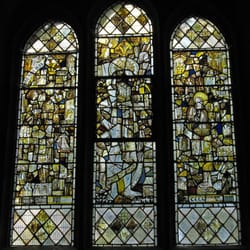
The parish church at Llandyrnog is typical of those in the Vale of Clwyd with a double nave, and…read morehas some magnificent mediaeval stained glass. The church has an ancient foundation, established by St Tyrnog in the 6th century. He was one of what must have been a formidable family of saints in the area: his brother Deifor established a church at Bodfari and his sister Marchell founded a hermitage which gave rise to the church in Denbigh that bears her name. The present building dates largely from the 15th century, but was substantially restored in 1876-8 by William Eden Nesfield. It has the typical double-nave plan of the Vale of Clwyd, but the charming timbered porch and pale pink render are Nesfield's. The interior is well maintained and has a number of furnishings of note. The most outstanding of these is the East Window, which dates from about 1490. Re-assembled from fragment which had been hidden, it depicts the crucifixion and the seven sacraments of the church, with saints in the smaller lights above. Although much of it is missing, the poignant, central figure of the crucified Christ, with streams of blood leading to the scenes of the sacraments, is beautifully preserved. The panels depicting ordination and marriage are also well preserved, whereas those of the last rites (extreme unction) and penance are more fragmentary. Those depicting the mass, baptism and confirmation are unfortunately lost. Other items of interest include an Annunciation window by Kempe, the Coat of Arms of George II, a poor box dated 1687, some lovely Victorian encaustic tiling by Minton, and a stone carving of a monk's head, rescued from the churchyard, and possibly a depiction of St Tyrnog himself. If you wish to visit, a key is available from the nearby Post Office, for private prayer or simple a look around this lovely village church.

Photos
Parish Church of St Tyrnog

See all

Parish Church of St Dyfnog

Parish Church of St Dyfnog

5.0(1 review)
9.6 km

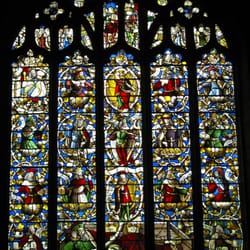
With a name all but impossible for the average English speaker to pronounce, this village church is…read moreone of the Vale of Clwyd's greatest treasures: it has what is widely regarded as the best surviving mediaeval stained glass in Wales, a stunning carved roof, and other items of historical interest. A short walk away is the holy spring which gives its name to the village (Llanrhaeadr means 'church enclosure by the waterfall'), which was regarded in mediaeval times as having healing properties endowed by its founding Saint. History The church was founded by St Dyfnog in the 6th century, deliberately located close to the healing well. Not much is known about Dyfnog himself except, like other Celtic saints, he is said to have bathed in its freezing waters in just a hair shirt with a chain for a belt, by way of penance and prayer. One of the mediaeval Welsh poets mentioned the well 'which gives grace to all nations and cures all ills'. The water was said to cure scabs and 'the itch', smallpox and even those who were deaf and dumb. In the 18th century it was described as being enclosed in an elaborate building, though only the pool itself now remains. There is nothing left of the first church, which was probably made of wood, but a church was mentioned in records of 1254 and 1291. The robust tower dates from the 13th century, with the double-naved church common in this part of Wales erected in the 14th century. Both the surviving mediaeval windows were taken down and hidden from the iconoclasts and reinstalled after the Civil War. The porch is harder to date, but the carved sides may be formed from the original rood screen, from around 1530. The church was restored in 1879-80 and again in 1986-9. The church The interior is spacious, with the two naves separated by a handsome arcade or broad arches in blood-red sandstone. The walls have unfortunately been scraped of their plaster, though this does give it a rustic feel. The famous east window is in the north nave: this is complete, and can be dated to 1533. It was the gift of the priest, Robert Jones, and depicts a simplified tree of Jesse, which illustrates the family tree of Christ from Jesse, through Kings David and Solomon, to Christ, shown with the Virgin. The figures are bold and expressive, and the local County guide-book points out that they rather resemble the form of playing cards, which achieved their traditional form around this period. In one or two places, the reinsertion has gone a little awry, but for the most part the scheme is as it would been originally. The colours red, green, blue, gold and white predominate are astonishingly vivid. At the other end of the nave, the west window has glass dated to 1508, but this is more fragmentary, and the original images are mostly jumbled. The glass was discovered in a cottage in the 19th century. The church's other great treasure is its roof, contemporaneous with the windows, and carved and decorated with angels on the hammer-beams and corbels: the south nave over the sanctuary is particularly finely decorated, forming a 'canopy of honour'. Other items of interest include a golden pelican from 1762, feeding its young from its own blood; and tucked away in the south east corner is the splendid classical monument to Maurice Jones, the local squire, who died in his early 30s in 1702. He reclines, resplendent in a huge periwig beneath a curtained archway, flanked with cherubs weeping into handkerchiefs. The church is open every day, with an active congregation and choir, with the main Sunday service at 11.15. St Dyfnog's well is a short walk north of the churchyard; the various springs flow into a large stone-lined pool, sadly in need of restoration.

Photos
Parish Church of St Dyfnog

See all

The Collegiate and Parochial Church of St Peter

The Collegiate and Parochial Church of St Peter

5.0(1 review)
8.7 km

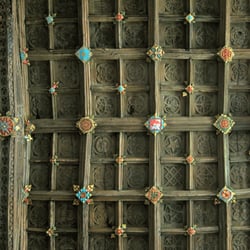
The pretty and historic town of Ruthin has a fine church, part of which dates from the 14th…read morecentury. It has many interesting memorials dating from the 16th century onwards, and a particularly fine decorated roof from the 16th century. History The church was built by John de Grey (of Ruthin Castle) in 1310, and founded as a collegiate church with a small community of 7 priests overseen by a Warden (a title still held by the Vicar). After the dissolution, the College was refounded as a grammar school, with the addition of almshouses. The earliest part of the church is the north aisle (the tower room now a vestry was the original choir). The original chancel (demolished in 1663) originally stood east of this, and the cloisters to the north now form part of the old college buildings. The south nave was constructed in the late 14th century, which included the insertion of the fine arcade, with its carved corbels. The magnificent roofs over the two naves was inserted around 1500-1540, and extensive restorations were carried out in the 18th and 19th centuries, the spire being erected in the 1850s. The church On entering, the scale of the double-naved church is immediately apparent. The arcade has interesting carved corbels, one of which may depict a bearded Negro. Apart from the arcade, 14th century details are hidden behind the organ, and outside on the north wall, where the remains of the cloister and priests' dwellings are now part of the Masonic Hall and music rooms. Back inside, look up, and let you eyes adjust to the gloom; the Tudor roofs over the naves are simply magnificent, containing over 408 carved panels and dozens of painted bosses. The church also includes some fine memorials: there are rare early Welsh brasses to Edward Goodman (d. 1560), and unusually a separate one for his wife and family on which he appears again. One of their sons, Gabriel Goodman, became Dean of Westminster and chaplain to William Cecil, Elizabeth I's Chief Minister, and founded the grammar school and almshouses. His splendid memorial, complete with life-sized painted bust, overlooks the High Altar. There are a number of other elegant 17th, 18th and 19th century memorials. The current congregation has an active church life and strong tradition of church music.

Photos
The Collegiate and Parochial Church of St Peter

See all

Parish Church of St Michael

Parish Church of St Michael

5.0(1 review)
9.0 km

The ancient village of Caerwys has an attractive church, hidden from the main road, in a large and…read moreexpansive churchyard. It has some interesting and historic furnishings. History Caerwys was laid out as a planned town by Edward I as part of his policy of embedding his conquest of Wales, receiving a charter in 1290. However, it is evident that there was a church here before then: in 1244 it was nominated as a meeting place between Henry III and Prince David of Gwynedd. The oldest part of the church is the tower, dating from the late 13th century. Dating the rest of the church is difficult, but the south nave has 14th century elements and the north nave features from the 15th, although it may date from an earlier period. The porch is a 19th century addition. Many of the features were restored in the 19th century. The church The church is dominated by its robust west tower, but also has the curious feature of a double nave, a speciality of the Vale of Clwyd area. Inside, the windows date from the 14th to 15th centuries, with some Victorian renewal. There is a two-bay arcade in the chancel leading through into the north nave, now effectively used as an aisle and separate chapel. The oldest furnishing is a wall tomb in the south chancel wall, with a 14th century cusped arch containing an effigy of earlier date. This is reputed to be of Elizabeth Ferrers (1250-c. 1300), wife of Dafydd, the last independent Prince of Wales. A window above has a small quantity of mostly jumbled late mediaeval glass, although the top light has two angels or saints carrying heads of wheat, surrounded by various floral emblems, including a Tudor rose. The chancel is screened off with some attractive woodwork panels, dating from the 17th century, and more, and possibly earlier woodwork forms a dado in the north nave. This includes two splendid facing dragons. Panelling from the box pews also lines the walls, one recording that it was the pew of Sir Thomas Mostyn, Baronet. The font is dated 1661 and is framed by some broken sepulchral panels of 14th century date, and some later tomb slabs. The door into the tower from the north nave is the original ancient main door.

Photos
Parish Church of St Michael

See all

St Winefride's Well

St Winefride's Well

4.5(2 reviews)
11.0 km

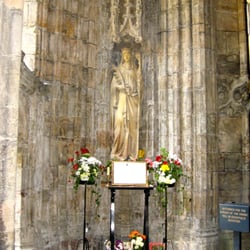
St Winefride's Well often referred to as the 'Welsh…read moreLourdes' is reputed to be Britain's oldest continuously visited pilgrimage site. The unique well-head and St Winefride's Chapel above constitute some of Wales's best 15th century architecture. History Shrouded in legend, the site is said to date from the 7th century, when Winefride, daughter of a local nobleman and a devout Christian, was decapitated by the local Chieftain Caradog for resisting his advances. Through the prayers of her Uncle, Saint Beuno, her head was restored with only a faint scar, and a spring flowed from the spot where her head had fallen. Whatever the legend, the historic Winefride became a nun and ultimately abbess of the foundation at Gwytherin, and died there in 660AD. The well has since been a popular pilgrimage site, especially through the middle ages. Royal visitors have included Richard I, Henry V, Edward IV, and Richard III. James II and his second wife, Mary of Modena, visited in 1686 and it is said their prayers for a child were answered by the birth of their son, James Stuart. The present well-head and chapel were built in the early 1500s, although the shrine of St Winefride was destroyed in the reformation. Despite the best efforts of the authorities, the well continued to be a popular place of pilgrimage and was associated with the Catholic recusancy. The well was rented by the Jesuits in 1873 and is now in the care of the Catholic Diocese of Wrexham. St Winefride's Chapel is in the care of Cadw. The well and chapel The well complex includes a modern entrance building, museum and shop, with attractive lawns fronting the well-head. There is a large modern pool beside the well, where bathing is still permitted at certain times. The well-head itself (effectively forming the crypt of the chapel above) is an intricate structure, the stone-lined pool covered with an elaborate octagonal late Perpendicular vault. A profusion of elaborately carved bosses include depictions of St Winefride's legend, the likely patron of the building, Lady Margaret Beaufort, and scenes of healing. Nearby is a modern statue of St Winefride, complete with neck scar. The Chapel above is a delightful example of Perpendicular architecture, with a fine wooden roof and wide windows filled with clear glass. Corbels and bosses abound with yet more carving, depicting saints and angels, heraldic devices, beasts, dragons, hunting scenes and grotesque faces. The Chapel hosts occasional festival services.

Visited April 2015: "For Pilgrims suffering from aches and pains"…read more We were not sure where to park, since we did not see a parking lot adjacent to the buildings. We went through the gift shop, and paid 1 pound to get in. We were able to see several pilgrims swimming in the waters of the well. There is a garden and small cemetery attached to the buildings. My friend lit a candle and we were on our way.
Photos
St Winefride's Well
St Winefride's Well
St Winefride's Well

See all

St Mary's Church - religiousorgs - Updated May 2026

Loading...
Loading...
Loading...