Cancel

    Open app

    Search

    St. Walburga Photos

    St. Walburga Reviews in Other Languages

    Kaiserburg Nürnberg - ... Impressionen ...

    Kaiserburg Nürnberg

    4.5(100 reviews)
    70.3 kmInnenstadt

    The castle ground is free to roam around. We bought tickets for the tower and deep well for 3.5…read moreeuros. Keep your ticket. You'll need to scan it before and after. Restrooms are free and there's a mini cafe. The Sinwell Tower is 350 meter up, about 100+ steps. "Sinwell" in German means perfectly round so it's up a spiral wooden staircase. We were able to see the courtyard and the view of the city. It gets really windy up here. The deep well tour is every 30 minutes and last for 5 minutes. It's the castle's water supply at 50 meters deep. The water flows horizontally through sandstones and different layers of rocks as a filtration system. Four weeks after the rain, it flows into the deep well and ready for drinking. You'll see a video and a demonstration of the lit candle which proves that there is oxygen in the well.

    Cool castle just a few minutes walk uphill from the Hauptmarkt…read more There are tours you can purchase to learn the history of the castle and see more of it, but you can always just wander around the grounds for free. We went that route, and it was a fun way to spend an hour or so. There are fabulous views of the city from the top and different sections to check out on all sides. The castle and grounds are well-preserved and kept. There are restrooms inside and a little cafe to grab a drink and pretzel after the trek up. It's kind of a must-see when in the city. Free castle fun? Why not!

    Photos
    Kaiserburg Nürnberg
    Kaiserburg Nürnberg - ... Impressionen ...

    ... Impressionen ...

    Kaiserburg Nürnberg - Castle ground-Sinwell tower

    See all

    Castle ground-Sinwell tower

    Schloss Dachau

    Schloss Dachau

    4.6(14 reviews)
    77.5 km

    Most people go to Dachau to visit the concentration camp. Of course, that was on our list for our…read moretrip. But most do not seem to realize that Dachau is a premedieval city with plenty to explore that has nothing to do with the Third Reich. Take the Schloss Dachau and the BEAUTIFUL gardens. It was only a euro or two to get in to the palace - though they let us in for free with our Mehrtagesticket (best investment ever in our trip!). Now, a majority of the palace was closed that morning...I'm not sure if other parts are normally open. We were able to see the main entrance and two rooms on the upper floor...one a normal palace-y room at the top of the stairs, and then a breathtaking room with a gorgeous carved wood ceiling. It was mesmerizing...and then add the view out into the gardens...just spectacular! We went back downstairs and went around the backside of the palace to see the gardens (no entrance fee required). I think we spent more time exploring the gardens than we did the palace itself. A few mornings a week, you can get fresh flowers (I saw the sign) to bring home. If we would have had more time, I would have brought a picnic to enjoy along the paths. There is a pay parking lot right up front of the castle - it was a euro or two to park. More expensive than in the old town, but still very reasonable. Do yourself a favor and explore everything that Dachau has to offer!

    My favorite place to visit when I am there (almost every year when we are there for the Dachau…read moreVolks Festival in Aug ). The gardens and views of the city are beautiful and there is a nice path to walk down to the city. There is also a restaurant where you can sit outside and a little beer garden at the wall. Wish they would publish the menu and what music and band they have playing.

    Photos
    Schloss Dachau
    Schloss Dachau
    Schloss Dachau

    See all

    St. Georgskirche - Epitaph

    St. Georgskirche

    4.5(6 reviews)
    27.0 km

    St. Gorgeskirche is a late Gothic hall church built between 1427 and 1505 with its 89.9-meter tower…read moreabove the west portal, popularly known as "Daniel," can be seen from some distance, is the town's landmark. The council of the imperial city of Nördlingen decided to build the Georgskirche on October 17, 1427. The choir of the hall church was completed in 1451, and in 1454 construction of the tower began. The high altar by Friedrich Herlin was completed in 1462, and the tower in 1490. With the completion of the vault in 1505, the construction, which consists largely of suevite, was completed. Because Nördlingen joined the Reformation under Kaspar Kantz, St. Georg became the Protestant town church in 1523/1525. The 93-meter long and over 20 meter high nave makes St. Georg one of the largest hall churches in southern Germany. The building consists of a three-aisled choir and a three-aisled, twelve-bay hall with twelve central columns. The baroque high altar is decorated with late Gothic wooden sculptures. It is a crucifixion group with Mary and John and two mourning angels, flanked by St. George with the defeated dragon at his feet and Mary Magdalene with the anointing vessel in her hand. These figures, which can be seen today in the Nördlingen City Museum, were originally in a wooden shrine with movable wings that was built around the same time and painted by Friedrich Herlin. The altar was given its baroque appearance in 1683. The housing of the late Gothic wooden shrine was only discovered under the baroque casing during the restoration in 1971-1973. Today it stands on the north wall with the painted rear front (eight Passion scenes of Christ and the Last Judgment ) to the front. The late Gothic stone pulpit has a plinth with lush, intertwined ribs and a staircase with an openwork tracery parapet. The four evangelists with their symbols are depicted as reliefs on the pulpit. In between, the Man of Sorrows, Mary, Mary Magdalene, John the Evangelist and St. George can be seen under canopies. The baroque sound cover, on which Christ is enthroned with the globe, was made by Johann Michael Ehinger in 1681. The wooden sound cover is decorated with putti and angel heads. First restoration happened in the years 1877 - 1887. On March 30, 1945 at 9:25 p.m., an aerial bomb destroyed the "Steinmeyer Organ" set up in 1889. On February 2,1974 a fire destroyed the old baroque organ from 1610.

    Photos
    St. Georgskirche - St. Georg

    St. Georg

    St. Georgskirche - Epitaph

    Epitaph

    St. Georgskirche - Orgel und Kanzel

    See all

    Orgel und Kanzel

    Ulmer Münster

    Ulmer Münster

    4.8(73 reviews)
    80.5 km

    Ulmer Münster (Ulm Minster) is a Evangelisch-Lutherische (Lutheran) church located in Ulm, State of…read moreBaden-Württemberg. It is currently the tallest church in the world and will likely remain so until Sagrada Familia in Barcelona is finally completed. The church is the fifth-tallest structure built before the 20th century, with a steeple measuring 161.5 meters (530 ft.). Ulmer Münster was begun in the Gothic architecture of the Late Middle Ages (1377) but the building was not completed until the late 19th century (1890) after a hiatus of centuries. When work ceased in 1543, all of the church except the towers and some outer decorations were complete, unlike at Kölner Dom (Cologne Cathedral) where less than half of the work had been done before construction halted in 1473 (started in 1248). Visitors can climb the 768 steps that lead to the top of the minster's spire. At 143 m (469 ft.) it gives a panoramic view of Ulm in Baden-Württemberg and Neu-Ulm in Bavaria, and, in clear weather, a vista of the Alps from Säntis to the Zugspitze (highest point in Germany). Though it is sometimes referred to as Ulm Cathedral because of its great size, the church is not a cathedral as it has never been the episcopal see of a bishop. Though the towers and all decorative elements are of stone masonry, attracting the attention of visitors, most of the walls, including the façades of the nave and choir, actually consist of visible brick. Therefore, the building is sometimes referred to as a brick church. As such, it lays claim to the rank of second- to fourth-largest, after San Petronio Basilica in Bologna and together with Frauenkirche in München and St. Mary's Church in Gdańsk. The tower, however, was mainly built from sandstone. The tale/legend of the Ulmer Spatz (sparrow) is an interesting story. I received a pamphlet at the Tourist Information: the inhabitants of Ulm needed a particularly large beam for the construction of Ulm Minster, but could not get it through the city gate. As they were about to tear the gate down, they noticed a sparrow carrying a straw for its nest; which turned it from crosswise to lengthwise in its beak. A realization descended on the people of Ulm. Since that epiphany, they have placed long loads along rather than across their carts and were able to enter the city without rebuilding their gate. It's a must visit when you are in Ulm. Gothic architecture is magnificent, and you'll earn bragging rights of having been to the tallest church in the world!!

    What a beautiful and amazing church. The inside of the church is absolutely worth walking around…read moreand looking at. Gorgeous. Make sure you are prepared to climb 700+ stairs. Pay the €5 and climb it. The view is amazing. It is very difficult, but worth it in the end. If you find yourself in Ulm, you must visit the cathedral. You won't regret it.

    Photos
    Ulmer Münster
    Ulmer Münster
    Ulmer Münster

    See all

    St. Lorenz Kirche

    St. Lorenz Kirche

    4.4(18 reviews)
    69.6 kmInnenstadt

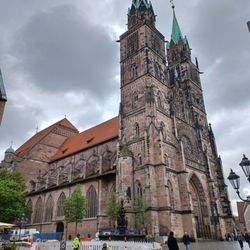
    One of my favorite churches in Nuernberg. I believe it is also the largest. I'm not going to state…read moreall the history and facts about this church, others have already done so. Just one little anecdote that always amuses me is that the builders could not agree on the style of the towers and this is why each tower is different. A feud that is permanently displayed on the towers of a church no less... Anyway, take a close look at this church both inside and out. There are so many details to see, that even after years coming here, I still seem to discover new details. A must see for sure.

    This is the largest church in Nuremberg. To my surprise, I thought I was entering in a Catholic…read moreGothic style church (built circa 1250) to find out it was a Lutheran one. In any case, amazing church with so much art to see in just an hour I spent there (I was with a colleague and did not want to spend the usual amount of time I would do in this type of sacred buildings with so many details and art in every corner). I can't believe it was bombarded during WWII, then rebuilt with great effort. The stained glass art is amazing and I was happy to see that during our visit it was an exhibit about the artist who created all of them originally. It was a very well paid 2 euros visit (I dont like to pay to enter in a church, I am more pro-donations, but still it was worth it). One suggestion is that I would prefer not to have a gift shop inside the church. That devalue both the religious experience and the artistic value, converting the whole thing in a theme park. That is the only part I disliked during my visit as well as the attitude of the young girl that was collecting the money...I got confused of door of our way out and she started yelling at me: no, not there, stop stop...which made me feel weird. Anecdotes apart, a must visit.

    Photos
    St. Lorenz Kirche
    St. Lorenz Kirche - ... Abendstimmung ...

    ... Abendstimmung ...

    St. Lorenz Kirche

    See all

    Frauenkirche - ... Impressionen ...

    Frauenkirche

    4.1(19 reviews)
    69.9 kmInnenstadt

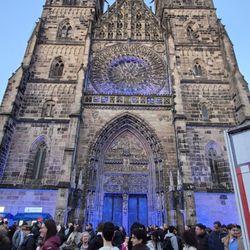
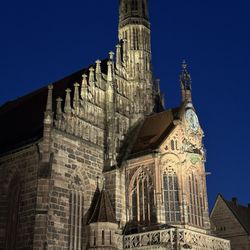
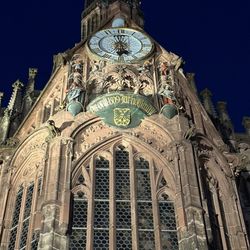
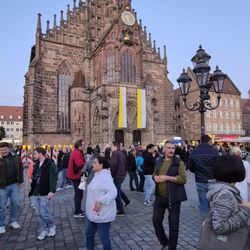
    I am not going to go through the history and facts of the church. Clearly another example of…read moreNuernberg's rich history as a medieval city. What makes this church stand out is the fact that it overlooks the main market place with it's many fruit and veggie stands, most with locally grown produce. Of course there are also food trucks and household wares to be had. The market place turns into a giant Christkindl Market and at its opening the Christkindl (which by the way is a Christmas angel - child of Christ) stands atop the church balcony and officially opens the Christkindl Market with a speech and blessings. Definitely worth attending, if you can squeeze in somehow, because be aware that it will be super crowded. Just before 12 noon you will see crowds gather looking up towards the top of the church. They are all waiting for the "Maennleinlaufen" were the figures start moving and the electors turn and face the Roman emperor. There are also musician figures that move as if playing their instruments.

    Frauenkirche or " The Church of Our Lady" is an example of brick Gothic architecture, and it was…read morebuilt on the initiative of Charles IV, Holy Roman Emperor (reign 1346-1378) between 1352 and 1362. The church contains many sculptures, some of them heavily restored. Numerous works of art from the Middle Ages are kept in the church, such as the so-called Tucher Altar (c. 1440, originally the high altar of the Augustinian church of St. Vitus also in Nürnberg). The church was built in the grand market, in place of the former Jewish synagogue, which was destroyed during the Nürnberg pogrom (Jewish persecutions of 1349) which followed an outbreak of Black Death. Charles IV wanted to use the Frauenkirche for imperial ceremonies, which is reflected in the porch with the balcony, and in the fact that the church is relatively unadorned except for the coats of arms of the Holy Roman Empire, the seven Electors, the town of Nuremberg, and the city of Rome, where the Holy Roman Emperors were crowned. Construction of the church continued until the 1360s. Charles IV's son Wenceslas was baptized in the church in 1361, on which occasion the Imperial Regalia, including the imperial reliquaries, were displayed to the people. References to Wenceslaus can be found throughout the sculptural program of the church. Beginning in 1423, the Imperial Regalia was kept permanently in Nürnberg and displayed to the people once a year on a special wooden platform constructed for that purpose. The current west gable of the church dates from 1506-8. Historic images show that this gable was once richly decorated with sculptures which were presumably destroyed in the Reformation. In 1525 the church became Lutheran and galleries were added in the aisles. In 1810, the church was acquired by a Catholic parish which removed the galleries and restored the church in 1816. This restoration involved replacing and repairing surviving sculptures and gathering Medieval art to adorn the church. One of the most notable features of the church is the Männleinlaufen, a mechanical clock that commemorates the Golden Bull of 1356. The clock was installed in the church between 1506 and 1509. The Holy Roman Emperor is shown seated with the prince-electors surrounding him. The clock mechanism is activated at noon when a bell is rung to start the sequence and is followed by the trumpeters and drummer. Then there is a procession of the electors around the figure of the Holy Roman Emperor.

    Photos
    Frauenkirche - ... Impressionen ...

    ... Impressionen ...

    Frauenkirche
    Frauenkirche

    See all

    St. Walburga - landmarks - Updated May 2026

    Loading...
    Loading...
    Loading...