Cancel

    Open app

    Search

    St Peter Catholic Church

    5.0 (1 review)

    St Peter Catholic Church Photos

    Recommended Reviews - St Peter Catholic Church

    Your trust is our priority, so businesses can't pay to alter or remove their reviews. Learn more about reviews.
    Yelp app icon
    Browse more easily on the app
    Review Feed Illustration

    13 years ago

    Helpful 0
    Thanks 0
    Love this 0
    Oh no 0

    Verify this business for free

    Get access to customer & competitor insights.

    Verify this business

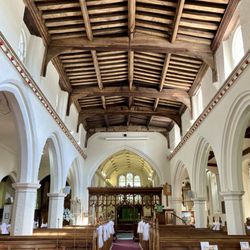
    St Margaret's Church Barking - Nave

    St Margaret's Church Barking

    5.0(1 review)
    3.3 miBarking, Dagenham

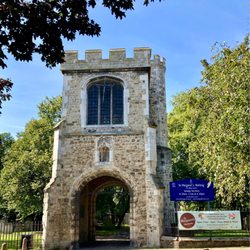
    At the edge of the bustling town centre is a delightful (and substantial) mediaeval church, which…read moreis well worth a visit. St Margaret of Antioch was built as a chapel within Barking Abbey, and in 1300 it became the town's parish church. It sits east of the centre in a wide expanse of green - once the Abbey grounds, of which only the Curfew Tower remains. The church has been expanded over the years, so it now contains a happy mix of all periods from the 13th to the 16th centuries. Inside, the oldest part is the chancel and part of the nave, which date from c. 1215, although most of the fabric is 15th Century: the outer north aisle and chapel were added in the 16th Century using materials from the dissolved abbey. In 1772, the church was heavily remodelled under the direction of a local landowner, Bamber Gascoyne, who had much of the original fabric encased in decorative plasterwork. Of this, the lovely chancel ceiling remains, complementing the fine mediaeval roofs in the nave and north aisles. Traces of mediaeval painting remain in the chancel arch. However, the true joy of the church is its furnishings, testament to the wealth of Barking from the 17th Century onwards, when it was a sizeable fishing port. In the chancel, the memorial to Sir Charles Montagu (d. 1625) shows him in his tent on campaign, dozing while armed musketeers stand guard. Nearby is the fine engraved tombstone of Martinus, the first recorded Vicar of Barking, dating from 1315. Of special note is that to Captain John Bennett (d. 1715) and his mother and father, his figure surrounded by the fore and aft of a fully-rigged sailing ship, navigational instruments and globes. He also has a fine tomb in the churchyard in the same style. The nave has poppyhead pews incorporating 18th century woodwork, and the classical-style font (c.1635) is topped by a jolly cover, decorated by Jessie Jack, daughter of the Arts & Crafts craftsman George Jack. There is some good stained glass, and the Fisherman's Chapel includes statues of local notables associated with the parish, including Captain Cook (who married Elizabeth Batts here in 1762), the Quaker and prison reformer Elizabeth Fry, and St Ethelburga, the first Abbess of Barking. The church is the centre of a busy parish life, and includes an excellent tea room in the adjoining church centre, where I enjoyed a lovely lunch and a very friendly welcome.

    Photos
    St Margaret's Church Barking - The Curfew Tower, the only remaining part of Barking Abbey to survive.

    The Curfew Tower, the only remaining part of Barking Abbey to survive.

    St Margaret's Church Barking - Nave, looking west

    Nave, looking west

    St Margaret's Church Barking - Stained-glass window depicting the last supper

    See all

    Stained-glass window depicting the last supper

    St Alfege's Church

    St Alfege's Church

    4.5(2 reviews)
    3.3 miGreenwich

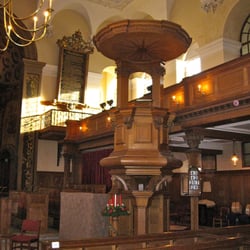
    A beautiful historic church. One of the 6 Hawksmoor churches in London. It has Hawksmoor's…read moresignature design. It's a working church and situated in the center of Greenwich Town near Greenwich market. It's hemmed in by roads and other building so it's not the most tranquil place to sit in it's grounds.

    The historic parish church of Greenwich sits right in the centre of the town. Although…read moreunfortunately hemmed in on the east by the main road, the green at the west end and the interior are oases of calm. History The church is built on the alleged site of St Alphege's martyrdom at the hands of Viking pirates in 1012. Alphege, then Archbishop of Canterbury, had been taken hostage but refused to be ransomed, and so was (by tradition) killed by being pelted with animal bones, before one Viking struck him with an axe to the head to spare his suffering. He was canonized in 1078. Details of the first church erected on the site after the martyrdom are scanty, but it was an important shrine. A new church was built to replace it in the 13th century, and was witness to many Royal visitors up to the 17th century due to its proximity to the royal palace at Greenwich. Thomas Tallis, the composer, was one of the notable people buried there. The church roof collapsed in a storm in 1710, and the present church was built to replace it, as the first of the 50 churches sanctioned under the New Churches in London and Westminster Act of 1711. Designed in the Baroque style by Nicholas Hawksmoor, it was built in 1712-14 and consecrated in 1718. The intended tower was never built: instead, in 1730, the remains of the old tower were encased to match the rest of the church to designs by John James. Much of the interior woodwork was by Grinling Gibbons. The church was gutted by incendiary bombs in 1941. Restoration began in 1946 and was completed in 1953. The interior is largely new, but incorporates what could be saved from the original fabric and is faithful to the original design. The church The exterior particularly the splendid east front (oddly, the original entrance) with its bold Doric portico is a beautifully balanced example of Baroque architecture, although the proportions of James's tower are unfortunately not a match for the rest. The interior has galleries on three sides, with delicately carved wooden columns, and the ceiling consists of a huge plaster disc suspended on corbels on the exterior walls. At the west end, the organ is mounted a fine portico of a gallery. Fittings of note include two original benefactor boards on the east wall, memorials to James Wolfe and Thomas Tallis, and stained glass depicting other (mostly royal) associations with the church.

    Photos
    St Alfege's Church
    St Alfege's Church
    St Alfege's Church

    See all

    All Saints Church - Photo.  12.7.2014.

    All Saints Church

    5.0(1 review)
    2.9 miBlackheath

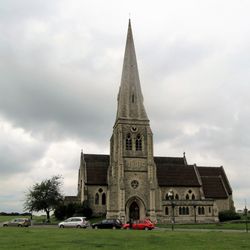
    Blackheath is perhaps best known for its broad, flat expanse of common land, on which All Saints…read morechurch is a prominent landmark. There has been a hamlet here since Saxon times, but there was no church, the area being served by neighbouring parishes. Nevertheless, it occupied a strategic location on Watling Street, the former Roman road which formed the main route from Kent to London. As such, the heath was a famous rallying point for all sorts of causes, most notably for the Peasant's Revolt of Wat Tyler in 1381 and later of Jack Cade in 1450. In the era of the stagecoach, the area became notorious for its highwaymen. Growth of the little hamlet began in earnest in the 18th century, as London expanded, with the development of the Blackheath Park estate. Although churches were established on the estates in 1830 (St Michael's) and 1853 (St John the Evangelist), they were inadequate for the growing population. A petition by the local populace led to the founding of All Saints in 1857. The architect was Benjamin Ferrey, who chose a mixture of the Early English and Decorated Gothic styles, executed in Kentish ragstone with freestone dressings. The church was consecrated in 1858. The church has a five-bay nave with chamfered columns and square, stiff leaf capitals, and generous aisles, but it most notable externally for its prominent spire. The interior is bright and fiercely whitewashed, enlivened by a painted and gilded chancel screen, decorated ceilings and late 19th century Murano mosaics in the chancel. There is also some stained glass by Martin Travers (1886-1948). Morning and Evening Prayer are said daily through the week and there are three services on Sunday in the church, which has a strong choral tradition.

    Photos
    All Saints Church - Photo.  12.7.2014.

    Photo. 12.7.2014.

    All Saints Church - Photo.  12.7.2014.

    Photo. 12.7.2014.

    All Saints Church - All Saints Church, Blackheath

    See all

    All Saints Church, Blackheath

    St Peter Catholic Church - churches - Updated May 2026

    Loading...
    Loading...
    Loading...