Cancel

    Open app

    Search

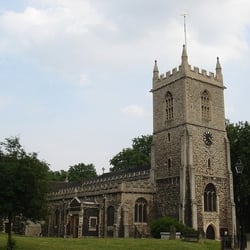
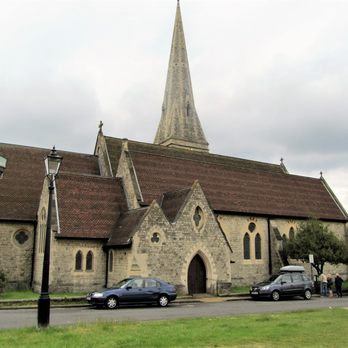
    All Saints Church

    5.0 (1 review)

    All Saints Church Photos
    Recommended Reviews - All Saints Church

    Your trust is our priority, so businesses can't pay to alter or remove their reviews. Learn more about reviews.
    Yelp app icon
    Browse more easily on the app
    Review Feed Illustration
    Photo of David J.
    96
    2344
    11912

    11 years ago

    Helpful 0
    Thanks 0
    Love this 0
    Oh no 0

    Verify this business for free

    Get access to customer & competitor insights.

    Verify this business

    St Alfege's Church

    St Alfege's Church

    4.5(2 reviews)
    1.1 miGreenwich

    A beautiful historic church. One of the 6 Hawksmoor churches in London. It has Hawksmoor's…read moresignature design. It's a working church and situated in the center of Greenwich Town near Greenwich market. It's hemmed in by roads and other building so it's not the most tranquil place to sit in it's grounds.

    The historic parish church of Greenwich sits right in the centre of the town. Although…read moreunfortunately hemmed in on the east by the main road, the green at the west end and the interior are oases of calm. History The church is built on the alleged site of St Alphege's martyrdom at the hands of Viking pirates in 1012. Alphege, then Archbishop of Canterbury, had been taken hostage but refused to be ransomed, and so was (by tradition) killed by being pelted with animal bones, before one Viking struck him with an axe to the head to spare his suffering. He was canonized in 1078. Details of the first church erected on the site after the martyrdom are scanty, but it was an important shrine. A new church was built to replace it in the 13th century, and was witness to many Royal visitors up to the 17th century due to its proximity to the royal palace at Greenwich. Thomas Tallis, the composer, was one of the notable people buried there. The church roof collapsed in a storm in 1710, and the present church was built to replace it, as the first of the 50 churches sanctioned under the New Churches in London and Westminster Act of 1711. Designed in the Baroque style by Nicholas Hawksmoor, it was built in 1712-14 and consecrated in 1718. The intended tower was never built: instead, in 1730, the remains of the old tower were encased to match the rest of the church to designs by John James. Much of the interior woodwork was by Grinling Gibbons. The church was gutted by incendiary bombs in 1941. Restoration began in 1946 and was completed in 1953. The interior is largely new, but incorporates what could be saved from the original fabric and is faithful to the original design. The church The exterior particularly the splendid east front (oddly, the original entrance) with its bold Doric portico is a beautifully balanced example of Baroque architecture, although the proportions of James's tower are unfortunately not a match for the rest. The interior has galleries on three sides, with delicately carved wooden columns, and the ceiling consists of a huge plaster disc suspended on corbels on the exterior walls. At the west end, the organ is mounted a fine portico of a gallery. Fittings of note include two original benefactor boards on the east wall, memorials to James Wolfe and Thomas Tallis, and stained glass depicting other (mostly royal) associations with the church.

    Photos
    St Alfege's Church
    St Alfege's Church
    St Alfege's Church

    See all

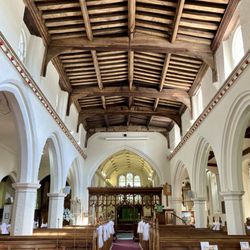
    St Margaret's Church Barking - Nave

    St Margaret's Church Barking

    5.0(1 review)
    5.5 miBarking, Dagenham

    At the edge of the bustling town centre is a delightful (and substantial) mediaeval church, which…read moreis well worth a visit. St Margaret of Antioch was built as a chapel within Barking Abbey, and in 1300 it became the town's parish church. It sits east of the centre in a wide expanse of green - once the Abbey grounds, of which only the Curfew Tower remains. The church has been expanded over the years, so it now contains a happy mix of all periods from the 13th to the 16th centuries. Inside, the oldest part is the chancel and part of the nave, which date from c. 1215, although most of the fabric is 15th Century: the outer north aisle and chapel were added in the 16th Century using materials from the dissolved abbey. In 1772, the church was heavily remodelled under the direction of a local landowner, Bamber Gascoyne, who had much of the original fabric encased in decorative plasterwork. Of this, the lovely chancel ceiling remains, complementing the fine mediaeval roofs in the nave and north aisles. Traces of mediaeval painting remain in the chancel arch. However, the true joy of the church is its furnishings, testament to the wealth of Barking from the 17th Century onwards, when it was a sizeable fishing port. In the chancel, the memorial to Sir Charles Montagu (d. 1625) shows him in his tent on campaign, dozing while armed musketeers stand guard. Nearby is the fine engraved tombstone of Martinus, the first recorded Vicar of Barking, dating from 1315. Of special note is that to Captain John Bennett (d. 1715) and his mother and father, his figure surrounded by the fore and aft of a fully-rigged sailing ship, navigational instruments and globes. He also has a fine tomb in the churchyard in the same style. The nave has poppyhead pews incorporating 18th century woodwork, and the classical-style font (c.1635) is topped by a jolly cover, decorated by Jessie Jack, daughter of the Arts & Crafts craftsman George Jack. There is some good stained glass, and the Fisherman's Chapel includes statues of local notables associated with the parish, including Captain Cook (who married Elizabeth Batts here in 1762), the Quaker and prison reformer Elizabeth Fry, and St Ethelburga, the first Abbess of Barking. The church is the centre of a busy parish life, and includes an excellent tea room in the adjoining church centre, where I enjoyed a lovely lunch and a very friendly welcome.

    Photos
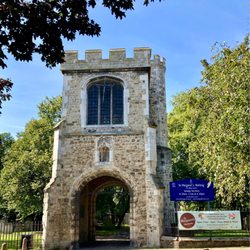
    St Margaret's Church Barking - The Curfew Tower, the only remaining part of Barking Abbey to survive.

    The Curfew Tower, the only remaining part of Barking Abbey to survive.

    St Margaret's Church Barking - Nave, looking west

    Nave, looking west

    St Margaret's Church Barking - Stained-glass window depicting the last supper

    See all

    Stained-glass window depicting the last supper

    St Mary Le Bow

    St Mary Le Bow

    4.4(5 reviews)
    5.4 miThe City

    A historically very significant church. The bells are the Bow bells featured in the nursery rhyme…read moreOranges and Lemons. They were the bells that called Dick Whittington back to London. During the 14th Century they were used to ring a curfew every night: probably the origin of the tradition that only those born within sound of the bells can claim to be a true Cockney. During the 2nd World War the BBC used the sound of the bells at the start of every broadcast to Europe. Unfortunately the church has also seen a history of destruction. There has been a church on the site since 1070. The church was destroyed by the Great Fire, and rebuilt by Sir Christopher Wren between 1670 and 1682. The name comes from the bow arches in the surviving Norman crypt, which were echoed in the steeple. The church was destroyed again in 1941 during the blitz, leaving only the steeple, 2 outer walls and the crypt. Between 1956 and 1964 the church was rebuilt again. The bells were also destroyed and recast several times, but metal from the original set was used to cast new. Today the first sight of the church is the stunning steepled entrance which opens onto Cheapside. The crypt contains a café (sadly not open when I was there). The church itself is unusually square, and, with the alter and organ, actually feels wider than it's long. It has a modern feel with black and white floor tiles and some wonderful modern stained glass windows. The organ is particularly stunning. Information leaflets are available, for which you are asked to leave 40p each in a donation box. There's also a program of events, including art exhibitions and performances. Information on the website.

    St Mary-Le-Bow,Cheapside, was immortalised in the nursury song Oranges and Lemons…read more To be born with the sound of Bow Bells is said to be the sign that you are a true Londoner or Cockney. The Bow bells in the Norman Crypt, for which the church owes its name, were once used to signal a curfew in the City of London. Before modern traffic noise, they could be heard as far away as Hackney Marshes. The bells are also credited with having persuaded Dick Whittington to turn back from Highgate and remain in London to become Lord Mayor (three times in the story but four times in reality). This church was rebuilt by Christopher Wren after the Great Fire of London and again after World War II bomb damage, and it was during this period that the distinctive peal of the Bow Bells was broadcast by the BBC to the enemy-occupied countries of Europe. For a Londoner to be able to call him or herself an 'authentic cockney', they must have been born within the sound of St Mary-Le-Bow Church in Cheapside. 'Cockney' or 'cock's egg' was a 14th Century term applied contemptuously by rural people to native Londoners who lived rather by their wits than their muscle. Today's natives of London, especially its East End use the term with pride - 'Cockney Pride'.

    Photos
    St Mary Le Bow
    St Mary Le Bow
    St Mary Le Bow - Photo. June 2014.

    See all

    Photo. June 2014.

    St Dunstan & All Saints Church, Church of England

    St Dunstan & All Saints Church, Church of England

    4.8(5 reviews)
    4.0 miStepney

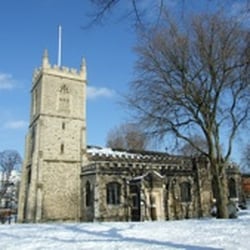
    St Dunstans church is a hidden gem and a relatively unknown slice of East-End history. Located…read morejust a stone's throw away from Stepney Green Park and opposite a rather bizarre farm, the church boasts 1000 years of history and each turn reveals eye-catching features like gravestones dating from the Civil War and etchings of its patron Dunstan beneath a set of tongs, symbolic of his connection to metalwork. There are two particularly fascinating stories of St Dunstan outlined in a brochure you can pick up by the entrance to the building. The first tells of a day when Dunstan was approached by the devil whilst he was busy with his metalwork. The devil attempted to tempt Dunstan to evil pleasures but Dunstan, the crafty so-and-so, pulled his red-hot tongs from the furnace and saw the devil off by tweaking him on the nose. The second story also takes place at the metalworks and the devil again approached Dunstan, this time riding his horse. The devil requested Dunstan shoe his horse but the crafty Dunstan instead attached a shoe to the hoof of the devil. In return for releasing him Dunstan made the devil promise to never enter a house where a horseshoe hung over the door. It is from this story that we get the legend of the lucky horse shoe. Dunstan founded his church in the 10th century and at one time it served the entire population of Middlesex east of the City of London. The current building is the third church to have been built on the site and dates mainly from the 15th century though the chancel is 200 years older. It is a truly beautiful building with a rich and vibrant history and the perfect place to see a piece of London free from the general milieu of tourist spots.

    A few weeks ago I got lost on my bike trying to find an art gallery and stumbled upon St Dunstan's…read more I was immediately smitten. To begin with, it's old. It's also not at all ostentatious, which seems fitting for the style of its East London parishioners. Furthermore, it somehow survived the Blitz when the balance of the neighbourhood was obliterated. I hesitate to write 'miraculous', but it really doesn't get much more uncanny than that.

    Photos
    St Dunstan & All Saints Church, Church of England
    St Dunstan & All Saints Church, Church of England
    St Dunstan & All Saints Church, Church of England

    See all

    All Saints Church - churches - Updated May 2026

    Loading...
    Loading...
    Loading...