Cancel

    Open app

    Search

    St Mary's Church

    4.0 (2 reviews)

    St Mary's Church Photos

    Recommended Reviews - St Mary's Church

    Your trust is our priority, so businesses can't pay to alter or remove their reviews. Learn more about reviews.
    Yelp app icon
    Browse more easily on the app
    Review Feed Illustration
    Photo of David J.
    96
    2344
    11912

    19 years ago

    Helpful 0
    Thanks 0
    Love this 0
    Oh no 0

    14 years ago

    Helpful 0
    Thanks 0
    Love this 0
    Oh no 0

    Verify this business for free

    Get access to customer & competitor insights.

    Verify this business

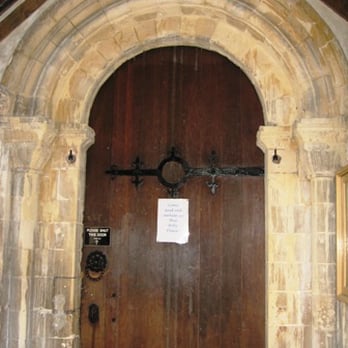
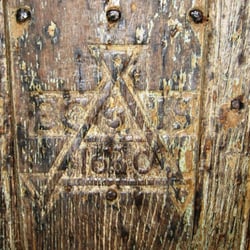
    St Botolph's Church, Botolphs - Date on the church door - 1630 - and the initials of (possibly) the Churchwardens

    St Botolph's Church, Botolphs

    5.0(1 review)
    3.0 mi

    Sussex is well endowed with Saxon churches, and St Botolphs is one of the finest…read more Situated in the hamlet to which it gave its name, the church also serves the adjacent hamlet of Annington. Together, their population is today less than 50, but this large church gives away the fact that in earlier times this was a thriving port on the nearby River Adur. The church dates from 950 AD, and the nave is typical of the Saxon style: narrow, tall and long. Around 1250, a north aisle was erected, and three generous and elegant Early English Gothic arcades were inserted in the north wall. At the same time, the chancel was rebuilt, possibly replacing a Saxon apse, and the west tower added. However, as the river silted up and changed its course, the little town declined, and around 1450 the north aisle was demolished and the north wall closed up, although the three arcade arches are still clearly visible, both inside and out. Thereafter, little has altered: the south wall is the Saxon original, and includes a small Saxon window alongside newer (mostly mediaeval) insertions. The chancel arch includes a Saxon roll on its interior, unusual in that it does not follow the arch to the floor, but rests on two corbels, which have early Saxon decoration, made using a trowel. The chancel has some fine very early Gothic lancet windows, including two 'squints', to allow people outside the church (such as those excommunicated or with a disease) to watch the service within. The one on the north side is probably a 'Leper's Squint'; we know there was a leper's hospital in nearby Bramber in mediaeval times. The one on the south wall has a scratch sun-dial outside, possibly to denote the times of confession. There are also faint wall paintings above the chancel arch, the oldest of which may date from the Saxon period. Three bells dating from 1536 still ring out from the tower, hanging in their original wooden frame. There is a fine Jacobean pulpit, and a royal coat of arms from the time of Charles II. The heavy wooden door bears the date 1630 and the initials of the churchwardens. The church is well worth a visit - why not combine it with a walk along the adjacent Downs Link long distance footpath?

    Photos
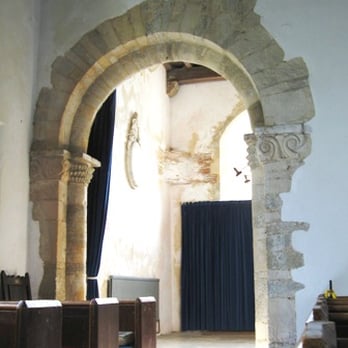
    St Botolph's Church, Botolphs - Remains of the elegant north arcade of the nave, with Early English gothic arches resting on plain moulded capitals. Built

    Remains of the elegant north arcade of the nave, with Early English gothic arches resting on plain moulded capitals. Built

    St Botolph's Church, Botolphs - Interior of church door.

    Interior of church door.

    St Botolph's Church, Botolphs - Overal view of the church from the north west.

    See all

    Overal view of the church from the north west.

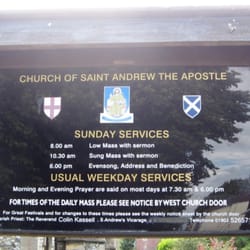
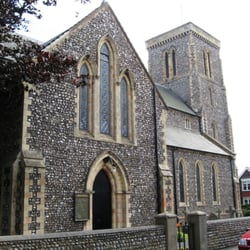
    Church of St Andrew's and the village of West Tarring

    Church of St Andrew's and the village of West Tarring

    5.0(1 review)
    2.1 mi

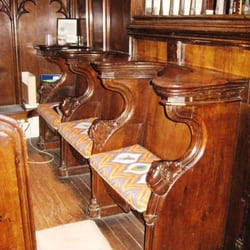
    West Tarring is surrounded on all sides by the suburban sprawl of modern Worthing, but it much the…read moreolder and, originally, more important settlement. The village still retains its attractive original High Street, on which are several old pubs and a lovely 15th century half-timbered house, with a distinctive overhang (now the Parsonage Restaurant, and a grade II* listed building). It also contains the remains of an old palace belonging to the Archbishops of Canterbury (see separate review), now the Parish Hall. The origins of the town date back at least to 941AD, when King Athelstan gave the Manor of Terringes to the Church of Christ at Canterbury. Domesday mentions two churches, although nothing of these buildings survives. Today, the skyline is dominated by the fine tower and spire of St Andrews, one of only a handful of Grade 1 Listed buildings in Worthing. Reflecting its status as a peculiar of Canterbury, it is a huge church for such a small village. Saint Richard, Bishop of Chichester, took refuge here in 1245-1247, when he was temporarily banished from his See by Henry III. Although heavily restored by the Victorians, the five-bay Nave and aisles are essentially Early English Gothic from the 13th century, with lancet windows in both aisles and the clerestory. In the south aisle is a fine trefoil-headed piscina, preserved in fine condition by being plastered over in the Reformation rather than destroyed. In the 15th century, the present tower and chancel were built, both with fine Perpendicular windows. The spire covered in wooden shingles - was added in the 16th century. But the church's real glory lies in its woodwork: a fine 15th century chancel screen, complete with an impressive (and rather intimidating) row of spikes along the top, and a set of six misericords, with fine carvings underneath, including two bearded heads with flowing locks, and floral compositions. The Victorians continued the panelling around the chancel wall, but the very fine carved Communion Rail - described by Nairn and Pevsner in 'The Buildings of England' as 'perky' is Jacobean. Unfortunately, the original font was taken to New Zealand by the principal landowners in the 19th century, and the present one is a copy. However, the interior of nave is decorated by a complex mosaic decorative scheme of 1885, designed by the church architect William Butterfield. On my visit, I was made very welcome by the Rector and Churchwarden, very proud of their historic church. Outside, the attractive churchyard is full of 18th and 19th century tombs, many of high quality. The oldest and most poignant is a table tomb to one John Parson, dated 1633. A listed monument in its own right, it carries a short but painfully evocative verse: Young was his age Virginity his state Learning his love Consumption his fate It's a perfect antidote to some of the more sentimental Victorian epitaphs.

    Photos
    Church of St Andrew's and the village of West Tarring
    Church of St Andrew's and the village of West Tarring
    Church of St Andrew's and the village of West Tarring

    See all

    St Mary's Church - churches - Updated May 2026

    Loading...
    Loading...
    Loading...