Cancel

    Open app

    Search

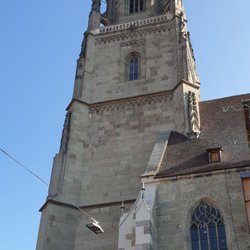
    St. Martin

    4.0 (1 review)

    St. Martin Photos

    St. Martin Reviews in Other Languages

    St. Lorenz Kirche

    St. Lorenz Kirche

    4.4(18 reviews)
    53.7 kmInnenstadt

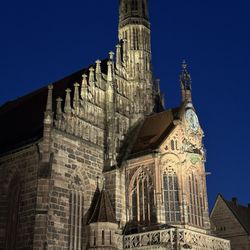
    One of my favorite churches in Nuernberg. I believe it is also the largest. I'm not going to state…read moreall the history and facts about this church, others have already done so. Just one little anecdote that always amuses me is that the builders could not agree on the style of the towers and this is why each tower is different. A feud that is permanently displayed on the towers of a church no less... Anyway, take a close look at this church both inside and out. There are so many details to see, that even after years coming here, I still seem to discover new details. A must see for sure.

    This is the largest church in Nuremberg. To my surprise, I thought I was entering in a Catholic…read moreGothic style church (built circa 1250) to find out it was a Lutheran one. In any case, amazing church with so much art to see in just an hour I spent there (I was with a colleague and did not want to spend the usual amount of time I would do in this type of sacred buildings with so many details and art in every corner). I can't believe it was bombarded during WWII, then rebuilt with great effort. The stained glass art is amazing and I was happy to see that during our visit it was an exhibit about the artist who created all of them originally. It was a very well paid 2 euros visit (I dont like to pay to enter in a church, I am more pro-donations, but still it was worth it). One suggestion is that I would prefer not to have a gift shop inside the church. That devalue both the religious experience and the artistic value, converting the whole thing in a theme park. That is the only part I disliked during my visit as well as the attitude of the young girl that was collecting the money...I got confused of door of our way out and she started yelling at me: no, not there, stop stop...which made me feel weird. Anecdotes apart, a must visit.

    Photos
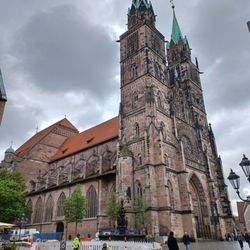
    St. Lorenz Kirche
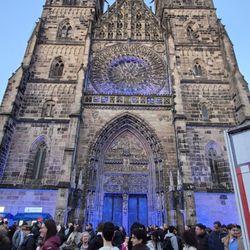
    St. Lorenz Kirche - ... Abendstimmung ...

    ... Abendstimmung ...

    St. Lorenz Kirche

    See all

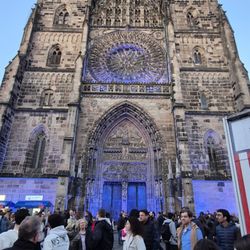
    Frauenkirche - ... Impressionen ...

    Frauenkirche

    4.1(19 reviews)
    53.9 kmInnenstadt

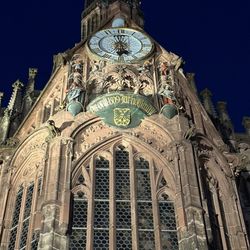
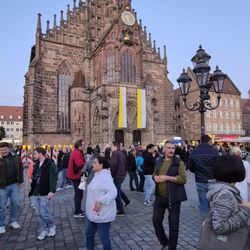
    I am not going to go through the history and facts of the church. Clearly another example of…read moreNuernberg's rich history as a medieval city. What makes this church stand out is the fact that it overlooks the main market place with it's many fruit and veggie stands, most with locally grown produce. Of course there are also food trucks and household wares to be had. The market place turns into a giant Christkindl Market and at its opening the Christkindl (which by the way is a Christmas angel - child of Christ) stands atop the church balcony and officially opens the Christkindl Market with a speech and blessings. Definitely worth attending, if you can squeeze in somehow, because be aware that it will be super crowded. Just before 12 noon you will see crowds gather looking up towards the top of the church. They are all waiting for the "Maennleinlaufen" were the figures start moving and the electors turn and face the Roman emperor. There are also musician figures that move as if playing their instruments.

    Frauenkirche or " The Church of Our Lady" is an example of brick Gothic architecture, and it was…read morebuilt on the initiative of Charles IV, Holy Roman Emperor (reign 1346-1378) between 1352 and 1362. The church contains many sculptures, some of them heavily restored. Numerous works of art from the Middle Ages are kept in the church, such as the so-called Tucher Altar (c. 1440, originally the high altar of the Augustinian church of St. Vitus also in Nürnberg). The church was built in the grand market, in place of the former Jewish synagogue, which was destroyed during the Nürnberg pogrom (Jewish persecutions of 1349) which followed an outbreak of Black Death. Charles IV wanted to use the Frauenkirche for imperial ceremonies, which is reflected in the porch with the balcony, and in the fact that the church is relatively unadorned except for the coats of arms of the Holy Roman Empire, the seven Electors, the town of Nuremberg, and the city of Rome, where the Holy Roman Emperors were crowned. Construction of the church continued until the 1360s. Charles IV's son Wenceslas was baptized in the church in 1361, on which occasion the Imperial Regalia, including the imperial reliquaries, were displayed to the people. References to Wenceslaus can be found throughout the sculptural program of the church. Beginning in 1423, the Imperial Regalia was kept permanently in Nürnberg and displayed to the people once a year on a special wooden platform constructed for that purpose. The current west gable of the church dates from 1506-8. Historic images show that this gable was once richly decorated with sculptures which were presumably destroyed in the Reformation. In 1525 the church became Lutheran and galleries were added in the aisles. In 1810, the church was acquired by a Catholic parish which removed the galleries and restored the church in 1816. This restoration involved replacing and repairing surviving sculptures and gathering Medieval art to adorn the church. One of the most notable features of the church is the Männleinlaufen, a mechanical clock that commemorates the Golden Bull of 1356. The clock was installed in the church between 1506 and 1509. The Holy Roman Emperor is shown seated with the prince-electors surrounding him. The clock mechanism is activated at noon when a bell is rung to start the sequence and is followed by the trumpeters and drummer. Then there is a procession of the electors around the figure of the Holy Roman Emperor.

    Photos
    Frauenkirche - ... Impressionen ...

    ... Impressionen ...

    Frauenkirche
    Frauenkirche

    See all

    St. Georgskirche - Epitaph

    St. Georgskirche

    4.5(6 reviews)
    25.8 km

    St. Gorgeskirche is a late Gothic hall church built between 1427 and 1505 with its 89.9-meter tower…read moreabove the west portal, popularly known as "Daniel," can be seen from some distance, is the town's landmark. The council of the imperial city of Nördlingen decided to build the Georgskirche on October 17, 1427. The choir of the hall church was completed in 1451, and in 1454 construction of the tower began. The high altar by Friedrich Herlin was completed in 1462, and the tower in 1490. With the completion of the vault in 1505, the construction, which consists largely of suevite, was completed. Because Nördlingen joined the Reformation under Kaspar Kantz, St. Georg became the Protestant town church in 1523/1525. The 93-meter long and over 20 meter high nave makes St. Georg one of the largest hall churches in southern Germany. The building consists of a three-aisled choir and a three-aisled, twelve-bay hall with twelve central columns. The baroque high altar is decorated with late Gothic wooden sculptures. It is a crucifixion group with Mary and John and two mourning angels, flanked by St. George with the defeated dragon at his feet and Mary Magdalene with the anointing vessel in her hand. These figures, which can be seen today in the Nördlingen City Museum, were originally in a wooden shrine with movable wings that was built around the same time and painted by Friedrich Herlin. The altar was given its baroque appearance in 1683. The housing of the late Gothic wooden shrine was only discovered under the baroque casing during the restoration in 1971-1973. Today it stands on the north wall with the painted rear front (eight Passion scenes of Christ and the Last Judgment ) to the front. The late Gothic stone pulpit has a plinth with lush, intertwined ribs and a staircase with an openwork tracery parapet. The four evangelists with their symbols are depicted as reliefs on the pulpit. In between, the Man of Sorrows, Mary, Mary Magdalene, John the Evangelist and St. George can be seen under canopies. The baroque sound cover, on which Christ is enthroned with the globe, was made by Johann Michael Ehinger in 1681. The wooden sound cover is decorated with putti and angel heads. First restoration happened in the years 1877 - 1887. On March 30, 1945 at 9:25 p.m., an aerial bomb destroyed the "Steinmeyer Organ" set up in 1889. On February 2,1974 a fire destroyed the old baroque organ from 1610.

    Photos
    St. Georgskirche - St. Georg

    St. Georg

    St. Georgskirche - Epitaph

    Epitaph

    St. Georgskirche - Orgel und Kanzel

    See all

    Orgel und Kanzel

    St. Martin - churches - Updated May 2026

    Loading...
    Loading...
    Loading...