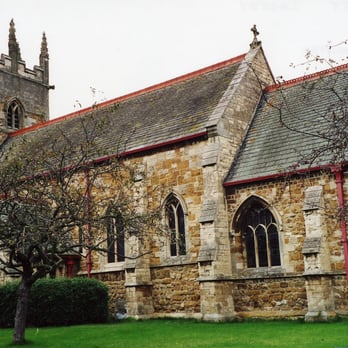
St Margaret's Church Photos


Recommended Reviews - St Margaret's Church
Start your review...



18 years ago
Laceby lies at the juncion of the A46 and A18, approached from Grimsby by turning right off the A46 before reaching Laceby Crossroads. The church is in the village centre, near the market place. I have been to funerals here and to family weddings and a more beautiful setting could not be imagined for a wedding. Laceby is an old old Viking village (Lus-BY) is steeped in history and contains many monuments dedicated to historic people. Although Grimsby is now much larger than Laceby, many years ago the Baron of Laceby sent his army into Grimsby and took over the town, taking prisoner the high officials and putting them in dungeons in Laceby! The Anglican parish church is dedicated to St. Margaret and is built from Ancaster stone. It may date back, in total, to prior to 1424, some time in the late Norman period. It seats about 300 from the days when all the village went to church on a Sunday. In 1583, the rector of this church, John WHITGIFT was appointed as Archbishop of Canterbury by Queen Elizabeth I. He had been born at Grimsby in 1530. St Margaret's church stands prominently in the centre of the village. The tower and the nave date from the 11th century and other Norman features include the doorway inside the porch with two window openings either side, dedicated to St John and St Margaret. Records show that a church and a rector have been at Laceby since 1172. The lower part of the tower dates from this period, and carries a ring of five bells. 19th century restoration and additions were made by James Fowler. John Whitgift, Archbishop of Canerbury in the reign of Queen Elizabeth I , was rector from 1572 - 77 and also Dean of Lincoln Catherdral. He is commemorated in stained-glass windows in the vestry and chancel. I annually spent many a happy hour, as a child visiting relatives, at the church garden fete which was in the grounds of the vicarage. A huge victorian building with massive gardens. No longer happens I believe. I oddly lectured on cemetaries and public health in the area..tried to make it gory and amusing all at once..a bit of trivia for those interested about here.(abbreviated:) Article in the Grimsby Observer and Humber News 24th June, 1874 LACEBY: From statements made concerning this parish it would seem that its sanitary condition is in a most alarming state.some startling disclosures in regard to the neglect of sanitary precautions at Laceby, in consequence of which the village is rarely free from disease. He found two cases of typhoid fever, the sufferers being both of the butchers. There had been eight interments in six weeks, and the inhabitants of some of the houses surrounding the churchyard bitterly complained of its state. There had been eleven deaths in nine weeks in a population of about 1000, that the fever was hushed up by the doctors, and again called his attention to the state of the churchyard In discussion it was mentioned that an order had already been issued from the Home Office for the closure of the churchyard as a burial ground on the 24th December next The Chairman said it was their duty to put an immediate stop to such practices Mr W Iles said when the weather was wet and warm too the ooze from the churchyard was dreadful. It was explained that the surface had been lowered 2ft 6 in or 3 ft, and that the remaining soil was saturated with decomposing animal matter. As to fever never being free of the place, he knew from certain and reliable information that there had been 100 cases of typhoid fever in the village in one year, and if it was not of a low kind to cause deaths it would create pauperism. Tuesday, July 28, 1874 Bad Condition of Laceby Churchyard. Some time previously, during work of restoration of the church, soil had been removed from the churchyard to a depth of 2ft 6in, and it was declared that further soil had been removed since. This was, indeed, admitted by the Rector. It was this removal of soil that had led to unsanitary conditions as it meant that many of the buried bodies were now much nearer the surface than was desirable. A Mr Watson, druggist, of Laceby told the committee that he had noticed a bad smell on the north side of the churchyard when soil was removed. He took up a handful of earth, found it was heavy and did not really look like soil. He carried it away and boiled it and a froth collected round the pan. The experiment put him against his food for some days afterwards..(wonder if he used the same pan for food?) A Mr Youhill expressed the belief that the removal of soil at the time the church was restored was injurious, and was still so. While walking over the churchyard he put his foot on a grave and it slipped into a coffin This coffin was not more than four inches from the surface. John Audiss, who had been gravedigger from 1869 to 1872, said he resigned the job because he dug up many skulls and skeletons. Once when digging a grave, and about three feet down, the side of read more




