Cancel

    Open app

    Search

    Spectre Ruins

    4.0 (4 reviews)

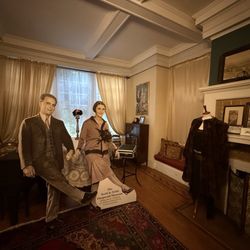
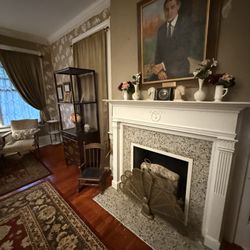
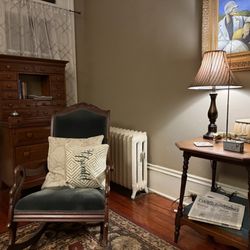
    Spectre Ruins Photos

    Recommended Reviews - Spectre Ruins

    Your trust is our priority, so businesses can't pay to alter or remove their reviews. Learn more about reviews.
    Yelp app icon
    Browse more easily on the app
    Review Feed Illustration

    4 years ago

    Helpful 0
    Thanks 0
    Love this 1
    Oh no 2

    5 years ago

    Helpful 4
    Thanks 0
    Love this 5
    Oh no 0

    5 years ago

    Helpful 2
    Thanks 0
    Love this 1
    Oh no 0

    2 years ago

    Helpful 1
    Thanks 0
    Love this 1
    Oh no 0

    Verify this business for free

    Get access to customer & competitor insights.

    Verify this business

    Tours of Montgomery

    Tours of Montgomery

    5.0
    (8 reviews)
    5.7 mi

    Have you ever looked for a postcard while in Montgomery? Well, they are far and few between! When I…read morearrived on a Sunday, I went to Walmart and Target, and to my dismay, no postcards. On Yelp, I saw a souvenir shop listed, Tours of Montgomery. But it wasn't open until Tuesday. I continued to look and am so happy I didn't find any postcards on Sunday or Monday, because the experience of going to Tours of Montgomery on Tuesday was priceless! We pulled into the parking area for the store (which is in the front), and as we walked up, I said, "Even the outside is adorable!" As you walk into the store, you are transported through the history of Montgomery! From the moment we arrived in the store, Ms. Valerie took care of us immediately, asking what we were looking for. When I mentioned postcards, she directed me to the various sections with postcards in a way that made it feel like I was buying something more valuable than a postcard! As she interacted with us, the conversation was natural. Her shop was a Tour of Montgomery with shirts, statues, prints, paintings, magnets, and so much more that covered every aspect of history in Montgomery! Then we talked about the neighborhood that the store is in. Dr. Martin Luther King Jr. walked down the road in front of the corner where the store is, across the street is the hotel where Billy Holiday played on the top floor, down the street, the first black theater, and in the other direction, the first black grocery store. All of the history was in one location, but even more special was that Ms. Valerie took the time to explain it all to my friend and me, who had stopped in for a postcard. She showed so much love for us in that 45 minutes that I would have stayed hours if allowed. If you are ever in Montgomery and want to experience a piece of Montgomery history or just purchase a postcard, this shop is the place to go. It's been one of my favorite experiences in Montgomery and Ms. Valerie will make it worth your time!

    Valerie Smedley is FANTASTIC! Not only is she one of the friendliest people I've ever been blessed…read moreto meet, but she gives an impeccable, personal and deep dive tour of historic proportions---literally. PLUS she has a super cool gift shop--I bought a t-shirt that reads: Never argue with anyone Harriet would leave behind Next time I get to Montgomery, I will definitely stop in just to say hello because she's that wonderful--a new friend I adore!

    Photos
    Tours of Montgomery
    Tours of Montgomery
    Tours of Montgomery

    See all

    Old Alabama Town

    Old Alabama Town

    4.0
    (9 reviews)
    4.8 mi

    So much history is simply demolished. Some cities, like Montgomery, have sites such as these that…read morereassemble these otherwise forgotten bits of bygone days. It's fun to ramble through these old buildings that are all quite well-preserved. If you have children, multiply the time you spend here by two or three or four.

    January 12, 2013, Tony and I did a self guided walking tour of Montgomery, Al. We had a great day…read more The weather was warm and lovely. We happened upon this 6 block historical section of old homes in Montgomery, Al. There are new homes here. Here is a brief history of the buildings: Tour the Authentic 19th Century Village Today There are no facades or newly constructed buildings here! Our 19th century village features completely authentic 19th and early 20th century homes and buildings that have been saved from demolition, carefully restored, and reopened to the public as a history museum. At Old Alabama Town, you will learn how early Americans of all backgrounds lived and worked in Central Alabama. History lives at Old Alabama Town, where six blocks of authentically restored 19th and early 20th century structures beckon you to step back in time to the days of one-room... Self-Guided Tours We offer self-guided tours Monday-Saturday, 9 a.m. to 4 p.m. The last ticket is sold at 3 p.m., though visitors are free to explore until 4 p.m. Upon purchasing admission at the Old Alabama Town Reception Center, guests will receive a property map to guide them on their walking tour of our Living and Working Blocks. Visitors are free to explore at their own pace and leave and return throughout the day. Costumed interpreters are available on each block to answer questions. A fully guided tour of the Ordeman House is also included in general admission. Tours of the Ordeman House are available Monday-Friday at 10 a.m., 11 a.m., 12 p.m. and 1 p.m. Ordeman tour times are subject to change without notice. Call 1-888-240-1850 on the day of your visit to confirm times.

    Photos
    Old Alabama Town
    Old Alabama Town
    Outside of building

    See all

    Outside of building
    The Legacy Museum: From Enslavement to Mass Incarceration

    The Legacy Museum: From Enslavement to Mass Incarceration

    4.8
    (185 reviews)
    4.7 mi

    Montgomery Civil Rights Walk of Freedom Self-Guided (GPS) Walking Tour…read more As a retired 20-year veteran who grew up during the Watts Riots, I've seen a lot in this country--but I can honestly say this experience gave me something I didn't know I was missing. Taking this walk through Montgomery alongside my younger brother made it even more meaningful. We lost our mother early in life, so moments like this--where we can learn, reflect, and grow together--carry a different kind of weight. This wasn't just a tour for us; it was a chance to connect with each other and with a history that wasn't fully taught to us growing up. Hearing the stories of Dr. Martin Luther King Jr. and Rosa Parks while standing where it all happened brought a level of understanding I never got in school. It filled in gaps and gave voice to experiences that shaped not only the country, but generations like ours. The self-guided format allowed us to take our time, have conversations, and really absorb what we were learning. There was no rush--just space to reflect, remember, and appreciate how far we've come and how much more there is to understand. For me, this was more than history--it was personal, it was healing, and it was something I'm grateful I got to share with my brother Mark.

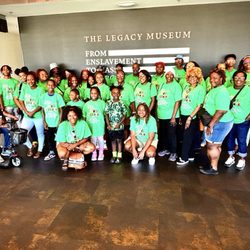
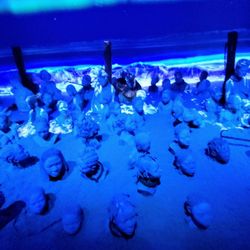
    We visited the Legacy Museum on Jan 8, 2026 as part of Road Scholar's "The Civil Rights Movement -…read moreAtlanta, Montgomery, Selma, Birmingham" program. It is one of the three Equal Justice Initiative (EJI) Legacy sites in Montgomery, AL, and one of the two where photography is not allowed. The latter was emphasized at the security checkpoint, of which there was only one line. I surrendered my foldable (smartphone) tripod to the staff, and would later do it two more times at the other two sites. Within the exhibition halls, staff members are positioned every 100 feet (give or take) to ensure visitors are on their best behaviors, i.e. no photography, no vandalism, etc. The transatlantic slave trade is the subject of the first two halls, with the first focusing on the transits of the captured from Africa. Sets of pictorial, written and video content fill every wall. There is no particular order of viewing. The next hall continues with the arrival, transactions and transits from ports to new colonies in the New World. Life-sized models of slaves naked and in chains act as passageway that visitors pass to move on. Despite being previously informed, I did not understand the sheer volume of the museum's content. I stopped to read every content in detail because of the no-photography policy. By the time I was done perusing the transatlantic slave trade, more than 30 minutes had passed. One section consists of small rooms designed to look like prison cells, each showing a brief holographic projection of a moment in the life of a slave. These projections are triggered by motion sensors. Another hall focuses on federal and state court decisions - most of them ruling against African-Americans - as well as numerous hate crimes and other (violent) racial injustices, all of which that had occurred since Reconstruction. Past that is a larger hall that displays copies of newspaper ads of slaves for sale on one side, and life during Reconstruction on the other. I had started to peruse the latter when I realized that I was approaching two hours in time spent in the museum. Deciding to head on to the other two sites, I was surprised to discover many more sections - including an art gallery - and the volume of content in each that I would miss. The Legacy Museum requires up to a day to truly appreciate its treasure. It is certainly worth visiting given its low admission price ($5 as of Jan 2026). However, I do not give this 5 stars because of the unnecessary security checkpoint to do the boat ride from Boat Launch at 101 Morris Street to Freedom Monument Sculpture Park, and vice versa. See attached image for further details At 12:56pm, after visiting the National Memorial for Peace and Justice (NMPJ), I showed up at Boat Launch. There was a security checkpoint. I was told to turn over my tripod before getting on the boat. The big, burly bespectacled guy in the suit claimed that tripods could be used to vandalize the sculptures, and I could take the boat back and to this pier to get it back. He gave no explanation as to how a tripod would be a hazardous or dangerous object on a boat ride itself. The Sculpture Park has its own security checkpoint where I would turn over the tripod, and I wasn't planning on coming back to this pier just to pick up my tripod. It would be a waste of time. So I waited for the shuttle to take me back to the Legacy Museum after stopping over at NMPJ. When I finally arrived at Sculpture Park, 45 minutes of my time was wasted. This limited the time spent there. There was no necessity to have security checkpoint at Boat Launch when Sculpture Park has its own security checkpoint. Until EJI Legacy updates their policy to one that makes sense, this EJI site gets no more than three stars.

    Photos
    SCLC West Jefferson Chapter group
    SCLC West Jefferson Chapter group
    Pictures from the Civil Rights era
    Pictures from the Civil Rights era
    Right next to the fountain

    See all

    Right next to the fountain
    National Memorial for Peace and Justice

    National Memorial for Peace and Justice

    4.9
    (130 reviews)
    5.2 mi

    There are some places you visit, and then there are places that stay with you. The National…read moreMemorial for Peace and Justice is one of those places. Opened in 2018 by the Equal Justice Initiative, this memorial honors more than 4,400 African American men, women, and children who were victims of racial terror lynchings between 1877 and 1950. It tells a story that is painful, sobering, and absolutely essential to confront. As you enter, the experience is quiet and intentional. Steel rectangular monuments are arranged by state and county, each engraved with the names of victims and the dates they were killed. At first, the columns stand at eye level. You can look directly at the names. But as you continue walking, the ground gradually slopes downward and the columns begin to rise above you. It is impossible not to understand the symbolism. The markers are roughly human-sized. As you descend and look upward, they resemble bodies suspended overhead. That realization hit me deeply. The weight of it -- the scale of it -- settles into your chest. It is heavy. It should be. Along the walls, detailed plaques explain the circumstances behind many of the lynchings. Some victims were murdered by mobs of hundreds or even thousands. Some were killed for reasons so trivial and unjust -- accusations, perceived slights, even something as simple as having a photograph of a white woman. You quickly realize how little it took, and how terrifying daily life must have been for Black Americans living under that constant threat of violence. Near the exit, there is a waterfall installation representing the countless undocumented lynchings -- lives lost that may never be fully known. It is a quiet but powerful reminder that even this memorial cannot capture the entire scope of the tragedy. Outside, each hanging monument is duplicated and laid flat across the grounds. This allows visitors to read each name more closely. I deeply appreciated this thoughtful design choice. Every name is treated with dignity and equality. As you walk among them, you may notice multiple names from the same county on the same date -- entire acts of mob violence frozen in steel. Further along, sculptures and signage from various states and counties acknowledge the history and efforts toward reconciliation. The Equal Justice Initiative encourages each county represented to claim its monument and publicly confront its history. Many have begun to do so. Many still have not. The memorial asks visitors to be respectful and to stay off the grass. There are restrooms available on site. Everything about the space is orderly, intentional, and reverent. This is not an easy place to visit. It is not meant to be. But it is profoundly important. If you are in Montgomery, this is a must-visit. It provides critical context for understanding why the end of slavery, Reconstruction, and the Civil Rights Movement were not just historical milestones -- but moral necessities born from immense suffering. I would give this memorial 10 out of 5 stars if I could. Go. Walk slowly. Read the names. Remember.

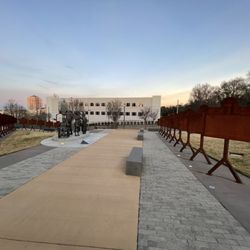
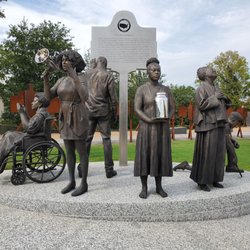
    We visited the National Memorial for Peace and Justice (NMPJ) on Jan 8, 2026 as part of Road…read moreScholar's "The Civil Rights Movement - Atlanta, Montgomery, Selma, Birmingham" program. It is one of the three Equal Justice Initiative (EJI) Legacy sites in Montgomery, AL, and the only one where photography is allowed. Like with the other two sites, security checkpoint is present and I surrendered my foldable (smartphone) tripod. While the Freedom Monument Sculpture Park has a collection of artwork in a park setting, the entire area of the NMPJ can be seen as a single artwork of many sections, like the long wall mural in Dexter Ave Baptist Church (also in Montgomery; within walking distance from the Legacy Museum). The first section of NMPJ is a large grassy area bordered by walkways, wall-mounted written content on the subject of "from slavery to lynching". and the Nkyinkyim Installation sculpture. I don't know if picnics or napping on the grassy area is allowed. I didn't ask. Walking from this area to the next section took time. The next section, being the memorial temple, is the highlight of NMPJ. An open structure that houses numerous tall tablets resembling coffins. Each tablet bears the names of county and state, followed by the names of lynching victims and their respective dates of death. Initially, the tablets look like they are resting on the floor. At the center of the temple is a grassy square accessible from multiple points. Standing at the center of the square, the visitor can see the sheer masses of deaths memorialized within the temple. (Photos and footages are found on my YouTube channel @1Somber. Look for video title "Day 5: National Memorial for Peace and Justice, Freedom Monument Sculpture Park" in playlist "2026-1: The Civil Rights Movement - Atlanta, Montgomery, Selma, Birmingham".) At one end of the structure, the path turns right to a corridor that slopes down. I then realized that the tablets are hanging from the ceiling. When the corridor reaches the bottom level, the tables are hanging over my head. Mounted on opposite walls are panels, each mentions the known "justification" for the victim's death. Why only the bottommost area of the panel is used is a mystery. I hope in time more names will be added to these panels. The final wall has an inscription draped by a waterfall states that the "victims of racial terror lynchings... whose deaths cannot be documented... whose names will never be known... are all honored here." Leaving memorial temple, I came to Monument Park. In this area, the tablets take on the shape and size of coffins, and lay on the ground rows after rows on the left and the right of the walkway. Like the tablets at the memorial temple, each bears the names of county and state, followed by the names of lynching victims and their respective dates of death. After Monument Park comes the "Guided By Justice" sculpture, and then Community Park. Tablets shaped like signposts line up in a single file to one side, and act as shoulders for the visitor walkway. Each has written details of specific lynchings. I followed these "signposts" and arrived at the "Arise" sculpture. The path then leads back to starting point. Visitors can either go for another round or leave. Our tour guide said that a visit at the NMPJ can be done in 45 minutes. I say, "Take all the time you want." The patrolling staff is sparse and there's no hurry. The $5 admission price covers all three EJI sites. Although I appreciated the NMPJ, particularly capturing a considerable amount of photos and footages, I do not give this place 5 stars because of the unnecessary security checkpoint to do the boat ride from Boat Launch at 101 Morris Street to Freedom Monument Sculpture Park, and vice versa. See attached image for further details. At 12:56pm, after visiting the National Memorial for Peace and Justice (NMPJ), I showed up at Boat Launch. There was a security checkpoint. I was told to turn over my tripod before getting on the boat. The big, burly bespectacled guy in the suit claimed that tripods could be used to vandalize the sculptures, and I could take the boat back and to this pier to get it back. He gave no explanation as to how a tripod would be a hazardous or dangerous object on a boat ride itself. The Sculpture Park has its own security checkpoint where I would turn over the tripod, and I wasn't planning on coming back to this pier just to pick up my tripod. It would be a waste of time. So I waited for the shuttle to take me back to the Legacy Museum after stopping over at NMPJ. When I finally arrived at Sculpture Park, 45 minutes of my time was wasted. This limited the time spent there. There was no necessity to have security checkpoint at Boat Launch when Sculpture Park has its own security checkpoint. Until EJI Legacy updates their policy to one that makes sense, this EJI site gets no more than three stars.

    Photos
    Arise by Branly Cadet memorializing local community leaders and descendants of victims
    Arise by Branly Cadet memorializing local community leaders and descendants of victims
    National Memorial for Peace and Justice
    National Memorial for Peace and Justice

    See all

    Rosa Parks Library & Museum

    Rosa Parks Library & Museum

    4.6
    (75 reviews)
    5.0 mi

    This is the best museum we have seen on our civil rights tour so far. Lots of movie clips…read moreintegrated with the exhibits so sitting alternates with standing and listening and watching alternates with reading. Take the Time machine ride in the children's wing first if you possibly can. And watch for references to all the women leading the movement that we often don't hear about.

    We visited Troy University's Rosa Parks Museum in Montgomery, AL on Jan 7, 2026 as part of Road…read moreScholar's "The Civil Rights Movement - Atlanta, Montgomery, Selma, Birmingham" program. As the name indicates, this museum is entirely about the titular civil rights icon. Tickets were covered by our program. We spent less than an hour here, in part because we got two other sites to visit in our day's itinerary. Our tour guide informed us that photography was not allowed inside the exhibition rooms. (Judging by the content on this business listing, that didn't stop other visitors from taking photos.) In the first room, we saw a short film that summarizes the segregation in Montgomery prior to Parks' historic act. After that, we went another room and were standing in front of a bus modeled after the one that Parks boarded and refused to give up her seat. The bus's windows serves as screens for another short film that re-enacted the historic moment. The dialogue is boosted by surround sound all over the room so that visitors could feel what it was like at that moment. After that, we went into the third and final room of exhibits showing what happened after Parks' arrest and its impact on the Civil Rights Movement. I recalled life-size figures, a model of a 1950s car and dimmed lighting. (Many thanks to Lulu Wang and her article "Rosa Parks Museum: Take You Back to 1955, Montgomery, AL" in medium.com for helping with my recollections.) The museum is clearly focused on Rosa Parks the civil rights icon, but not Rosa Parks the person, family member and human being. To my recollection, there was little mention about her life before and after the bus boycott (and the larger Civil Rights Movement). Nor was there a mention of the asteroid named after her: 284996 Rosaparks. I learnt about that from a "Doctor Who" episode (series 11, episode 3, titled "Rosa"). I don't recall if the exhibits mention of Parks' prior encounter with the bus driver James Blake 12 years earlier. After paying her fare at the front entrance, she tried to enter through the back entrance. But Blake drove off without her. Some accounts claimed that she refused to board. It'd be nice to know what's the museum's take on that incident. Of the three Montgomery mini-sites about the Civil Rights movement - the other two being the Civil Rights Memorial Center and the Freedom Rides Museum - the Rosa Parks museum is the smallest in space and content, and the only one that does not allow photography. I was the least happy with it. It's certainly worth the visit if done in conjunction with the Civil Rights Memorial Center and the Freedom Rides Museum, both of which are within walking distance. In addition to that, go see the Rosa Parks statue at the Rosa Parks Bus Stop on Court Square, which is also within walking distance.

    Photos
    Inside
    Inside
    Portrait of Rosa Parks
    Portrait of Rosa Parks
    Outside exhibition rooms

    See all

    Outside exhibition rooms

    Spectre Ruins - historicaltours - Updated July 2026

    Loading...
    Loading...
    Loading...