Cancel

    Open app

    Search

    Schloß Photos

    Schloß Reviews in Other Languages

    Verify this business for free

    Get access to customer & competitor insights.

    Verify this business

    Schwäbisch Hall

    Schwäbisch Hall

    5.0(3 reviews)
    47.6 km

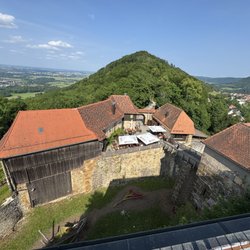
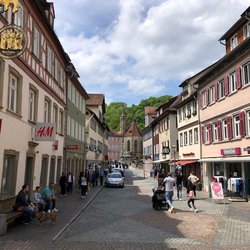
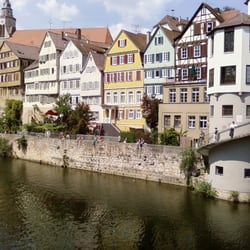
    Schwäbisch Hall or Hall for short was first mentioned in a document dating from 1063. It's…read moreunclear, but Hall possibly refers to the open-pan salt making method used there until the saltworks closed down in 1925. Salt was produced from brine by the Celts at the site of Schwäbisch Hall as early as the fifth century BC. Hall flourished through the production of salt and coins after imperial mint was founded by Emperor Frederick I Barbarossa. Hall became a Free Imperial City of the Holy Roman Empire around 1280. From the 14th to the 16th centuries, Hall systematically acquired a large territory in the surrounding area, mostly from noble families and the Comburg Monastery. The wealth of this era can still be seen in some gothic buildings like St. Michael's Church (rebuilt 1427-1526) with its impressive stairway (1507). The town joined the Protestant Reformation very early. Johannes Brenz, a follower of Martin Luther, was made pastor of St. Michael's Church in 1522 and quickly began to reform the church and the school system along Lutheran lines. Hall suffered severely during the Thirty Years' War (1618-1648) though it was never besieged or scene of a battle. However, it was forced to pay enormous sums to the armies of the various parties, especially to the imperial, Swedish and French troops. Between 1634 and 1638 every fifth inhabitant died of hunger and disease, especially from the bubonic plague. The war left the town an impoverished and economically ruined place, but with the help of reorganizations of salt production and trade and a growing wine trade, there was an astonishingly fast recovery. The Napoleonic wars brought the history of Hall as a Free Imperial City to an end. Following the Treaty of Lunéville (1801), the duke of Württemberg was allowed by Napoleon to occupy the town and several other minor states as a compensation for territories on the Left Bank of the Rhine that fell to France. Although Swäbisch Hall doesn't have any medieval fortifications walls surrounding it like Rothenburg o. d. T. or Dinkelsbühl, it certainly provides a very quaint medieval atmosphere with its numerous half-timbered houses and buildings, cobble stone streets, massive Gothic church on the hill, and Kocher River running through it. You can certainly enjoy strolling and wandering in this town for hours imagining how one's life might have been during those days. You'll enjoy visiting this town.

    Photos
    Schwäbisch Hall
    Schwäbisch Hall
    Schwäbisch Hall

    See all

    Burg Hohenzollern - Es ist kaum erkennbar, was historisch, und was einfach nur unglaublicher Kitsch ist

    Burg Hohenzollern

    4.5(44 reviews)
    74.0 km

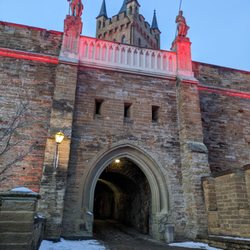
    After a solo tour of Schloss Lichtenstein, we arrived at Burg Hohenzollern to find that they're in…read morefull Christmas Markets season. The place was crowded and lively and quite busy. You'll park in a lower parking lot adjacent to the gift shop. A shuttle van will bring you almost to the entrance of the castle. From there, it's a bit of a walk. It is barely handicapped accessible though the castle itself is not at all wheelchair friendly and many rooms require transiting a number of stairs. The current castle was built between 1846 and 1867 in a Gothic Revival style and influenced by the Châteaux of the Loire Valley. The exterior is regal, dominating the hill it resides on. Inside, each room is decorated with period furniture and artifacts that were owned by Prince Louis Ferdinand of Prussia. The vault in the basement contains the Crown of Wilhelm II and a uniform that belonged to King Frederick the Great. No photographs allowed in that room but the rest of the castle, absolutely. [Review 21244 overall - 248 in Germany - 209 of 2024.]

    Beautiful castle! Pretty views from the top. But getting there from Stuttgart was really…read morebreathtaking as well. We took public transportation which is not recommended. It took 3 hours one way to get there by trains and bus. If you have a car it takes an hour. I would say it was worth it, but we were exhausted by the end of the day. The castle had a cafe that actually tasted pretty good.

    Photos
    Burg Hohenzollern - Burg Hohenzollern

    Burg Hohenzollern

    Burg Hohenzollern - Burg Hohenzollern

    Burg Hohenzollern

    Burg Hohenzollern - Burg Hohenzollern

    See all

    Burg Hohenzollern

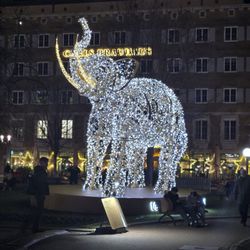
    Stadtmauer - Wörnitztor Getting ready for Christmas

    Stadtmauer

    5.0(1 review)
    56.6 km

    The city wall of Dinkelsbühl is one of three well-preserved medieval city fortification walls in…read morethe area that encircle the entire old towns; incidentally, other two towns are Nördlingen and Rothenburg o. d. Tauber. It's always so much fun to walk around these medieval towns imagining how the life might have been lived within these walls. A circular hiking trail (about 2.6 km) leads around the entire medieval city wall of Dinkelsbühl, mostly right along the wall. The western part of the fortification is particularly impressive. Due to the hillside location, the double wall built on the deep moat has a staggered height. We have King Ludwig I of Bavaria to thank for our pleasures of walking on the entire city wall around this fantastic medieval town since he placed the wall under his protection and prohibited for demolition in 1826. It's a must stop when you are visiting this area. There is a free parking lot available outside the city wall at every town gate for your convenience. To this day, all road traffic in and out of the city only goes through the four medieval city gates. Of course, you always have to watch out for oncoming traffic. This is probably one of the reasons why large parking lots were built for visitors and tourists in front of each gate. This is very practical, especially since you can park right in front of the first attractions you see as you enter the old town. The Segringertor already existed in 1384. During renovations in the 17th century, the gate tower was given its current baroque dome. There is a small, at first glance somewhat inconspicuous, Chapel of the Three Kings built in 1378 near the gate tower. Today the church houses a memorial for the victims of the Nazi regime. The Rothenburgertor was built around 1390 and has its original appearance to this day, which is why this gate can only be passed in one direction by car. The Wörnitztor with humpback blocks from the Staufer period is the oldest of the four city gates. The tower was raised at the end of the 14th century. The renaissance gable with bell tower dates from the 16th century. On the outside, as on all four city gates, there is the coat of arms of the imperial city of Dinkelsbühl - three golden ears of dinkel (wheat) on three hills. In addition, the imperial eagle is shown as a symbol of imperial involvement. The Nördlingertor (around 1400) is adorned with a stepped gable with half-shells (16th century). This town appears to be a lot less commercialized (it almost seems the town keeps it that way to discourage herd of tourists pouring in to this town) especially compared to Rothenburg. You will enjoy quietness of this town as you wander in and out of the city wall. If you had one to one and half hour of your time, you can enjoy a very leisurely stroll around this town.

    Photos
    Stadtmauer - Münster St. Georg from the City Defensive Wall

    Münster St. Georg from the City Defensive Wall

    Stadtmauer - Free clean restrooms under Segringertor (outside of the wall)

    Free clean restrooms under Segringertor (outside of the wall)

    Stadtmauer - Noerdlingertor, can you see the stork nest on top?

    See all

    Noerdlingertor, can you see the stork nest on top?

    Schloß - landmarks - Updated June 2026

    Loading...
    Loading...
    Loading...