Cancel

    Open app

    Search

    Burg Esslingen Photos

    Recommended Reviews - Burg Esslingen

    Your trust is our priority, so businesses can't pay to alter or remove their reviews. Learn more about reviews.
    Yelp app icon
    Browse more easily on the app
    Review Feed Illustration

    4 years ago

    Helpful 1
    Thanks 0
    Love this 1
    Oh no 0

    17 years ago

    Helpful 1
    Thanks 0
    Love this 0
    Oh no 0

    Burg Esslingen Reviews in Other Languages

    Verify this business for free

    Get access to customer & competitor insights.

    Verify this business

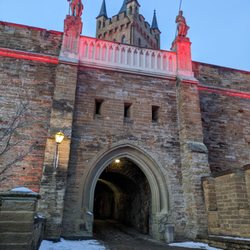
    Burg Hohenzollern - Es ist kaum erkennbar, was historisch, und was einfach nur unglaublicher Kitsch ist

    Burg Hohenzollern

    4.5(44 reviews)
    53.3 km

    After a solo tour of Schloss Lichtenstein, we arrived at Burg Hohenzollern to find that they're in…read morefull Christmas Markets season. The place was crowded and lively and quite busy. You'll park in a lower parking lot adjacent to the gift shop. A shuttle van will bring you almost to the entrance of the castle. From there, it's a bit of a walk. It is barely handicapped accessible though the castle itself is not at all wheelchair friendly and many rooms require transiting a number of stairs. The current castle was built between 1846 and 1867 in a Gothic Revival style and influenced by the Châteaux of the Loire Valley. The exterior is regal, dominating the hill it resides on. Inside, each room is decorated with period furniture and artifacts that were owned by Prince Louis Ferdinand of Prussia. The vault in the basement contains the Crown of Wilhelm II and a uniform that belonged to King Frederick the Great. No photographs allowed in that room but the rest of the castle, absolutely. [Review 21244 overall - 248 in Germany - 209 of 2024.]

    Beautiful castle! Pretty views from the top. But getting there from Stuttgart was really…read morebreathtaking as well. We took public transportation which is not recommended. It took 3 hours one way to get there by trains and bus. If you have a car it takes an hour. I would say it was worth it, but we were exhausted by the end of the day. The castle had a cafe that actually tasted pretty good.

    Photos
    Burg Hohenzollern - Burg Hohenzollern

    Burg Hohenzollern

    Burg Hohenzollern - Burg Hohenzollern

    Burg Hohenzollern

    Burg Hohenzollern - Burg Hohenzollern

    See all

    Burg Hohenzollern

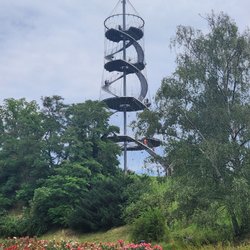
    Killesbergturm - Killesberg tower

    Killesbergturm

    4.8(6 reviews)
    12.1 km

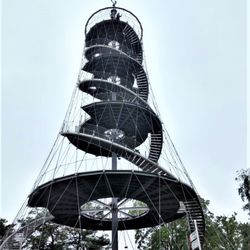
    The Killesberg Tower is a 40.4-meter high observation tower located in the Killesberg Park in…read moreStuttgart, Germany. According to the write-up posted, it was originally planned for the 1993 World Horticultural Exposition, however, it was finally erected in 2001. The four observation decks at 8, 16, 24, and 31 meters are hinged to the main mast and at their circumference connected to the net by press fittings. The two spiral staircases, one for ascending and another for descending, are suspended only by the steel cable net. Significant design elements of the tower are the central main mast whose heel is hinged by a steel ball to the central foundation, and the steel cable net of triangular meshes. The net is tensioned between a circular concrete foundation and a pressure ring at an altitude of 33.5 meters which in turn is suspended from the mast head by cables. All cables and fittings are galvanized. In addition, all steel construction elements received a double paint coat. The hollow sections, i.e., the mast and the stair tubes, are galvanized on both their inner and outer surfaces. Access to the park and the tower is free of charge. For the tower, a voluntary contribution is suggested. Opening hours are from 7 a.m. until nightfall. On a clear day, there would be a very nice view of Stuttgart from the top observation deck (31 meters). Unfortunately, it was cloudy/sprinkling when we visited. Even then, there was a very nice view of the park. If you have acrophobia or fear of heights, I'd suggest you'd skip climbing this one and look from below.

    Photos
    Killesbergturm - Spiral staircase up and    spiral staircase down

    Spiral staircase up and spiral staircase down

    Killesbergturm - A look from beneath the tower

    A look from beneath the tower

    Killesbergturm - A view from the Killesbergturm

    See all

    A view from the Killesbergturm

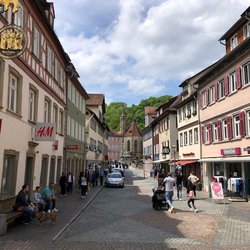
    Schwäbisch Hall

    Schwäbisch Hall

    5.0(3 reviews)
    51.4 km

    Schwäbisch Hall or Hall for short was first mentioned in a document dating from 1063. It's…read moreunclear, but Hall possibly refers to the open-pan salt making method used there until the saltworks closed down in 1925. Salt was produced from brine by the Celts at the site of Schwäbisch Hall as early as the fifth century BC. Hall flourished through the production of salt and coins after imperial mint was founded by Emperor Frederick I Barbarossa. Hall became a Free Imperial City of the Holy Roman Empire around 1280. From the 14th to the 16th centuries, Hall systematically acquired a large territory in the surrounding area, mostly from noble families and the Comburg Monastery. The wealth of this era can still be seen in some gothic buildings like St. Michael's Church (rebuilt 1427-1526) with its impressive stairway (1507). The town joined the Protestant Reformation very early. Johannes Brenz, a follower of Martin Luther, was made pastor of St. Michael's Church in 1522 and quickly began to reform the church and the school system along Lutheran lines. Hall suffered severely during the Thirty Years' War (1618-1648) though it was never besieged or scene of a battle. However, it was forced to pay enormous sums to the armies of the various parties, especially to the imperial, Swedish and French troops. Between 1634 and 1638 every fifth inhabitant died of hunger and disease, especially from the bubonic plague. The war left the town an impoverished and economically ruined place, but with the help of reorganizations of salt production and trade and a growing wine trade, there was an astonishingly fast recovery. The Napoleonic wars brought the history of Hall as a Free Imperial City to an end. Following the Treaty of Lunéville (1801), the duke of Württemberg was allowed by Napoleon to occupy the town and several other minor states as a compensation for territories on the Left Bank of the Rhine that fell to France. Although Swäbisch Hall doesn't have any medieval fortifications walls surrounding it like Rothenburg o. d. T. or Dinkelsbühl, it certainly provides a very quaint medieval atmosphere with its numerous half-timbered houses and buildings, cobble stone streets, massive Gothic church on the hill, and Kocher River running through it. You can certainly enjoy strolling and wandering in this town for hours imagining how one's life might have been during those days. You'll enjoy visiting this town.

    Photos
    Schwäbisch Hall
    Schwäbisch Hall
    Schwäbisch Hall

    See all

    Burg Esslingen - landmarks - Updated May 2026

    Loading...
    Loading...
    Loading...