Cancel

    Open app

    Search

    Pee Dee Meeting Photos

    Recommended Reviews - Pee Dee Meeting
    Your trust is our priority, so businesses can't pay to alter or remove their reviews. Learn more about reviews.
    Yelp app icon
    Browse more easily on the app
    Review Feed Illustration

    12 years ago

    Helpful 0
    Thanks 0
    Love this 0
    Oh no 0

    Verify this business for free

    Get access to customer & competitor insights.

    Verify this business

    House-In-the-Horseshoe

    House-In-the-Horseshoe

    4.3(7 reviews)
    45.6 mi

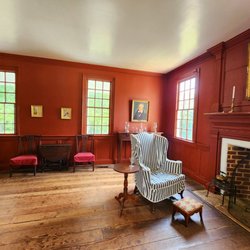
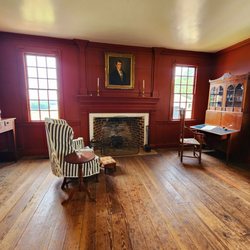
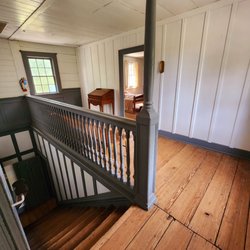
    The House In the Horseshoe is a historical gem for North Carolina. The property is on over 2500…read moreacres of land. The house is named after the Deep River that bends like a horseshoe. The house is a mile from the river but the views are stunning. The cotton gin has been turned into a museum. There are a lot of displays you can read to learn more about the property. There is also a short video that is a great introduction to the house. Guided tours of the house occur on the top of the hour. A $2 donation is asked at the visitor's center to help reserve the property. The tour ran about 45 minutes and covered the history of the time, the residents of the house and the architecture. The house is also known as the Alston House. Alston was attacked in his house during the Revolutionary War and there are still bullet holes from the pellet guns. Governor Benjamin Williams also lived in the house. He planted the cotton and had a racetrack. The house is furnished with period pieces of the Colonial and Revolutionary Wars. Four rooms are on the tour. It was worth the drive to see this property and learn of its historical background.

    A well preserved colonial house in a rural setting with beautiful vistas over fields of grain. A…read moreskirmish was fought in the house during the Revolutionary War. Many bullet holes were left unfixed. A very interesting story of the skirmish and the actions of the wife of the house is told by the tour guide. The tour guide was very knowledgeable and provided a detailed description of the house and the events that occurred there. The experience was interesting and relaxing.

    Photos
    House-In-the-Horseshoe
    House-In-the-Horseshoe
    House-In-the-Horseshoe

    See all

    Pisgah Covered Bridge

    Pisgah Covered Bridge

    4.3(16 reviews)
    44.5 mi

    This place feels wonderfully remote, so a little heads up that cell service is spotty and it's…read moreworth being mindful as you arrive. Once you're there, the quiet really sets in, with wildlife sounds all around and very few cars passing by. The atmosphere is incredibly relaxing and peaceful, perfect for slowing down and taking a breath . Picnic benches are scattered nearby, along with trash receptacles, which makes it easy to linger responsibly . The bridge itself is beautiful and well maintained, showing only moderate signs of wear that add character rather than distraction . During our mid autumn visit, the waterway and surrounding landscape were bursting with color , making the views especially memorable. I later realized there was a walking trail close by that I missed, so that's something I'd definitely suggest checking out when you visit ‍. Parking isn't clearly marked or abundant ‍, but with a bit of patience, you'll manage just fine. Overall, it's a quiet, scenic spot that feels refreshingly untouched and worth the effort to find .

    Fantastic little country roadside find! This historic bridge, one of the two remaining covered…read morebridges in the state of NC and designated a local/federal historical landmark, was built in 1911 at a whopping cost of $40. It was built to span the west fork of the Little River when horse & carriages were the main mode of transportation. There is a great little loop trail that circumvents this section of the Little River w/a little footbridge on the other side and a couple of off-shoots to go down to the water's edge and even rock hop to the middle (do so at your own risk ). Fantastic hues at Golden Hour and the soothing sound of the babbling waters make you quickly forget civilization is right there. I had the place to myself when I went, so the solitude was welcome. Definitely worth a visit when the weather is as gorgeous as it has been!

    Photos
    Pisgah Covered Bridge - Quinceañera in pisgat

    Quinceañera in pisgat

    Pisgah Covered Bridge
    Pisgah Covered Bridge

    See all

    NC Farmers' Alliance Historical Marker - NC Farmers' Alliance Historical Marker

    NC Farmers' Alliance Historical Marker

    4.0(1 review)
    3.0 mi

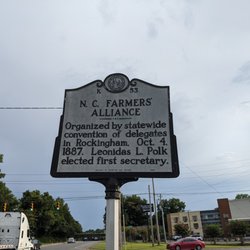
    This marker is in front of a farm stand not far from downtown Rockingham and points out the history…read moreof an important local union. The marker reads, "North Carolina Farmer's Alliance. Organized by statewide convention of delegates in Rockingham, Oct. 4, 1887. Leonidas L. Polk elected first secretary." Online, there is more information. "The Farmers' Alliance, which originated in Texas and appeared in North Carolina in 1887, was an important agent of change in an era of political and social upheaval. The organization, national in scope, was private and nominally nonpartisan. According to John D. Hicks, pioneer of Alliance historiography, the national organization's aims were fourfold: social, educational, financial, and political. In North Carolina the entanglements of the Alliance with politics were many, culminating with the defection of a sizable number of Alliance men to the Populist Party in 1892. Historian Lala Carr Steelman detailed the State Alliance's attempts to win control of the Democratic Party, purify politics, elected farmers to office, and enact agrarian reforms." "The organizational meeting of the State Alliance was held in Rockingham over two days, October 4-5, 1887. The convention drew up a constitution and appointed committees. Chosen as officers were: Alexander, president; Thaddeus Ivey, vice-president; Polk, secretary; J. D. Allen, treasurer; and Elias Carr, chairman of the executive committee." [Review 15457 overall, 961 of 2021, number 3001 in North Carolina.]

    Photos
    NC Farmers' Alliance Historical Marker - NC Farmers' Alliance Historical Marker

    See all

    NC Farmers' Alliance Historical Marker

    Henry William Harrington Historical Marker - Henry William Harrington Historical Marker, Rockingham

    Henry William Harrington Historical Marker

    4.0(2 reviews)
    2.9 mi

    As historical markers go, this one is pretty typical. As you can see, it is a gray sign with black…read morelettering. While it won't blow your socks off, it isn't ugly either. In fact, it looks similar to all other historical markers in North Carolina. If you're ever in Richmond County and in the mood to see a genuine state historical marker, I recommend that you consider this one. It certainly met all of my expectations for what a historical marker could and should be.

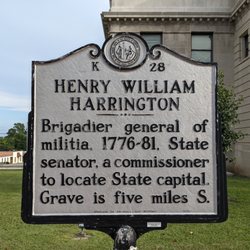
    Located in front of the Richmond County Court House, this marker points out a local hero of the…read moreRevolutionary War. The marker reads, "Henry William Harrington. Brigadier general of militia, 1776-81, State senator, a commissioner to locate State capital. Grave is five miles south." This is another instance where there is some distance from the site being pointed out to here where the marker is located. There is more information online. "Henry William Harrington, Revolutionary War political and military leader, was born in London in 1747. He immigrated to Jamaica in the 1770s, but left after a short time for South Carolina, where he settled along the Pee Dee River. At the outbreak of war in 1775, Harrington accepted a captaincy in the South Carolina militia. The following year he married Rosanna Auld, the daughter of a prominent Anson County militia officer. The couple moved to North Carolina, settling in part of Anson that became Richmond County in 1779." "Harrington was elected colonel of the Richmond County militia in November following their arrival and briefly commanded a militia regiment in Charleston, South Carolina, in 1780 before returning to serve in the General Assembly. In the summer of 1780 he was called upon to accept a temporary position as the brigadier general in command of the Salisbury District militia while Griffith Rutherford was serving in the Camden expedition." "After the conflict [a British raiding party attacked his home in January 1781] Harrington represented Richmond County in 1783 and again in 1785. In 1784 he was appointed a trustee of Salisbury Academy, and five years later became a trustee of the University of North Carolina, a post he held for six years. He also served as one of the commissioners that approved of placing the state capitol at Raleigh. In the latter 1790s Harrington retired to his plantation. He died on March 31, 1809, and is buried in the family cemetery overlooking the Pee Dee River." [Review 15474 overall, 978 of 2021, number 3017 in North Carolina.]

    Alfred Dockery Historical Marker - Alfred Dockery Historical Marker, Rockingham

    Alfred Dockery Historical Marker

    3.0(1 review)
    2.9 mi

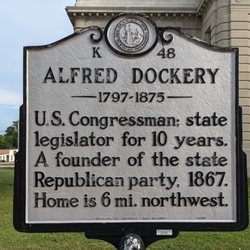
    This marker is located in front of the Richmond County Court House here in Rockingham and points…read moreout a sign that is six miles away. That seems to be the usual, but if it was there then no one would see it. So here it is. The marker reads, "Alfred Dockery. 1797-1875. United States Congressman; state legislator for 10 years. A founder of the state Republican party, 1867. Home is 6 miles northwest." Online, there is more information. "Alfred Dockery, Congressman and legislator, was born in 1797 into a large family living in Richmond County. Unable to attend school regularly because of his responsibilities on the family farm, Dockery planned to become a farmer but became involved in politics at the age of twenty-five when he served in the House of Commons from his home county. Always interested in continuing to work his farm, Dockery returned to farming whenever not involved in political office." "As a Whig, Dockery pushed for internal improvements and general reforms statewide although he focused his efforts on promoting western interests. He was also a proponent of public education, supporting a public schools bill while serving in the state senate. Among his major contributions was his involvement in the establishment of Wake Forest Institute and his service on the first board of trustees of Wake Forest College. In 1845, he was elected to Congress for one term, after which he refused to be re-elected to the same post, seeking, instead, to return to his farm." "Dockery was elected to serve in Congress from 1851-53. He was a Unionist at a time when pro-Union sympathies were unpopular in most parts of North Carolina. However, once war was declared, Dockery quietly supported the war, sending two of his sons to fight for the Confederacy. After the war, he served in the postwar government of North Carolina and was a member of the 1865 failed state convention to end Reconstruction. A founding member of the state's Republican Party, Dockery did not live to see the end of Reconstruction and died at home in 1873. [The marker is incorrect.]" [Review 15503 overall, 1007 of 2021, number 3045 in North Carolina.]

    Cotton Press Historical Marker - Cotton Press Historical Marker, Latta SC

    Cotton Press Historical Marker

    5.0(3 reviews)
    42.0 mi

    Located just a quarter mile south of I-95 on South Carolina Highway 38, this marker has a small…read morespace for parking and a view. There is a "historical marker ahead" sign and you shouldn't miss the hulking shape of the machinery it points out. The marker reads, "This cotton press, built in 1798 according to tradition, is thought by many to be the oldest in existence. It was first owned and used by John Bethea, III, and later by Henry Berry. Powered by oxen or mules rotating the beam to tighten the press, it was rendered obsolete by modern machinery. A Berry descendant moved it to this site about 1948 to preserve it." The marker was added to the National Register of Historic Places in 1972. It had been built in 1798 for bailing ginned cotton and is made of pegged and doweled oak. Turning the screw (powered by mules) compressed the cotton into a wooden frame to form a bale. A very clever piece of machinery, all built by hand well prior to modern power tools. Except for minor repairs of the base and roof, it is still the original materials and is the only press of this era in South Carolina. [Review 14328 overall, 1652 of 2020, number 706 in South Carolina.]

    This cotton press, built in 1798 according to tradition, is thought by many to be the oldest in…read moreexistence. It was first owned and used by John Bethea, III, and later by Henry Berry. Powered by oxen or mules rotating the beam to tighten the press, it was rendered obsolete by modem machinery. A Berry descendant moved it to this site about 1948 to preserve it. Erected by Dillon County Historical Society - 1974

    Photos
    Cotton Press Historical Marker - Cotton Press Historical Marker, Latta SC

    Cotton Press Historical Marker, Latta SC

    Cotton Press Historical Marker - Cotton Press Historical Marker, Latta SC

    Cotton Press Historical Marker, Latta SC

    Cotton Press Historical Marker

    See all

    Pee Dee Meeting - landmarks - Updated May 2026
    Loading...
    Loading...
    Loading...