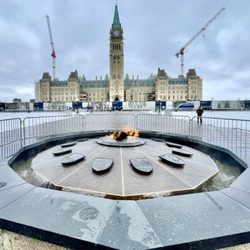
Today is Canada's 150th birthday, thus younger than the state of California. Canada occupies North…read moreAmerica's northern swath and shares a somewhat continuous border with the United States. While I wouldn't call Canada temperate, most of its population lives closer to the border, where the climate is relatively more reasonable compared to its Great White North. It could be larger than the U.S., but holds 5 million less inhabitants than California. For those who have traversed California, they know how much of it is open land, especially in its deserts, in its Central Valley, and in its protected recreational areas. As for Canada's expansive unpopulated areas, these lands are rich in natural resources.
Canada is, by its very nature, cultured and sophisticated. Its western side it is a portal to the Pacific Rim. Its eastern side is closer to Europe, from which it has received many immigrants, than is the U.S. With that infusion comes multicultural thinking and, in my opinion, Canada goes about it the right way. While the U.S. advocates a "melting pot" which implies a brand of assimilation that would involve the dilution of cultural roots, Canada prides itself on its "cultural mosaic." Whether native or naturalized, its citizens recognize being Canadian as well as of another ethnicity or culture. I applaud that being considered normative.
Canada also has an interesting wrench of sorts thrown into the equation. It's called Quebec. Bounded on both sides by Anglophone provinces, Quebec is officially Francophone. It enjoys a sort of autonomy that allows for this in conducting affairs. The U.S. has similar wrenches, where Pacific territories and Puerto Rico can preserve their native cultures. In reality, these are not wrenches at all as much as they are interesting. I can't picture a Canada without Quebec. At one point in time, the Quebec Referendum was a contentious event in which the province wanted to secede, largely surrounding cultural and linguistic issues. It didn't happen. With cultural cross fertilization, that looks to be further and further in the rear view mirror. Our selective memories allow us to remember some things more than others. In the late 90s, a higher-up in Quebec's government was queried about the language issue. His response was something like, 'We do not need to speak French ... we need French in order to speak.' I nearly bust a gut. While it sounded pompous, I also understood what he meant. The manner in which someone from an Anglophone culture and someone from a culture imbued by Latin European sensibilities processes and communicates is not the same. Whether fact or fiction, it is said that we have French-Canadian explorers to thank for the name of the Grand Tetons. It was probably random association. I'm sure these men didn't decide this by committee while around the campfire.
To many in the U.S. and around the world, Canada is synonymous with its big cities and its natural wonders. Some 15% of its population lives in the GTA, the Greater Toronto Area, Canada's economic engine. At one time, the United Nations declared the Toronto area to be the most culturally diverse in the world. Historic Montreal is on the up and up, after languishing some decades ago, and it is the largest French speaking city outside of France. Like Toronto, it has industry and commerce but, in North America, it is considered second only to New York for gastronomy. Scenic Vancouver is Western Canada's port to the Pacific and a city that has boomed, along with its prices. Only slightly more than 2 hours north of Seattle, it's the stuff that postcards are made of. Calgary, Alberta is Canada's western town, with its own lore and close to their Rockies. It's "Canada's Denver," being Canada's energy hub city, while sprawling Edmonton is the province's capital. With regard to capitals, Ottawa is the national capital, with its metro area straddling Ontario and Quebec. It's an interesting city to visit, although Quebec City is clearly in first place among Canadian capitals for being a tourist destination, given its being a UNESCO World Heritage site. Natural wonders include Vancouver Island, the Okanagan, the Canadian Rockies, Niagara Falls, the Laurentians, and the rugged Atlantic coast.
Canada is not perfect. However, it is consistently ranked among the top nations in the world for quality of life. It's both progressive and economically diversified. It's a large, beautiful country with much variety. On the other hand, its success has made its more bustling cities expensive and crowded. Canada has no real banana belt; Vancouver is its Miami. Canada, too, has problems with crime, homelessness, unrest, and strains in its social fabric. Regardless, we have more in common with Canada than not. The inscriptions at the Peace Arch crossing in the West read "Children of a Common Mother" and "Brethren Dwelling Together in Unity." That said, happy birthday, northern neighbors!