Cancel

    Open app

    Search

    Panorama Walcheren

    5.0 (1 review)

    Panorama Walcheren Photos

    Recommended Reviews - Panorama Walcheren

    Your trust is our priority, so businesses can't pay to alter or remove their reviews. Learn more about reviews.
    Yelp app icon
    Browse more easily on the app
    Review Feed Illustration
    Photo of Martin B.
    57
    161
    55

    7 years ago

    Helpful 0
    Thanks 0
    Love this 0
    Oh no 0

    Verify this business for free

    Get access to customer & competitor insights.

    Verify this business

    Deltawerke

    Deltawerke

    4.0(2 reviews)
    14.8 km

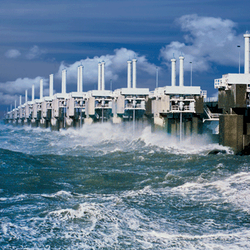
    History Studies conducted in 1937 by Rijkswaterstaat…read more(Department of Public Works), showed that safety in many parts of the Netherlands could not be guaranteed at times of storms and high sea levels. In the densely populated areas near the river mouths of the Rhine, the Meuse, and the Schelde, it proved very difficult to build new dikes or strengthen the original ones. The first solution was to close all the river mouths: the Western Schelde, the Eastern Schelde, the Haringvliet, and the Brouwershavense Gat. This proposal was christened 'the Deltaplan'. In 1950, the first river mouths of the Brieles' Gat and the Botlek were closed. The Brielse Maas became a freshwater basin. This not only made the area safer, but it also provided Voorne with a freshwater supply. The plan was to build the remaining dams in the following decades. Unfortunately though, the infamous flood of 1953 prevented this from happening. Nearly two thousand people died and more than 150,000 hectares of land were flooded. People soon became aware that something had to be done, and very, very quickly. Twenty days after the flood of 1953, the Delta commission was inaugurated. The commission would give advice about the execution of the Deltaplan, that would, in the long run, increase the safety of the Delta area. Although safety was the number one priority, the seaways De Nieuwe Waterweg and the Western Schelde would have to stay open, because of the economic importance of the ports of Rotterdam and Antwerp. In order to be able to build dams in the rivers' mouths, some auxiliary dams would first have to be built in the Zandkreek, the Krammer, the Grevelingen, and the Volkerak. These dams were known as 'compartment dams', since they would divide the large area of water into multiple compartments. In 1959, the Delta Law was passed, in order to organise the construction of the dams. The building of the 'Deltaworks' was such an enormous project, that it was sometimes referred to as the 'eighth wonder of the world' - and not without good reason. When you think about the Deltaworks, the first things which probably come to mind are steel and concrete. However, the people who built the Deltaworks did not simply place the heavy constructions on the bottom of the sea. With regard to the Oosterschelde, for instance, the bottom was so weak that specially made mattresses filled with stones had to be placed on the bottom. Geological research was required in order to find out more about the layers of the earth. Within the following pages of this section, you will find more information about geology in general, the geology of the Netherlands, and the geology of the Delta region. The environment was very important too when considering the design of the Deltaworks. Some dams could only be closed during particular circumstances, i.e. when the tides and the winds were favourable. And you may almost forget: why were the Deltaworks built anyway? Exactly, because of flood disasters, caused by a combination of extreme weather conditions and spring tide. Knowledge of the weather and the climate is especially important when building something as large as the Deltaworks. The most advanced computer programmes were used to calculate the wind speeds and the currents, before the Maeslantkering and Oosterscheldekering could first be closed. Now the Deltaworks have been completed, research into (the change of) climates still has priority, since climate changes could have an effect on the sea levels. In the Netherlands, in which about half of the country lays below sea level, swimming is still a preferred solution to sinking. Lastly, the Dutch landscape and some serious (global) environmental problems will be discussed. The Dutch landscape has been influenced particularly during the last two thousand years, since humans entered the area. Three prominent types of landscape will be described: the sea clay landscape, the river clay landscape and the dune landscape. Moreover, four environmental problems will be discussed: the rise sea level, the dangers to fish, the depletion of the ozone layer and water pollution. All these problems have (indirect) effects on us. It is not too late though and we can do a lot to help by treating our environment responsibly.

    The Delta Neeltje Jans, or Deltawerke, in Middleburg in the Netherlands is one of a serious of…read moreprojects in the area of land reclamation and sea defence. This particular project is a museum and information centre, bordering on a theme park, aimed at educating people on the amount of damage caused to agriculture and industry in the surrounding areas. To counter this, a barrier was built to keep the water away from the land, which is what the project centres on. The centre consists of a cafeteria, a film-room, a gift shop and several areas allowing visitors to see exactly what the project has entailed. It's brightly coloured and purpose built. Just outside the centre is a walkway to the actual barrier itself, which looks like a bridge from the outside. There's a seal show, and behind that there's a childrens play area with a water theme, so a slide into water and waterwheels, etc, and further along there's a childrens museum in the shape of a whale. At the project itself, visitors are able to descend into one of the towers of the barrier, where films and information posters are shown along the way. The idea of centring a museum on one of the Delta land reclamation and sea defence projects is a good one, but I think that unless you're interested in the themes, there's little to be impressed with. However, I'd imagine children would thoroughly enjoy the attractions here for them.

    Photos
    Deltawerke
    Deltawerke
    Deltawerke

    See all

    Museum Boijmans Van Beuningen

    Museum Boijmans Van Beuningen

    4.4(21 reviews)
    80.6 km

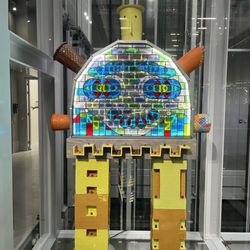
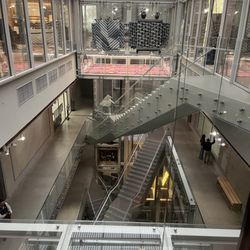
    A very unique experience, though a bit pricey at around $24 USD (€20-22). It's important to know…read morethat this isn't a traditional museum; it's a high-tech art storage center that happens to be open to the public. The focus is really on the "behind-the-scenes" of art preservation--how pieces are crated, cleaned, and stored in climate-controlled rooms. The building itself is a masterpiece. It spans several floors, and while the individual sections feel small, the central atrium with its zig-zagging staircases is massive. There's an elevator if you want to skip the stairs! They offer free 10-minute "walk-in" tours of the storage compartments, plus more detailed "behind-the-scenes" tours that are worth the extra look. The top floor has a great cafe/restaurant (Renilde) and an outdoor space with a forest of birch trees. The 360-degree view of Rotterdam is breathtaking. If you love architecture or are curious about how museums actually work, it's worth the price. If you just want to see a standard art gallery, you might find it a bit expensive.

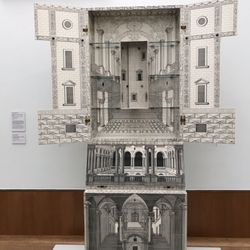
    The Boijmans is the main art museum in Rotterdam. It opened in 1847, originally with the collection…read moreof Frans Jacob Otto Boijmans. Since then, it has grown and now contains some of the preeminent works of art. Not just Dutch artists, the collection includes Rembrant, Claude Monet, Vincent van Gogh, René Magritte and Salvador Dalí. And those are just the more famous. There are Rubens and Bosch and many more! A friend of mine had visited a few months ago and found the Rembrant/Dali wing was closed. That wing was open this time, but the Kandinsky wing was closed. I'm a big fan of Kandinsky and I have a few posters of his work and his contemporaries. I was bummed. Even bummed, I still enjoyed the Bruegel "Tower of Babel", one of the most famous paintings in Rotterdam. And the Rodin sculptures. Amazing artworks! The museum wasn't particularly crowded on this weekday and they had no issue with photographs, as long as the flash was disabled. An audio tour is available, which I strongly recommend. Note: The museum is a member of the Museumkaart system, so if you're planning on visiting more than three or four museums in the Netherlands, get the card!

    Photos
    Museum Boijmans Van Beuningen
    Museum Boijmans Van Beuningen
    Museum Boijmans Van Beuningen

    See all

    Museum aan de Stroom - MAS

    Museum aan de Stroom - MAS

    4.2(52 reviews)
    62.2 kmHet Eilandje, Het Eilandje

    A Must-Visit Gem in Antwerp! MAS was an absolute highlight…read moreof my time in Antwerp. The Compassion exhibit was deeply moving--exactly what I needed and didn't know I was looking for. The museum's location by the port is beautiful, and the experience of exploring each floor was truly special. I loved how each level offered a new perspective--both artistically and visually. The artwork was thoughtfully curated, and taking the escalators between floors revealed stunning views over the city, creating a seamless blend of culture and scenery. Don't miss the panoramic rooftop--it's worth the visit alone.
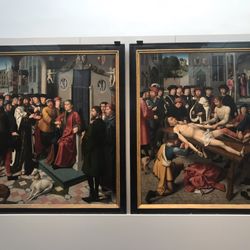
    We did not pay to go inside the museum BUT i will share what you can do for free…read more Walk or ride your bike to this area. If you have a rental bike there is a docking station right in front. There is a children's play area outside as well as plentiful places to sit to enjoy a rest or the sun. Once inside continue to the escalator. There is a free public toilet on the 2nd floor. Very clean. The ladies restroom also has free feminine products for those that need them. The window design blew me away and I wanted to stop on each floor to take photos and have a moment to take in the view. Continue to the roof top. Here you will have a 360 view of the city. Great place for photos. There is a thick plexiglass but you can hold your camera/phone up and reach the top. I cannot get over the glass design and how it continuously curves. Just simply amazing. On the Saturday we were there they had 2 art areas for children to create a photo. There is one free museum entry exhibit that impressed me-it is the storage area of pieces that either are rotated and stored. I do wish that all museums had this. Very neat to see behind the scenes. These items are in cages but you can see them still. Very interesting to also see the labels, tags etc. Definitely do not miss this. Tickets to actually go in the museum are sold on the first floor as soon as you enter the building to the right. There is a cafe and in the area several places you can eat and drink. You can also take a walk and see all the docked boats.

    Photos
    Museum aan de Stroom - MAS - Storage - wish all museums would let you see their archives area

    Storage - wish all museums would let you see their archives area

    Museum aan de Stroom - MAS
    Museum aan de Stroom - MAS

    See all

    Panorama Walcheren - museums - Updated May 2026

    Loading...
    Loading...
    Loading...