Cancel

    Open app

    Search

    Museum Dunkirk 1940

    4.5 (2 reviews)
    Open 9:00 am - 6:00 pm

    Museum Dunkirk 1940 Photos

    Recommended Reviews - Museum Dunkirk 1940

    Your trust is our priority, so businesses can't pay to alter or remove their reviews. Learn more about reviews.
    Yelp app icon
    Browse more easily on the app
    Review Feed Illustration

    9 years ago

    Helpful 1
    Thanks 0
    Love this 0
    Oh no 0

    Museum Dunkirk 1940 Reviews in Other Languages

    Verify this business for free

    Get access to customer & competitor insights.

    Verify this business

    In Flanders Field Museum

    In Flanders Field Museum

    (10 reviews)

    This is a great museum in the heart of Ypres. There is a parking lot nearby and some street parking…read moreavailable. Entrance was 10 euros for adults. Kids under 6 are free. You get a poppy bracelet to let you in and out of exhibit and to follow along with one person's experience. Audio guides are available for a small fee. It's a great museum with lots of great artifacts, and amazing dramatized first hand accounts. The museum offers everything in English, French, Dutch, and German so it's easy for many people to read and understand. We spent about 2 hours there. I'm a history nerd and read a majority of the panels. Our little one did well. The museum is stroller accessible and when he was done my husband was able t take him to the cafe downstairs for a snack while I continued in the museum. Highly recommend.

    A WWI history excursion to Belgium would not be complete without spending time here. The building…read morein which it is housed is a sight unto itself as it features wonderful architecture. The museum allows a somewhat personalized visit as a watch issued upon entry allows registration of basic information such as nationality and preferred language. One can then activate certain displays to get a response specific to that information. There are many items of interest to the history buff and the casual observer alike. It will require two to three hours at minimum to take in all of the information though some will spend more. The displays are excellent. The multimedia presentation is gripping and very well done featuring re-enactments of the accounts of medical personnel. For an extra cost, you can choose to climb the tower to take in the magnificent views afforded by the perspective from the top. Overall, this is a must-see if you are visiting Ypres. The information presented is outstanding, the displays are well done and the museum is well laid out. The €9 fee is unquestionably worth it.

    Palais des Beaux Arts

    Palais des Beaux Arts

    (57 reviews)

    Centre

    Terrific museum We spent the best part of a rainy Saturday…read moreafternoon in this surprisingly good art museum. There was an extensive and varied collection of art and it was terrific value at €7. It would have been great if there had been some information in English.

    I'm going to be very upfront in the beginning of this review, when I arrived at Palais des Beaux…read moreArts I was pretty burnt out with museums at this point, it was extremely cold, raining, and we were waiting in a line outside for like twenty minutes so the start to this experience was pretty miserable. Once we got into the building and through the security checkpoint, you could tell right away that this place was pretty beautiful. The building itself is 3 stories and each floor has something a little bit different to offer you. We headed down first and spent some time looking at the statues which were absolutely incredible, followed by the second floor which was a mixture of different pieces of art and a dome style room you could sit on beanbags and watch something. The main event of the show was upstairs where I couldn't even estimate the insane amount of paintings that fill the walls of the different colored rooms. The rooms themselves are all tall and covered from floor to ceiling with such incredible pieces, and everything you think you are done suddenly the red painted rooms turn into white rooms or green rooms and it just keeps going, it was truly remarkable. Overall, the Palais des Beaux Arts was a fantastic place to spend an hour or so learning about French art. Did I leave some stuff out? Yeah, because this was like my 23rd museum and at some point they start blending together. I loved how diverse the art here was and really did enjoy walking around, I highly recommend checking this place out if you are in Lille.

    La Piscine - Musée d'Art et d'Industrie André Diligent

    La Piscine - Musée d'Art et d'Industrie André Diligent

    (74 reviews)

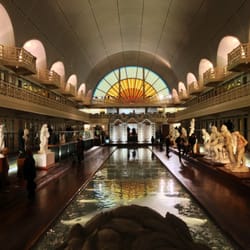
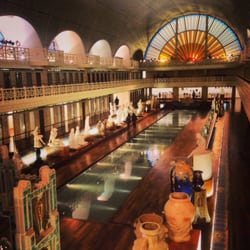
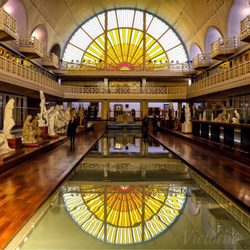
    This place is magnificent! Came here for the Week-End Familial for L'exposition of Degas Sculpteur…read more Throughout my years of Art History, none of my professors elaborated on the controversy revolving Edgar Degas' work. I have seen Degas work many times and his most notable sculpteur La Petite Danseuse de Quatorze Ans lives at at Musée D'Orsay, which I have seen there and now here. I didn't know ballerinas back then were considered lower class, since the girl's family would push them to do ballet in hopes to catch an eye of the wealthy. It's almost a form of pedophile...actually it is! Degas also made this ballerina have a face of criminals. So a lot of people weren't fans of him. Moving on out of Degas, this Musée isn't magnificent because of Degas pieces...it's breathtaking because the Philanthropist kept the look and feel of La Piscine. The swimming pool was constructed between 1927 and 1932 by the Lille architect Albert Baert. It closed as a swimming pool in 1985, and was remodelled as a museum by the architect Jean-Paul Philippon, opening in 2000. A modern entrance building, special exhibition space and garden were constructed within the roof-less shell of an adjoining textile factory. The museum's permanent collection has its origins in 1835, when a collection of fabric samples from the many local textile factories was started. By 1898 the collection was housed in the National High School of Arts and Textile Industry (ENSAIT), and was seen as a way of cultivating the tastes of the town's workers, foremen and manufacturers. To this end the collection combined elements of literature, fine-arts, science and industrial products. The ENSAIT museum closed with the onset of World War II, and never reopened. From 1899 the collections were displayed in Roubaix's town hall, in preparation for the opening of La Piscine in 2000. L thought I would enjoy this Musée more, since I am not really into Modern Art and since I have a background in Textile...this would be the better choice. They have art hanging on the ceilings and original shower stalls within, beautiful garden and also they have Meert here.

    Very nice atmosphere for this special museum. It has been built into the old swimming pool of…read moreRoubaix and kept plenty of accessories from this old time. You can admire sculptures and paintings there gathered by genre. You have a restaurant inside, an auditorium and a fabric room you can rent for your meetings.

    Le Blockhaus d'Eperlecques

    Le Blockhaus d'Eperlecques

    (5 reviews)

    The is one of several impressive sites from World War Two in northern France, connected to the…read moredevelopment and construction of the V2 rocket-bombs by the Nazi regime. The site at Éperlecques was designed and built by the Todt Organisation, initially using voluntary labour, but later using large numbers of forced labour. Essentially, the site consisted of a series of enormous bunkers, intended to include a liquid oxygen plant for the V2 rocket propellant, an assembly plant to load on the explosive warhead, and a firing facility. 35,000 labourers worked at the site between 1943 and 1944. However, the Allies were alerted to its existence before it was completed. A series of bombing raids, using the then newly-developed 'Tallboy' bunker-busting bombs, caused severe damage to the facility (as well as huge loss of life to the construction workers). Thereafter, V2 construction was moved to a new site at La Coupole, and the bunker was used only to manufacture liquid oxygen. The site to-day is surrounded by woods, and the most of the tour takes place out of doors: displays explain the concept of forced labour, the Todt organisation, and the background to the V1 and V2 rockets. But the highlight is the bunker itself. It's a huge construction - over 90,000 tonnes of concrete were used, and the Blockhaus rises over 25m from the ground. It's a sobering thought to think that it is only a third of its planned size. The atmosphere is chilling, almost eerie: much of the lower section is under water, as without pumps the groundwater has flowed back in. The impact of the tallboy bombs is made clear by huge holes in the bunker roof and masses of twisted metal reinforcement. Part of the interior is accessible: a video presentation in the largest chamber inside describes the construction and operation of the facility, and the lives (and deaths) of the labourers. The tour finishes with outdoor displays of a V1 launch pad and other military items. There's no cafe but there is a small shop on site, selling books and momentos. There is specially reserved (level and firm) parking for motorcycles, and motorcyclists get a reduction of 1EUR on the entry fee. The whole site is now a French national memorial, dedicated to the victims of forced labour.

    Dark. Concrete. Austere. Concrete. Twisted metal. Concrete. Concrete and more concrete. This is Le…read moreBlockhaus. It's also an immensely interesting place which in one foul swoop shows the strength and the evils of war. Situated in northern France, not far from the equally excellent La Coupole, Le Blockhaus is a war site, left untouched from its abandonment, standing as a monument to all. The bunker of Eperlecques was (and is) the largest WW2 bunker in Northern France. One cannot fail to be amazed at the scale of the construction, largely hidden from view until you're at its feet. There's a real sense of desolation here, despite other tourists walking round and chatting. The evil that was felt at La Coupole was not felt in such quantities here although it's hard to state why. Perhaps that Le Blockhaus was discovered by the Allies before too much evil was allowed to form here. Who knows? Evidence of warfare lies all around. The V1 doodlebug is on display, sitting atop its launch rails. Shells, rails, trains and did I mention the twisted metal and concrete? Le Blockhaus is more of a monument than a traditional museum. There is facility for guided tours but this place stands on its own and speaks far more loudly than any guide could. You'll only need an hour or so to visit here and it makes an ideal companion visit to La Coupole in nearby St Omer. Recommended.

    Museum Dunkirk 1940 - museums - Updated May 2026

    Loading...
    Loading...
    Loading...