Cancel

Open app

Search

Panhandle Pioneer Settlement

3.7 (3 reviews)
Closed • 8:00 am - 4:00 pm

Panhandle Pioneer Settlement Photos

More like Panhandle Pioneer Settlement

Recommended Reviews - Panhandle Pioneer Settlement

Your trust is our priority, so businesses can't pay to alter or remove their reviews. Learn more about reviews.
Yelp app icon
Browse more easily on the app
Review Feed Illustration

3 years ago

Helpful 0
Thanks 0
Love this 0
Oh no 0
Photo of Bob L.
7
159
101

14 years ago

Helpful 2
Thanks 0
Love this 1
Oh no 0

13 years ago

Helpful 0
Thanks 0
Love this 0
Oh no 0

Ask the Community - Panhandle Pioneer Settlement

Verify this business for free

Get access to customer & competitor insights.

Verify this business

Civil Rights Heritage Walk

Civil Rights Heritage Walk

4.3(3 reviews)
47.0 mi

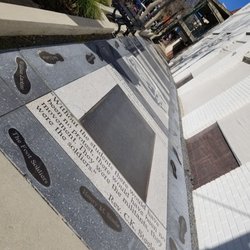
Post running Bank of America Tallahassee Half Marathon, I just kind of stumbled upon the Civil…read moreRights Heritage Walk which happened to be near the starting line for the event. While walking to my hotel after the event, I looked down and I was totally in shock because I unexpectedly visited it. And oh, was it a sight to see! Per, Council on Culture & Arts, the Civil Rights Heritage Walk was unveiled in 2013 and serves as a tribute to the foot soldiers of the civil rights movement, including notable figures such as Patricia Stephen Due, and Reverend Dr Reverend Charles Kenzie Steele, who played crucial roles in the fight against racial segregation and injustice in Tallahassee Florida. Not only does the panel highlight their names, but it also features inspiring messages and iconic protest signs from the era. The 16 terrazzo panels tell the story of the city's civil rights movement, particularly highlighting the 1956 bus boycott and the lunch counter sit-ins that occurred from 1960 to 1963. If you are planning to visit the city of Tallahassee, I recommend including the Civil Rights Heritage Walk to your tour unless you just happen to stumble upon it as I did while downtown. ~ Keep moving Forward ~ Thomas G

This is a small but powerful tribute to the Civil Rights Movement. The walk consists of The…read moresidewalk has 16 terrazzo panels that features the names of fifty local Civil Rights leaders and other activists who participated in the city's bus boycott of 1956 and the lunch counter sit-in demonstrations of 1960-1963. The walk features Rev. Dr. Charles Kenzie (C.K.) Steele, who was known as the MLK of Tallahassee and is the namesake of the city bus terminal after leading the bus boycott in 1956. You will find it on corner of East Jefferson Street and Monroe Street, across the street from the Statehouse Complex. The walk was installed in September of 2013 by the FSU Master Craftsman Studio. It is a combination of bronze plaques, nice artwork depicting a bus, a lunch counter and a sign that reads "what we ask is simple, impartial service for all". You will also find some footsteps on the panels' perimeter. I believe that the front prints use to be bronze or at least bronze colored, but that is not the case anymore for some reason. The walk is starting to understandably show signs of wear, as it is not only exposed to the elements, but has constant foot traffic over it. This is definitely a must see when you are in downtown Tallahassee. Anyway, as with most similar attractions that I have visited and reviewed, this is not a long stop. I was there less than 10 minutes. So, you may want to consider planning out additional stops at many of the other attractions in the area, or making this stop part of a larger itinerary to maximize your time and trip. The State House is right across the street and there of tons of memorials and parks to check out in the immediate area including the WWII Memorial and the Civil War Memorial.

Photos
Civil Rights Heritage Walk

See all

World War II D-Day Training Site Marker

World War II D-Day Training Site Marker

4.0(3 reviews)
48.8 mi

Review 3200 Sorry,…read morethere are no tours or activities available to book online for the date(s) or places you selected. Please choose a different date or place - uhm this is a historic marker, it's information on a stick. Seriously, sometimes something so significant happens in an area or specific location that it becomes historically documented and there are societies that ensures these sites are recognized and never forgotten - I for one love these markers and find them irresistible, I must read them when I find them. I wish all these plaques were displaying fun stuff, but history hasn't always been fun we can't change history although it seems some want to minimize it or cover it up, wouldn't it be so amazing if all newly erected marker were educating us on all things good. I'm okay with accurately depicting factually correct information we should all want to learn from the past so we never forget. I salute those that have bravely served our country and have defended our freedom with their lives, it's unfortunate we have lost so many in struggles and conflicts that's probably could have been resolved by other means, but the facts are the facts and the decisions made here has changed the lives of all of us. Allied military leaders knew that casualties on D-Day could be staggeringly high. Historians are still calculating the death toll to this day it's seems to be an impossible task, estimates range between 4,000 - 12,000 US soldiers I think one is too many and all deserve to be honored...

This black marker with white text stands near the restroom of the beach park that is Carrabelle…read moreBeach. You can look out from here into Saint George Sound and see Dog Island. Beyond that is the Gulf of Mexico. The slowly sweeping beach is shallow for a good bit so there is excellent wading and that is likely why The marker reads, "In late 1943, Carrabelle Beach and Dog Island, while they were a part of Camp Gordon Johnston, were used by the U.S. Army 4th Infantry Division to train for the Normandy Invasion on D-Day, June 6th, 1944. The Amphibious Training Center had been officially closed, but it was reopened and staffed for the purpose of training for this important mission. Although the troops had trained for over three years, the amphibious training conducted on this site was the last step before shipping out to England for the invasion. On D-Day, the first amphibian infantry assault teams to arrive on French soil were from the 4th Infantry Division at Utah Beach. On June 6, 2000, the Camp Gordon Johnston Association extracted a small amount of soil from this site and delivered it to the National 4th Infantry Division Association to be placed in the Association's monument in Arlington, VA. The U.S. Department of Defense's World War II Commemoration Committee in 1995 named the Camp Gordon Johnston Association an official "Commemorative Community."" Enjoy the beach and take a moment think about those who were here before, some of whom never returned. [Review 14711 overall, 211 of 2021, number 1267 in Florida.]

Photos
World War II D-Day Training Site Marker
World War II D-Day Training Site Marker - World War II D-Day Training Site Marker, Carrabelle FL

See all

World War II D-Day Training Site Marker, Carrabelle FL

Gideon vs Wainwright Case Historical Marker - Gideon vs Wainwright Case Historical Marker in Panama City

Gideon vs Wainwright Case Historical Marker

5.0(1 review)
40.8 mi

This marker is in excellent condition and denotes an important piece of history. Did you know that…read morethere was a time that you might not always have had the right to have the court appoint an attorney for all cases if you could not afford one? It's true, and it started here in Panama City. The marker reads: This is the site of the landmark Gideon case, after which the Public Defender system was established in Florida and throughout the nation. In 1961, Clarence Earl Gideon (1910-1972) stood trial in this courthouse for the felony of burglary. Lacking funds to hire a lawyer, Gideon requested that a lawyer be appointed to represent him at trial. Gideon's request was denied, because at that time, a person accused of a non-capital felony did not have a constitutional right to a free lawyer. Gideon represented himself at his trial and was convicted. While serving his five-year prison sentence, Gideon petitioned the United States Supreme Court to review his case. The Supreme Court issued its decision in 1963 in Gideon v. Wainwright, ruling that every poor person charged with a serious crime in this country must be provided a lawyer for his defense at public expense. Panama City attorney, W. Fred Turner (b. 1922) represented Gideon at his retrial and won an acquittal. Built in 1914, this building is one of only a few original courthouses in Florida still being used for its original purpose. A fire in 1920 gutted the building, but it was immediately rebuilt in its Classic Revival architectural style.

Panhandle Pioneer Settlement - landmarks - Updated May 2026

Loading...
Loading...
Loading...