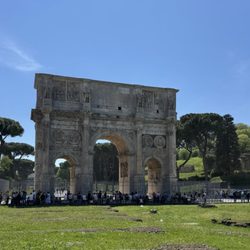
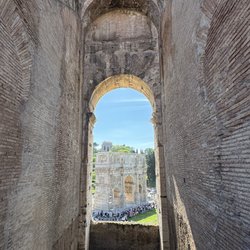
Like other reviews have mentioned, the Arch of Constantine is the largest triumphal arch in Rome,…read moreand being located adjacent to the Colosseum, you can't miss it.
Commissioned by the Roman Senate to commemorate Constantine's victory over Maxentius at the Battle of the Milvian Bridge, this arch was dedicated in 315 AD. The background of this confrontation arose out of a power struggle in the western Roman Empire. When Maxentius, who was favored in Rome, tried to claim the role of caesar,* then Constantine--who was son of Constantius, the previous augustus of the western Roman Empire, and favored in the northern regions--sought to defeat Maxentius and stake his own claim to lead as an augustus,* though he eventually settled for caesar later.
From what can be considered either sectarian or providential historical accounts, divine providence or superstition was the reason Maxentius chose to leave the safety within Rome's walls and meet Constantine in battle outside the city fortifications. Ultimately when his army tried to retreat across the Milvian Bridge, the already damaged bridge collapsed and Max didn't leave with his life.
This battle in 312 AD bore the significance of consolidating rule over Western Europe, and was attributed by Christian scholars as a turning point in Constantine's decision to convert to Christianity (since the emperor attributed the victory to divine intervention), thereby paving the path for this religion's prevalence in Europe and eventually over the rest of the Roman Empire.
Getting back to the arch--the scenes on it depict the emperor shown battle and civilian duties, and it's established that the different artistic styles used were due to some sections of carved reliefs being taken from existing monuments of previous rulers. It's not clear whether including other rulers was to legitimize Constantine's position in relation to prior emperors, or if the builders simply used existing stone reliefs to save time.
Logistical tips:
- there is a fence surrounding the arch on all sides to protect it from the massive flows of tourists in the area.
- free to visit.
- I wish there was a little more info available on the spot since I had to do some google research to learn about the arch's background
*essentially an augustus was the highest ranked ruler of the western or eastern Roman Empire. Under this, a caesar was the second in command, under each of the augusti, in a system named the Tetrarchy, where each half of the empire had a senior and junior leader. This was intended to promote a balance of power though ultimately led to civil unrest where rivals fought to gain control over each other. Bc yeah...people just can't be happy with what they have and always want more...