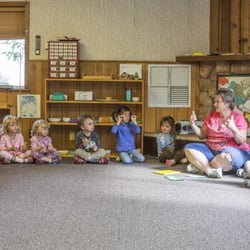
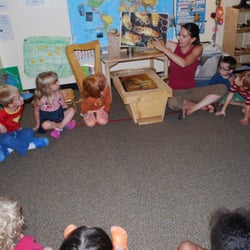
Our kid goes to Mountain Shadows Montessori School, and we're so happy she does. After a horrible first grade year at a nearby Waldorf school, we woke up and got her out of there and into the positive, supportive environment that MSMS provides. Mountan Shadows deserves our highest praise.
Warning: This review is as much about what was wrong at our daughter's previous school as it is a celebration of what's right about Mountain Shadows Montessori. If I sound angry about our experience at the other, that's because I am.
Here's what we love about Mountain Shadows, contrasted to the failures of the Waldorf school we left behind.
1. A pedagogy that is relevant to our era and modern understanding of how learning works, rather than one mired in the ramblings of a mystic who lived 100 years ago.
The Waldorf movement is sometimes described as a cult. That's a tad overstated, but only a tad. Rudolf Steiner's writings are taken as gospel -- almost literally -- and Waldorf educators generally dismiss any idea that conflicts with Steiner. (Need proof? My daughter's teacher once described -- in all seriousness -- the process by which a child's soul slowly lodges itself into their body over the first several years of their life, called 'incarnating.' According to Steiner, the reason that boys voices are deeper is because their soul incarnates 'deeper' into their bodies. Really? Wow!)
On the other hand, while I can't adequately define the Montessori pedagogy, I can attest to its results: At Mountain Shadows, the Montessori philosophy creates an outstanding learning environment. It is practical, grounded and deeply respectful of children. The kids are serious about learning, but it's the happy kind of seriousness that comes from concentrating deeply.
2. A culture of deep respect. Bullying and other sorts of disrespect are not tolerated at MSMS, yet misbehaving children aren't humiliated as punishment. Instead, each class uses a remarkably effective system to allow the children to communicate about their differences and resolve them peacefully. As a result, no child becomes cowed into submission by an abusive kid, which was an endemic problem at our daughter's last school (and at at least one other Waldorf school in the area). Instead, the culture of the classroom develops a strong atmosphere of respect for each other, for the school and for the greater world. It's a beautiful model that we adults would do well to emulate.
3. A grounded, practical approach. At MSMS, the classrooms are remarkably quiet because the kids are hard at work. They choose what they want to do and how long they want to do it. At the end of the week, each child meets with the teacher to review their work and set expectations for the following week. The kids are given plenty of latitude to pursue topics that interest them, which lets them follow their natural curiosity and indulge in the joy of learning. No child is ever compared to another child, and they each progress at their own appropriate pace.
In contrast, a Waldorf classroom features neat rows of assigned desks facing a blackboard. The teacher writes and draws each lesson on the board, and the children copy it all down, word for word, line for line, in sync. Every child is expected to do the same thing, at the same time, as the other children. Even the 'art' projects are very tightly prescribed. The result: Mayhem. Most kids resist the stifling structure of the lessons and act out, effectively eliminating whatever learning opportunity may have been possible. Even in the best moments, the speed of the class is governed by the slowest child. Every kid knows who that is, and this provides additional fuel for cruelty.
4. Effective. Kids at MSMS learn. They grow intellectually, as citizens and as human beings. You can tell by talking to them and by watching their body language: These kids are proud, engaged and energized. They respect adults and will look you in the eye to talk to you. They are kind to each other.
In contrast, many Waldorf kids slouch and tend to look unhappy. Surprising acts of violence have taken place on the campus (it would be inappropriate to elaborate), and many parents slowly come to realize that their kids haven't learned much by the fourth or fifth grade -- they frequently hire private tutors. It's sad, but most of the Waldorf parents -- and all of the faculty -- have 'taken the Kool-ade' and do not see the despair and antisocial behavior for what they are.
These two schools cost almost exactly the same, but that's where the similarity ends. After enduring kindergarten and first grade at a Waldorf school, my kid emerged beaten-down, insecure and dejected. She was also very self-conscious that she hadn't learned nearly as much as her non-Waldorf friends. A year later, this same child burst out of second grade at Mountain Shadows, triumphant. She was restored to her original, true self: Vibrant, confident, energized and happy. read more